Department of Gastroenterology, Portuguese Oncology Institute, Lisbon, Portugal.
Department of Oncology, Portuguese Oncology Institute, Lisbon, Portugal.
World J Surg Oncol. 2024 Nov 28;22(1):317. doi: 10.1186/s12957-024-03590-4.
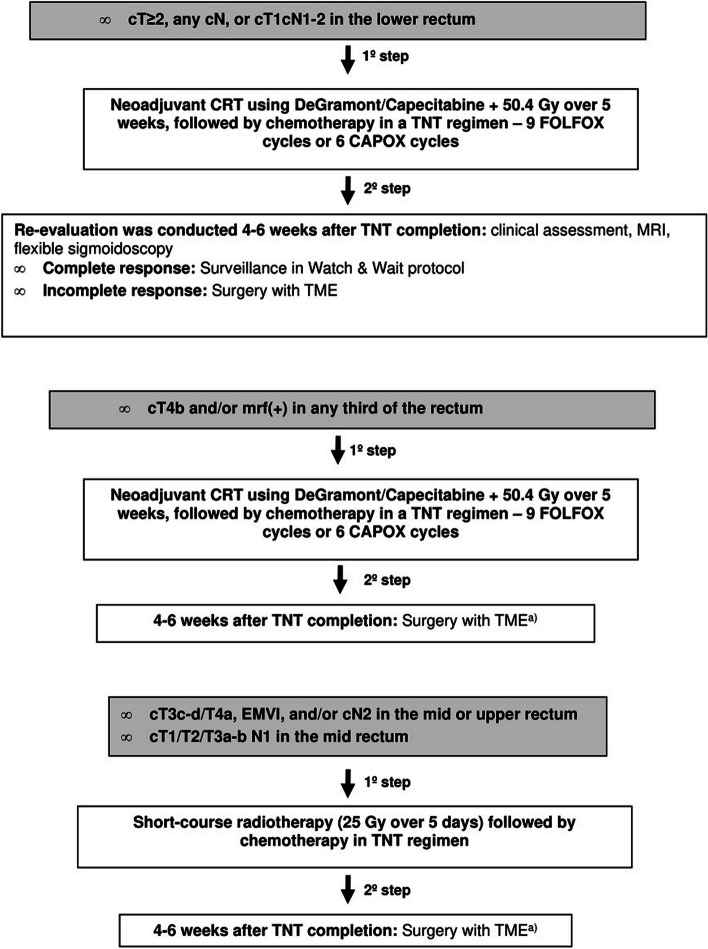
Locally advanced rectal cancer (LARC) poses a significantly challenge in clinical management, requiring a multimodal treatment approach. Among innovative strategies, Total Neoadjuvant Therapy (TNT) has emerged, delivering all planned chemotherapy before surgery.
Our aim was to evaluate the real-world application and efficacy of TNT and to compare it with the non-TNT standard strategy.
This retrospective study compared locally advanced rectal adenocarcinoma patients treated with Total Neoadjuvant Therapy (TNT) in 2022 with those who underwent traditional chemoradiotherapy (CRT) in 2020-2021. The primary endpoints were the pathologic complete response rate and the sustained clinical complete response rate in patients under W&W.
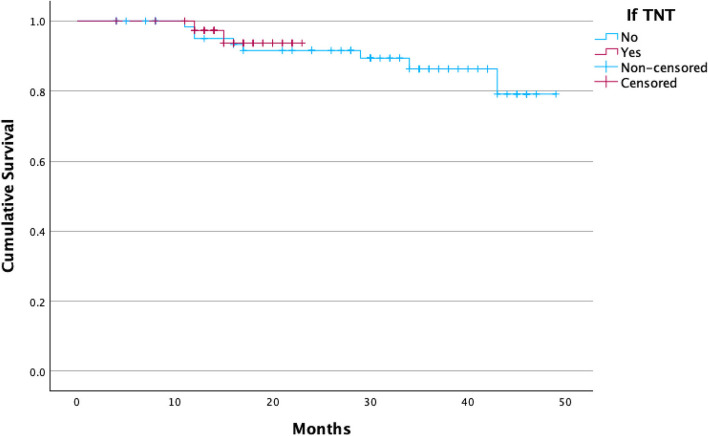
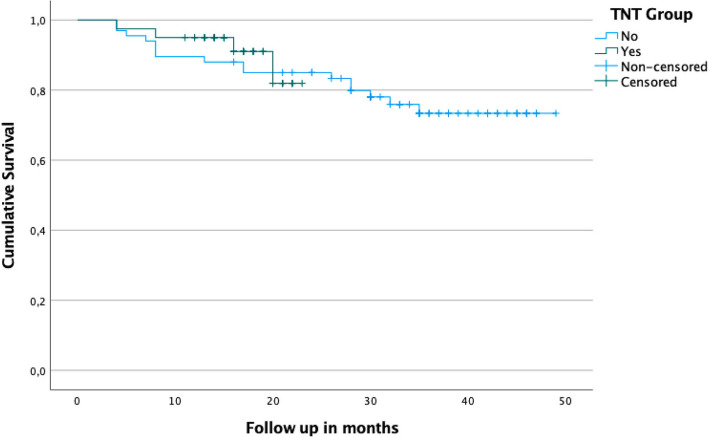
Among 107 patients (54.2% male, mean age 62.48 years), non-TNT (67 patients) and TNT (40 patients) mean follow-ups were 26.7 and 8.2 months, respectively. No differences in gender(p = 0.163), staging (p = 0.707), or location (p = 0.727) were noted. TNT patients received more short-course radiotherapy (42.5% vs1.5%, p < 0.001). Clinical responses favored TNT (p = 0.030) with no significant differences in pathological responses, recurrence rates, or survival. TNT exhibited higher chemotherapy completion (p = 0.007) and lower adverse events (p < 0.001). Post-surgery events showed no significant differences (p = 0.470). Single center with retrospective design and carries limitations that may restrict the generalizability of the findings and the relatively short follow-up duration are our main limitations.
Our data add to the body of literature favoring the TNT treatment strategy for locally advanced rectal cancer, aiming to achieve comparable complete response rates with less adverse events.
局部晚期直肠癌(LARC)在临床管理中具有挑战性,需要采用多模式治疗方法。在创新策略中,总新辅助治疗(TNT)已经出现,即在手术前完成所有计划的化疗。
我们的目的是评估 TNT 的真实应用和疗效,并将其与非 TNT 标准策略进行比较。
这项回顾性研究比较了 2022 年接受全新辅助治疗(TNT)的局部晚期直肠腺癌患者与 2020-2021 年接受传统放化疗(CRT)的患者。主要终点是 W&W 下患者的病理完全缓解率和持续临床完全缓解率。
在 107 例患者(54.2%为男性,平均年龄 62.48 岁)中,非 TNT(67 例)和 TNT(40 例)的平均随访时间分别为 26.7 和 8.2 个月。两组在性别(p=0.163)、分期(p=0.707)或位置(p=0.727)方面无差异。TNT 患者接受更多的短程放疗(42.5%对 1.5%,p<0.001)。临床反应有利于 TNT(p=0.030),但在病理反应、复发率或生存率方面无显著差异。TNT 表现出更高的化疗完成率(p=0.007)和更低的不良事件发生率(p<0.001)。手术后事件无显著差异(p=0.470)。单中心回顾性设计,存在可能限制研究结果普遍性和随访时间相对较短的局限性。
我们的数据增加了支持 TNT 治疗局部晚期直肠癌策略的文献,旨在实现可比的完全缓解率,同时减少不良事件。