Mgwenya Tintswalo N, Abrahamse Heidi, Houreld Nicolette N
Laser Research Centre, Faculty of Health Sciences, University of Johannesburg, Johannesburg, Gauteng, South Africa.
Wound Repair Regen. 2025 Jan-Feb;33(1):e13239. doi: 10.1111/wrr.13239. Epub 2024 Nov 28.
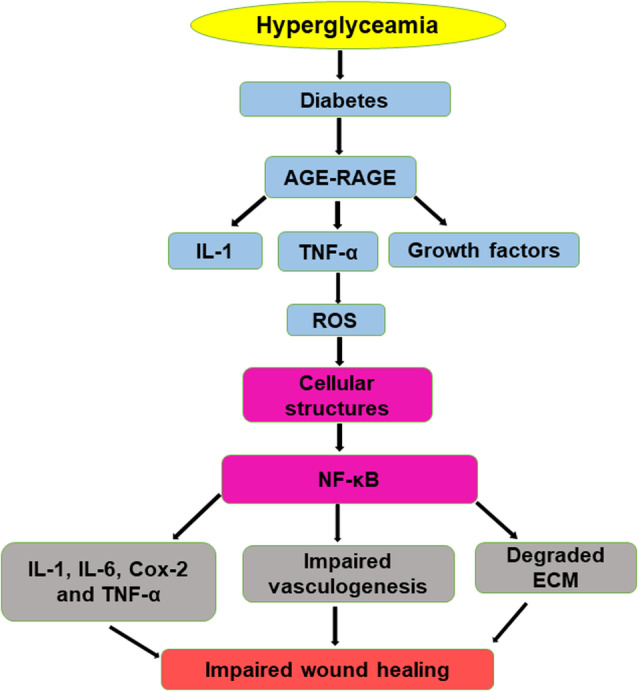
Diabetes mellitus remains a global challenge to public health as it results in non-healing chronic ulcers of the lower limb. These wounds are challenging to heal, and despite the different treatments available to improve healing, there is still a high rate of failure and relapse, often necessitating amputation. Chronic diabetic ulcers do not follow an orderly progression through the wound healing process and are associated with a persistent inflammatory state characterised by the accumulation of pro-inflammatory macrophages, cytokines and proteases. Photobiomodulation has been successfully utilised in diabetic wound healing and involves illuminating wounds at specific wavelengths using predominantly light-emitting diodes or lasers. Photobiomodulation induces wound healing through diminishing inflammation and oxidative stress, among others. Research into the application of photobiomodulation for wound healing is current and ongoing and has drawn the attention of many researchers in the healthcare sector. This review focuses on the inflammatory pathway in diabetic wound healing and the influence photobiomodulation has on this pathway using different wavelengths.
糖尿病仍然是全球公共卫生面临的一项挑战,因为它会导致下肢慢性溃疡难以愈合。这些伤口愈合起来颇具挑战性,尽管有各种不同的治疗方法可促进愈合,但失败率和复发率仍然很高,常常需要进行截肢手术。慢性糖尿病溃疡在伤口愈合过程中并非遵循有序进展,而是与一种持续的炎症状态相关,其特征是促炎性巨噬细胞、细胞因子和蛋白酶的积累。光生物调节已成功应用于糖尿病伤口愈合,主要是使用发光二极管或激光以特定波长照射伤口。光生物调节通过减轻炎症和氧化应激等方式促进伤口愈合。目前,关于光生物调节在伤口愈合中的应用研究正在进行中,并且已经引起了医疗保健领域许多研究人员的关注。本综述聚焦于糖尿病伤口愈合中的炎症途径以及不同波长的光生物调节对该途径的影响。