Department of Endocrinology and Metabolism, Chosun University Hospital, Chosun University College of Medicine, Gwangju, Korea.
Department of Ophthalmology, Asan Medical Center, University of Ulsan College of Medicine, Seoul, Korea.
Diabetes Metab J. 2024 Nov;48(6):1084-1092. doi: 10.4093/dmj.2024.0275. Epub 2024 Nov 21.
This study aimed to provide updated insights into the incidence and management of cardiovascular disease (CVD) in Korean adults with diabetes.
Using data from the Korean National Health Insurance Service and Korea National Health and Nutrition Examination Survey, we analyzed the representative national estimates of CVD in adults with diabetes.
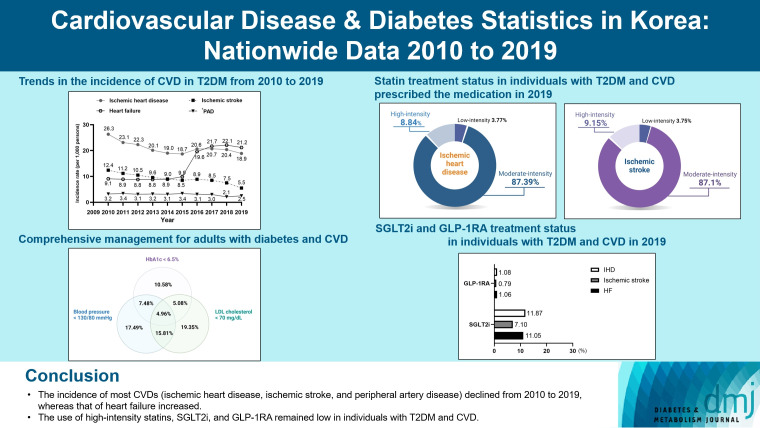
The age- and sex-standardized incidence rate of ischemic heart disease (IHD), ischemic stroke, and peripheral artery disease (PAD) decreased from 2010 to 2019 in individuals with type 2 diabetes mellitus (T2DM). However, an increase in the incidence of heart failure (HF) was observed during the same period. Only 4.96% of adults with diabetes and CVD achieved optimal control of all three risk factors (glycemic levels, blood pressure, and lipid control). Additionally, high-intensity statin treatment rates were 8.84% and 9.15% in individuals with IHD and ischemic stroke, respectively. Treatment with a sodium-glucose cotransporter-2 inhibitor (SGLT2i) or a glucagon-like peptide-1 receptor agonist (GLP-1RA) was relatively low in 2019, with only 11.87%, 7.10%, and 11.05% of individuals with IHD, ischemic stroke, and HF, respectively, receiving SGLT2i treatment. Furthermore, only 1.08%, 0.79%, and 1.06% of patients with IHD, ischemic stroke, and HF, respectively, were treated with GLP-1RA.
The incidence of most CVD (IHD, ischemic stroke, and PAD) decreased between 2010 and 2019, whereas the incidence of HF increased. The overall use of high-intensity statins, SGLT2i, and GLP-1RA remained low among individuals with T2DM and CVD.
本研究旨在提供韩国成年人糖尿病患者心血管疾病(CVD)发病和管理的最新见解。
使用韩国国民健康保险服务和韩国国民健康和营养检查调查的数据,我们分析了成年人糖尿病患者 CVD 的代表性全国估计值。
从 2010 年到 2019 年,2 型糖尿病患者的缺血性心脏病(IHD)、缺血性中风和外周动脉疾病(PAD)的年龄和性别标准化发病率下降。然而,在此期间观察到心力衰竭(HF)的发病率增加。只有 4.96%的糖尿病合并 CVD 的成年人实现了所有三种危险因素(血糖水平、血压和血脂控制)的最佳控制。此外,IHD 和缺血性中风患者的高强度他汀类药物治疗率分别为 8.84%和 9.15%。2019 年,钠-葡萄糖共转运蛋白-2 抑制剂(SGLT2i)或胰高血糖素样肽-1 受体激动剂(GLP-1RA)的治疗相对较低,IHD、缺血性中风和 HF 患者分别只有 11.87%、7.10%和 11.05%接受 SGLT2i 治疗。此外,IHD、缺血性中风和 HF 患者分别只有 1.08%、0.79%和 1.06%接受 GLP-1RA 治疗。
2010 年至 2019 年间,大多数 CVD(IHD、缺血性中风和 PAD)的发病率下降,而 HF 的发病率增加。在患有 T2DM 和 CVD 的患者中,高强度他汀类药物、SGLT2i 和 GLP-1RA 的总体使用率仍然较低。