Krauss Thomas F, Miller Lisa, Wälti Christoph, Johnson Steven
School of Physics, Engineering and Technology and York Biomedical Research Institute, University of York, York, UK.
School of Electronic and Electrical Engineering, University of Leeds, Leeds, UK.
Optica. 2024 Oct 4;11(10):1408-1418. doi: 10.1364/OPTICA.530068. eCollection 2024 Oct 20.
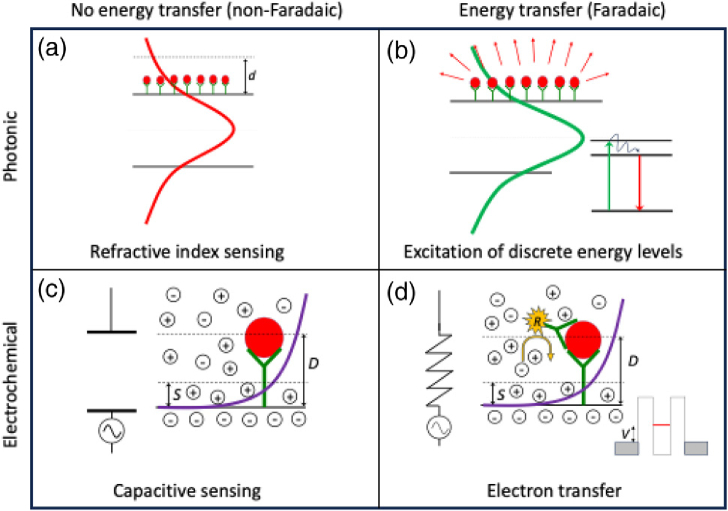
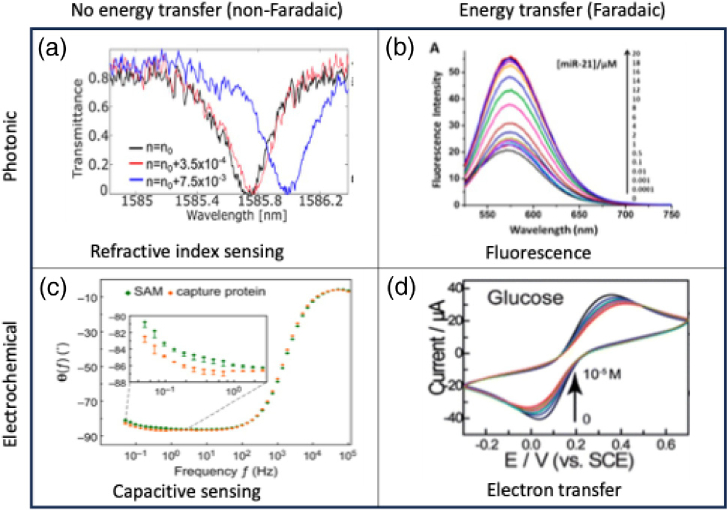
Research into diagnostic biosensors is a vibrant field that combines scientific challenge with translational opportunities; innovation in healthcare is of great societal interest and is an essential element of future healthcare provision. Photonic and electrochemical biosensors are the dominant modalities, both scientifically and commercially, yet the two scientific communities largely remain separated and siloed. It seems astute to better understand what the two fields can learn from one another so as to progress the key scientific, translational, and commercial challenges. Here, we provide an analysis of the fundamental operational characteristics of photonic and electrochemical biosensors using a classification based on energy transfer; in photonics, this separates refractive index sensors from fluorescence and vibrational spectroscopy, while in electrochemistry, it distinguishes Faradaic from non-Faradaic processes. This classification allows us to understand some of the key performance characteristics, such as the susceptibility to fouling and dependence on the clinical matrix that is being analyzed. We discuss the use of labels and the ultimate performance limits, and some of the unique advantages of photonics, such as multicolor operation and fingerprinting, and critically evaluate the requirements for translation of these technologies for clinical use. We trust that this critical review will inform future research in biosensors and support both scientific and commercial developments.
诊断生物传感器的研究是一个充满活力的领域,它将科学挑战与转化机会结合在一起;医疗保健领域的创新具有重大的社会意义,是未来医疗保健服务的重要组成部分。光子生物传感器和电化学生物传感器在科学和商业上都是主导模式,但这两个科学界在很大程度上仍然相互分离、各自为政。更好地了解这两个领域可以相互借鉴之处,以应对关键的科学、转化和商业挑战,似乎是明智之举。在这里,我们基于能量转移进行分类,对光子生物传感器和电化学生物传感器的基本操作特性进行分析;在光子学中,这将折射率传感器与荧光光谱和振动光谱区分开来,而在电化学中,它将法拉第过程与非法拉第过程区分开来。这种分类使我们能够理解一些关键的性能特征,例如对污染的敏感性以及对所分析临床基质的依赖性。我们讨论了标记的使用和最终性能极限,以及光子学的一些独特优势,如多色操作和指纹识别,并批判性地评估了将这些技术转化为临床应用的要求。我们相信,这一批判性综述将为生物传感器的未来研究提供参考,并支持科学和商业发展。