Jans Alexander, Sinonquel Pieter, Seerden Tom C J, De Bodelier Alexander, de Ridder Rogier, Pierik Marieke J, Karstensen John Gásdal, Sloth Stine, De Hertogh Gert, Demedts Ingrid, Willekens Hilde, Vermeire Severine, Bisschops Raf
Department of Gastroenterology and Hepotology, KU Leuven, Leuven, Belgium.
Gastroenterology and Hepatology, Amphia Hospital Location Langendijk, Breda, Netherlands.
Endosc Int Open. 2024 Nov 28;12(11):E1386-E1391. doi: 10.1055/a-2443-1080. eCollection 2024 Nov.
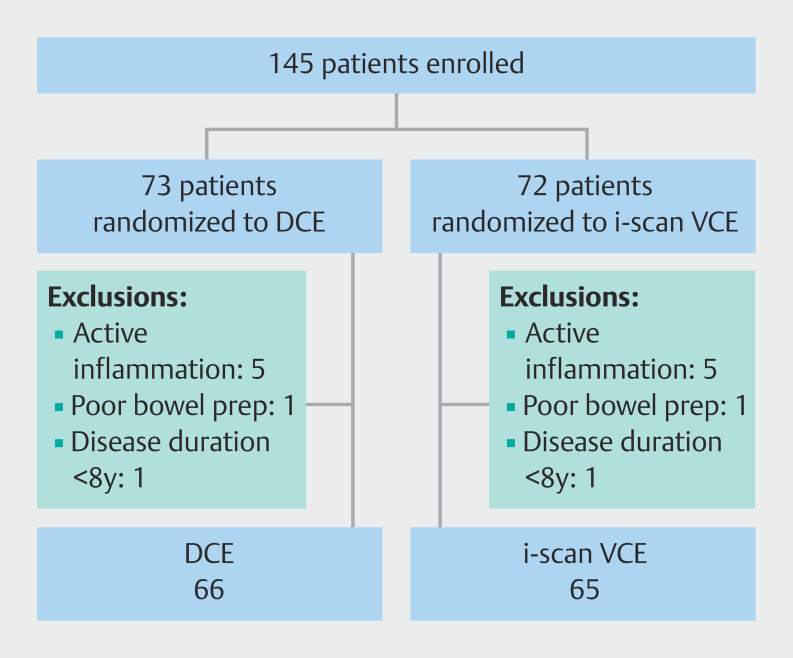
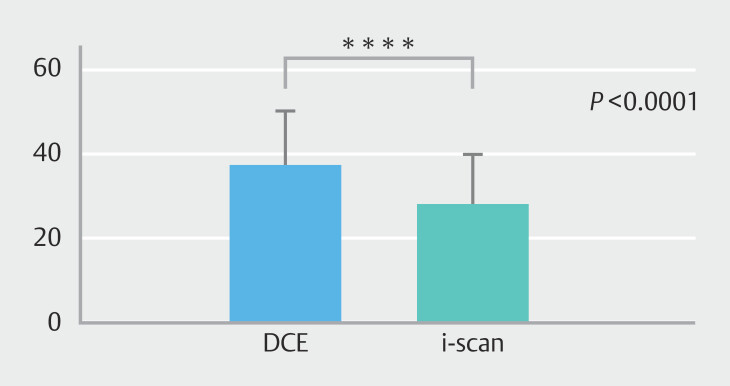
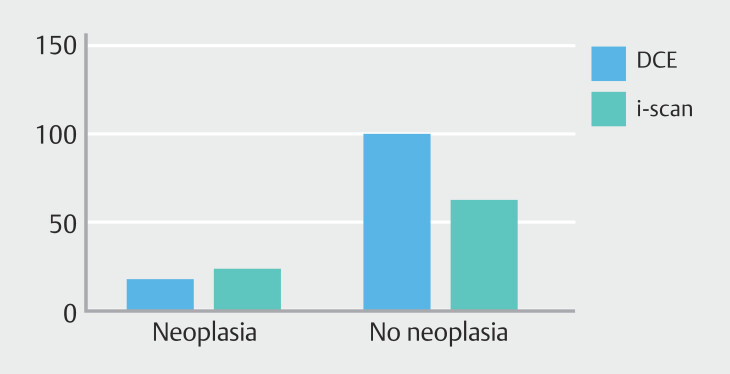
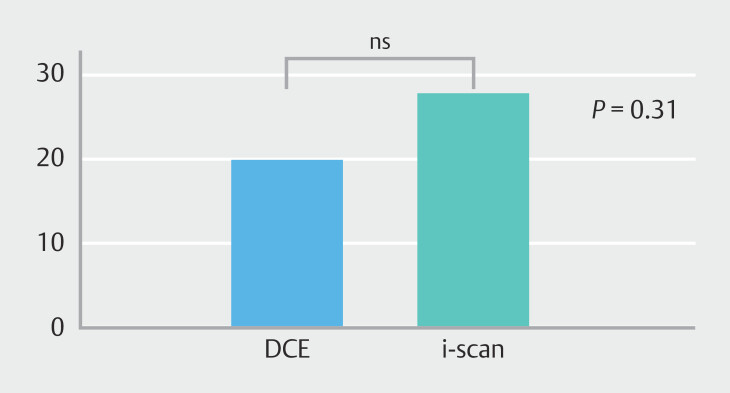
Long-standing ulcerative colitis (UC) is associated with an increased risk of developing colorectal neoplasia. Both dye-based chromoendoscopy (DCE) and virtual chromoendoscopy (VCE) increase detection of neoplastic lesions. In this prospective randomized controlled trial (RCT), we compared the neoplasia detection rate between DCE and i-scan VCE in patients with long-standing UC. In four European hospitals, 131 patients with long-standing UC (disease duration > 8 years) were randomized to either DCE with methylene blue 0.1% (n = 66) or i-scan VCE (n = 65). All procedures were performed by trained endoscopists. Biopsies were taken from all visible lesions and the surrounding mucosa. The mean number of neoplastic lesions detected per colonoscopy was not significantly different between DCE (0.27) and i-scan VCE (0.37) ( = 0.41). Similarly, there was no significant difference in neoplasia detection rate between DCE (19.7%) and VCE (27.7%) (odds ratio0.64, 95% confidence interval 0.28-1.50, = 0.31). However, the per lesion neoplasia detection rate was significantly higher with i-scan VCE compared to DCE (27.6% vs 15.3%, = 0.036). Both withdrawal and total procedure time were on average 10.0 and 9.9 minutes shorter using i-scan VCE (both < 0.001). This multicenter, prospective RCT showed no significant difference in neoplasia detection between DCE and i-scan VCE in long-standing UC. However, use of i-scan VCE was associated with a lower false-positive rate and a significantly shorter procedure time compared with DCE. I-scan VCE, therefore, could be a valid replacement for DCE in UC surveillance colonoscopies.
长期溃疡性结肠炎(UC)与结直肠肿瘤发生风险增加相关。基于染料的色素内镜检查(DCE)和虚拟色素内镜检查(VCE)均可提高肿瘤性病变的检出率。在这项前瞻性随机对照试验(RCT)中,我们比较了长期UC患者中DCE与i-scan VCE的肿瘤检出率。在四家欧洲医院,131例长期UC患者(病程>8年)被随机分为0.1%亚甲蓝DCE组(n = 66)或i-scan VCE组(n = 65)。所有操作均由经过培训的内镜医师进行。对所有可见病变及其周围黏膜进行活检。每次结肠镜检查检测到的肿瘤性病变平均数量在DCE组(0.27)和i-scan VCE组(0.37)之间无显著差异(P = 0.41)。同样,DCE组(19.7%)和VCE组(27.7%)的肿瘤检出率也无显著差异(优势比0.64,95%置信区间0.28 - 1.50,P = 0.31)。然而,与DCE相比,i-scan VCE的每病变肿瘤检出率显著更高(27.6%对15.3%,P = 0.036)。使用i-scan VCE时,退镜时间和总操作时间平均分别缩短10.0分钟和9.9分钟(均P < 0.001)。这项多中心前瞻性RCT表明,在长期UC中,DCE与i-scan VCE的肿瘤检出率无显著差异。然而,与DCE相比,使用i-scan VCE的假阳性率更低,操作时间显著更短。因此,在UC监测结肠镜检查中,i-scan VCE可能是DCE的有效替代方法。