Department of Health and Rehabilitation Sciences, College of Applied Medical Sciences, Prince Sattam Bin Abdulaziz University, Al-Kharj, Saudi Arabia.
Department of Physical Therapy for Pediatrics, Faculty of Physical Therapy, Cairo University, Giza, Egypt.
Medicine (Baltimore). 2024 Nov 29;103(48):e40667. doi: 10.1097/MD.0000000000040667.
This study evaluates the differential effects of constant-load (CL-AE) and graded (G-AE) aerobic exercise training approaches on cardiopulmonary fitness and functional capacity in obese children with bronchial asthma (BA).
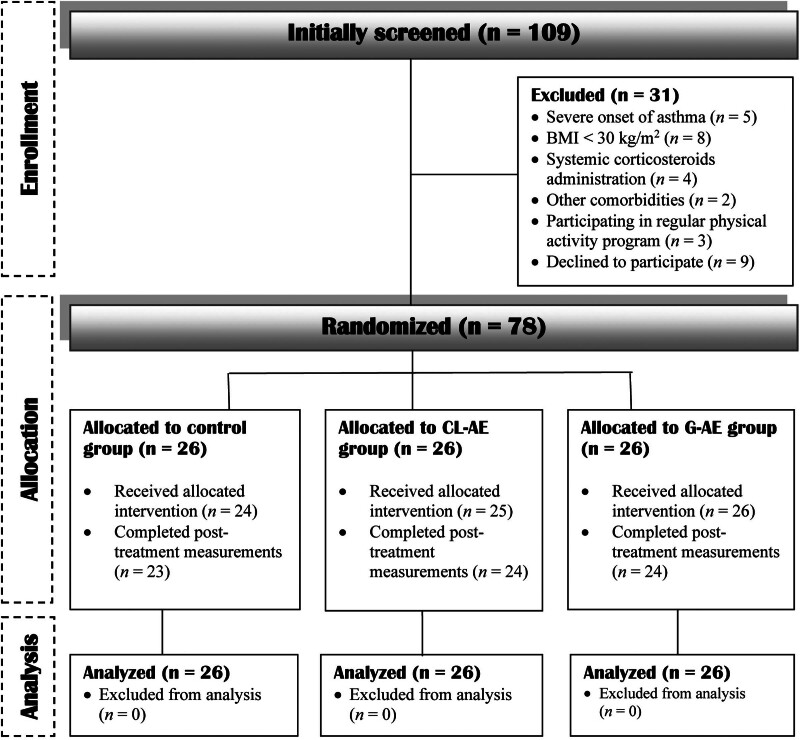
Seventy-eight obese children with moderate BA (age: 14.14 ± 2.31 years; body mass index: 31.93 ± 1.26 kg/m2) were randomly assigned to 3 intervention-based groups: control, CL-AE, or G-AE group (n = 26 in a group). The cardiorespiratory fitness (peak oxygen uptake, minute ventilation [VE], ventilation-oxygen uptake ratio, stroke volume of oxygen, oxygen/carbon-dioxide exchange ratio, heart rate maximum, and heart rate recovery at one minute) and functional capacity (6-minute walk test and perceived dyspnea and fatigue) were assessed at the baseline and posttreatment.
The G-AE group exhibited more favorable changes in cardiorespiratory fitness [VO2peak (P = .03), VE (P = .021), VE/VO2 (P = .032), SVO2 (P = .025), O2/CO2 ratio (P = .004), HRmax (P = .016), HRR1 (P = .046)] and functional capacity [6-minute walk test (P = .021), dyspnea (P = .041), fatigue (P = .04)] as compared to the CL-AE group.
The G-AE, compared to CL-AE, appears to be a more potent stimulus for enhancing cardiorespiratory fitness and functional capacity in obese children with BA. Further investigations are, however, required to corroborate the observed effects.
本研究评估了恒负荷(CL-AE)和分级(G-AE)有氧运动训练方法对患有支气管哮喘(BA)的肥胖儿童心肺功能和功能能力的差异影响。
78 名患有中度 BA 的肥胖儿童(年龄:14.14±2.31 岁;体重指数:31.93±1.26kg/m2)被随机分为 3 个基于干预的组:对照组、CL-AE 组或 G-AE 组(每组 26 人)。在基线和治疗后评估心肺功能(峰值摄氧量、分钟通气量[VE]、通气-摄氧量比、氧摄取量的每搏量、氧/二氧化碳交换比、最大心率和 1 分钟后心率恢复)和功能能力(6 分钟步行测试和感知的呼吸困难和疲劳)。
G-AE 组在心肺功能[VO2peak(P=.03)、VE(P=.021)、VE/VO2(P=.032)、SVO2(P=.025)、O2/CO2 比(P=.004)、HRmax(P=.016)、HRR1(P=.046)]和功能能力[6 分钟步行测试(P=.021)、呼吸困难(P=.041)、疲劳(P=.04)]方面的变化更为有利,与 CL-AE 组相比。
与 CL-AE 相比,G-AE 似乎更能增强患有 BA 的肥胖儿童的心肺功能和功能能力。然而,需要进一步的研究来证实观察到的效果。