Tsamouri Lydia P, Hsiao Jeffrey C, Bachovchin Daniel A
Pharmacology Program of the Weill Cornell Graduate School of Medical Sciences, Memorial Sloan Kettering Cancer Center, New York, New York, USA.
Pharmacology Program of the Weill Cornell Graduate School of Medical Sciences, Memorial Sloan Kettering Cancer Center, New York, New York, USA; Chemical Biology Program, Memorial Sloan Kettering Cancer Center, New York, New York, USA; Tri-Institutional PhD Program in Chemical Biology, Memorial Sloan Kettering Cancer Center, New York, New York, USA.
J Biol Chem. 2025 Jan;301(1):108034. doi: 10.1016/j.jbc.2024.108034. Epub 2024 Nov 29.
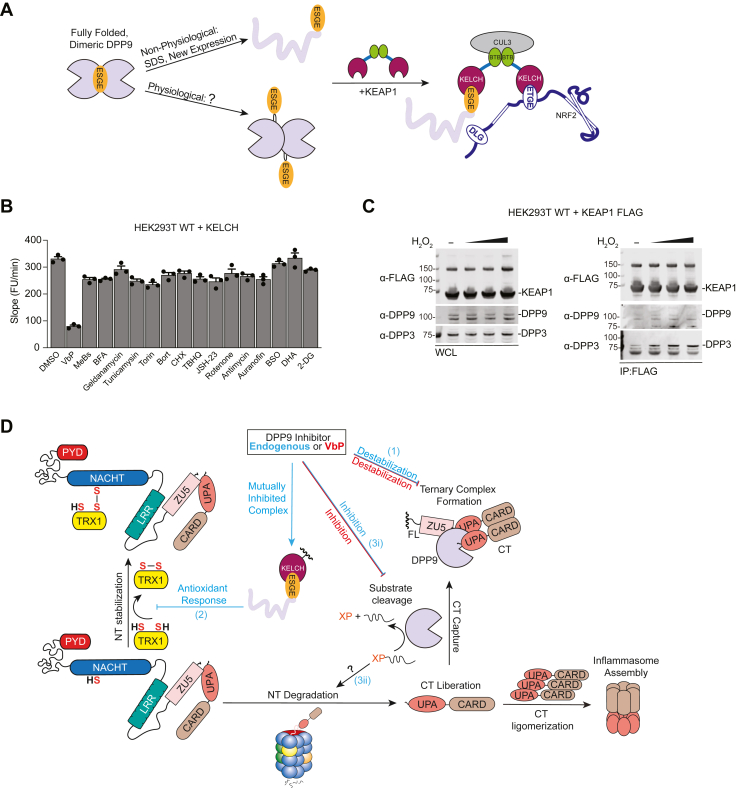
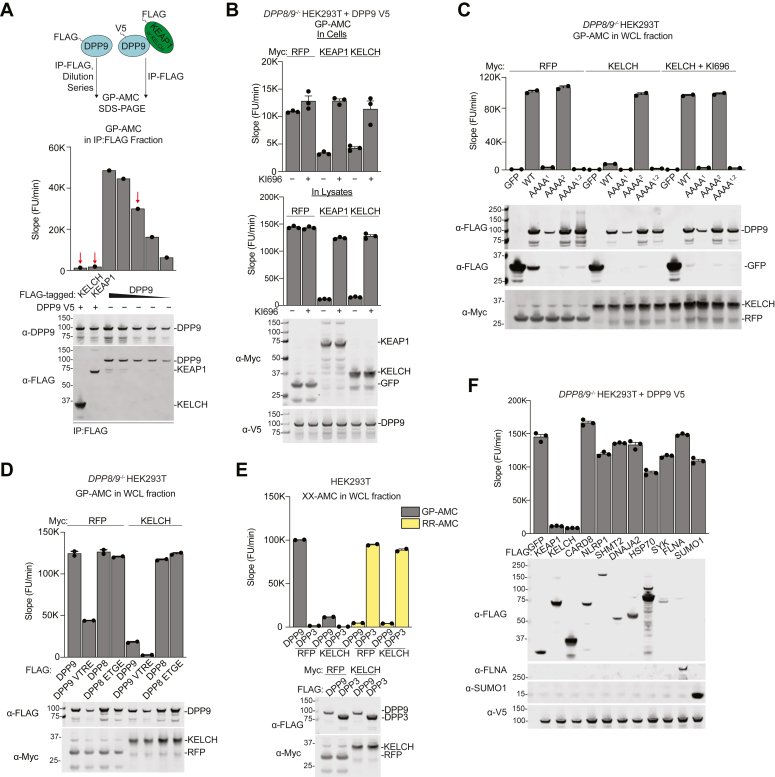
Synthetic inhibitors of the serine protease DPP9 activate the related NLRP1 and CARD8 inflammasomes and stimulate powerful innate immune responses. Thus, it seems plausible that a biomolecule similarly inhibits DPP9 and triggers inflammasome activation during infection, but one has not yet been discovered. Here, we wanted to identify and characterize DPP9-binding proteins to potentially uncover physiologically relevant mechanisms that control DPP9's activity. Notably, we found that the redox sensor protein KEAP1 binds to DPP9 in an inactive conformation and stabilizes this non-native fold. At the same time, this inactive form of DPP9 reciprocally inhibits the ability of KEAP1 to bind to and degrade the transcription factor NRF2, thereby inducing an antioxidant response. Although we discovered several experimental conditions, for example new protein expression and chemical denaturation, that force DPP9 out of its folded dimeric state and into a KEAP1-binding state, the key danger-related stimulus that causes this critical DPP9 conformational change is not yet known. Regardless, our data now reveal that an endogenous DPP9 inhibition mechanism does in fact exist, and moreover that DPP9, like the other NLRP1 regulator thioredoxin-1, is directly coupled to the intracellular redox potential. Overall, we expect this work will provide the foundation to discover additional biomolecules that regulate DPP9's activity, the DPP9-KEAP1 interaction, the intracellular redox environment, and the NLRP1 and CARD8 inflammasomes.
丝氨酸蛋白酶DPP9的合成抑制剂可激活相关的NLRP1和CARD8炎性小体,并刺激强大的先天免疫反应。因此,一种生物分子在感染期间类似地抑制DPP9并触发炎性小体激活似乎是合理的,但尚未发现这样的分子。在这里,我们想要鉴定和表征与DPP9结合的蛋白质,以潜在地揭示控制DPP9活性的生理相关机制。值得注意的是,我们发现氧化还原传感器蛋白KEAP1以无活性构象与DPP9结合,并稳定这种非天然折叠。同时,这种无活性形式的DPP9反过来抑制KEAP1结合并降解转录因子NRF2的能力,从而诱导抗氧化反应。虽然我们发现了几种实验条件,例如新的蛋白质表达和化学变性,可迫使DPP9脱离其折叠的二聚体状态并进入与KEAP1结合的状态,但导致这种关键的DPP9构象变化的关键危险相关刺激尚不清楚。无论如何,我们的数据现在表明,内源性DPP9抑制机制确实存在,而且DPP9与其他NLRP1调节因子硫氧还蛋白-1一样,直接与细胞内氧化还原电位相关联。总体而言,我们预计这项工作将为发现调节DPP9活性、DPP9-KEAP1相互作用、细胞内氧化还原环境以及NLRP1和CARD8炎性小体的其他生物分子提供基础。