Mao Fengfu, Wei Yafei, Wang Yuanfan
School of Economics, Zhejiang Gongshang University, No. 18, Xuezheng Street, Hangzhou, 310018, Zhejiang, China.
Sci Rep. 2024 Nov 30;14(1):29814. doi: 10.1038/s41598-024-81677-4.
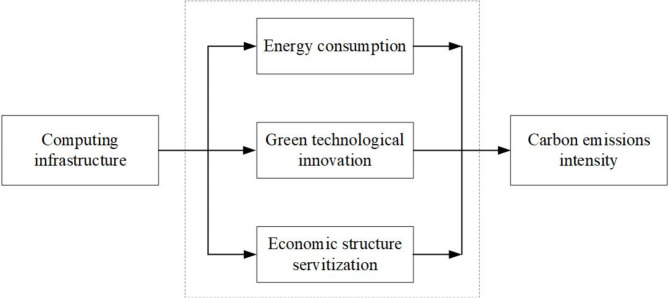
The development of computing infrastructure has brought about increased productivity, but it has also brought about energy consumption and carbon emissions. Based on the panel data and business enterprise registration data of 279 prefecture-level cities from 2008 to 2021, using the econometric model system, this study investigates the relationship between computing infrastructure and carbon emission intensity, yielding several findings: First, our result finds that there is an inverse "U-shaped" pattern in the association between carbon emission intensity and computing infrastructure. According to several robustness tests, such as using IV method and PCSD model, the research conclusion still holds. Second, heterogeneity analysis indicates that our findings are particularly pronounced in central regions, hub cities and moderately digitally developed cities. Third, mechanism analysis shows that carbon emission intensity is influenced by computing infrastructure through energy consumption, green technological innovation, and servitization of the economic structure, with energy consumption also following an inverted "U-shaped" pattern. These findings contribute to understanding the environmental impact of digital infrastructure and offer insights for promoting sustainable development.
计算基础设施的发展提高了生产力,但也带来了能源消耗和碳排放。基于2008年至2021年279个地级市的面板数据和企业登记数据,本研究运用计量模型系统,考察了计算基础设施与碳排放强度之间的关系,得出以下几点发现:第一,我们的结果发现碳排放强度与计算基础设施之间存在倒“U”形关系。通过使用IV方法和PCSD模型等多项稳健性检验,研究结论仍然成立。第二,异质性分析表明,我们的研究结果在中部地区、枢纽城市和数字发展水平中等的城市尤为明显。第三,机制分析表明,碳排放强度受到计算基础设施通过能源消耗、绿色技术创新和经济结构服务化的影响,能源消耗也呈现倒“U”形模式。这些发现有助于理解数字基础设施对环境的影响,并为促进可持续发展提供见解。