Gros Louis, Yip Rowena, Zhu Yeqing, Li Pengfei, Paksashvili Natela, Sun Qi, Yankelevitz David F, Henschke Claudia I
Department of Radiology, Icahn School of Medicine at Mount Sinai, One Gustave L. Levy Place, New York, NY, 10029, USA.
Sci Rep. 2024 Dec 2;14(1):29851. doi: 10.1038/s41598-024-76322-z.
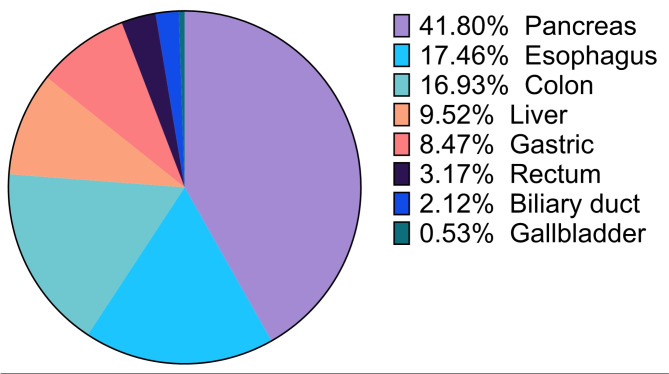
Lung cancer, the leading cause of cancer deaths globally, has better survival rates with early detection. Annual low-dose CT (LDCT) screenings are recommended for high-risk individuals due to age and smoking. These individuals are also at risk for other cancers. Our study explores gastrointestinal (GI) cancer mortality in lung cancer screening participants and the potential of LDCT screenings to detect pancreatic cancer. We utilized data from a prospective multi-institutional cohort study, the International Early Lung Cancer Action Project (I-ELCAP). We analyzed GI cancer deaths among participants in New York State (1992-2010), exploring demographics and GI cancer distribution. Radiologists retrospectively reviewed pancreatic cancer cases within 24 months post-LDCT, comparing findings with original reports. Among 10,150 participants, 189 died from GI cancers; mean age 75, mostly male smokers. Pancreatic cancer (41.8%) led, followed by esophageal (17.5%) and colon cancer (16.9%). Median time between baseline LDCT and death was 116 months (9.7 years). 82/189 (43.4%) participants died within 5 years of their last LDCT screening, with pancreatic cancer again prominent (45.1%). In 79 pancreatic cancer deaths, 17.7% occurred within 24 months post-LDCT. A re-review identified previously undetected pancreatic findings, with 4 out of 14 participants (28.6%) showing abnormalities. This underscores the potential of lung cancer screening programs to provide insights beyond lung health. This study of over 10,000 participants in a lung cancer screening program reveals that they are at risk for GI cancer deaths, particularly pancreatic cancer. Re-reviews of LDCT scans revealed previously undocumented pancreatic findings in a third of participants who died from pancreatic cancer, underscoring the need to identify, document, and follow up on these findings.
肺癌是全球癌症死亡的主要原因,早期发现可提高生存率。由于年龄和吸烟因素,建议高危个体每年进行低剂量CT(LDCT)筛查。这些个体也有患其他癌症的风险。我们的研究探讨了肺癌筛查参与者的胃肠道(GI)癌死亡率以及LDCT筛查检测胰腺癌的潜力。我们利用了一项前瞻性多机构队列研究——国际早期肺癌行动计划(I-ELCAP)的数据。我们分析了纽约州参与者(1992 - 2010年)中的胃肠道癌死亡情况,探讨了人口统计学特征和胃肠道癌分布。放射科医生对LDCT检查后24个月内的胰腺癌病例进行了回顾性审查,并将结果与原始报告进行了比较。在10150名参与者中,189人死于胃肠道癌;平均年龄75岁,大多数为男性吸烟者。胰腺癌(41.8%)居首位,其次是食管癌(17.5%)和结肠癌(16.9%)。基线LDCT检查至死亡的中位时间为116个月(9.7年)。82/189(43.4%)的参与者在最后一次LDCT筛查后的5年内死亡,胰腺癌再次占比突出(45.1%)。在79例胰腺癌死亡病例中,17.7%发生在LDCT检查后的24个月内。再次审查发现了先前未检测到的胰腺病变,14名参与者中有4名(28.6%)显示异常。这凸显了肺癌筛查项目在提供肺部健康以外信息方面的潜力。这项对10000多名肺癌筛查项目参与者的研究表明,他们有胃肠道癌死亡风险,尤其是胰腺癌。对LDCT扫描的再次审查发现,三分之一死于胰腺癌的参与者中有先前未记录的胰腺病变,这凸显了识别、记录和跟踪这些病变的必要性。