Gavrancic Tatjana, Stoddard Kassandra, Lewis Jason, Gorasevic Marko, Murawska Baptista Aleksandra, Cortes Melissa, Smerina Michael, Pagan Ricardo J, Dumitrascu Adrian, Rueda Prada Libardo
Department of Hospital Internal Medicine, Mayo Clinic, Jacksonville, FL, USA.
Department of Education, Mayo Clinic, Jacksonville, FL, USA.
Am J Case Rep. 2024 Dec 2;25:e945140. doi: 10.12659/AJCR.945140.
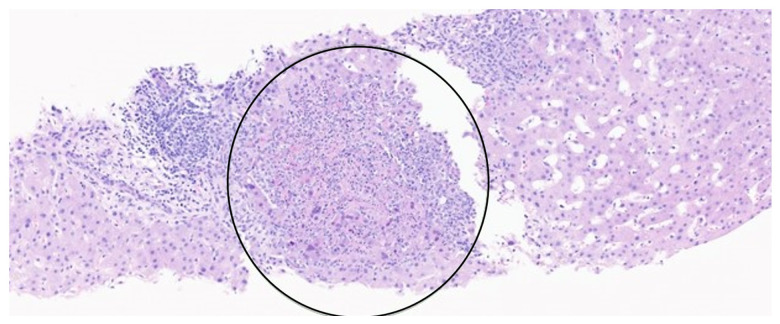
BACKGROUND Herpes simplex virus (HSV) is a rare cause of hepatitis. HSV hepatitis can be life-threatening due to its rapid progression to liver failure if not treated on time. It affects primarily immunocompromised individuals but can also present in immunocompetent hosts. HSV hepatitis in solid organ transplant recipients usually occurs in the early post-transplant period as fulminant hepatitis. We present a rare case of febrile anicteric HSV2 hepatitis occurring late in the post-transplant period, with only mild elevation in transaminase levels. CASE REPORT A 60-year-old man presented to the Emergency Department with generalized weakness, chills, and fever for 1 day. His medical history included Crohn's disease, primary sclerosing cholangitis, liver transplantation, and cholangiocarcinoma. Initial laboratory findings revealed leukocytosis. Extensive workup did not reveal a clear etiology of persistent fever. Liver enzymes peaked to aspartate transaminase 198 U/L and alanine transaminase 135 U/L, suggesting possible hepatitis. Liver biopsy showed focal areas of necrosis with vague histiocyte collections. Liver biopsy tissue was positive for HSV2 by polymerase chain reaction; therefore, HSV2 hepatitis diagnosis was made. Intravenous acyclovir was initiated for treatment of HSV2 hepatitis, which resulted with fever resolution within 48 h of initiation and return of liver enzymes to normal levels. CONCLUSIONS This case highlights the importance of having a high suspicion of HSV hepatitis as a rare cause of persistent fevers in immunosuppressed, post-transplant patients even in the late post-transplant period and in the absence of mucocutaneous lesions. Prompt recognition of this disease is crucial to start prompt treatment and decrease mortality.
背景 单纯疱疹病毒(HSV)是肝炎的罕见病因。HSV肝炎若不及时治疗,会迅速发展为肝衰竭,可危及生命。它主要影响免疫功能低下的个体,但也可出现在免疫功能正常的宿主中。实体器官移植受者中的HSV肝炎通常在移植后早期以暴发性肝炎的形式出现。我们报告一例罕见的移植后期发生的发热无黄疸型HSV2肝炎病例,转氨酶水平仅轻度升高。病例报告 一名60岁男性因全身无力、寒战和发热1天就诊于急诊科。他的病史包括克罗恩病、原发性硬化性胆管炎、肝移植和胆管癌。初始实验室检查发现白细胞增多。广泛检查未发现持续发热的明确病因。肝酶峰值为天冬氨酸转氨酶198 U/L和丙氨酸转氨酶135 U/L,提示可能存在肝炎。肝活检显示局灶性坏死区域,伴有模糊的组织细胞聚集。肝活检组织经聚合酶链反应检测HSV2呈阳性;因此,诊断为HSV2肝炎。开始静脉注射阿昔洛韦治疗HSV2肝炎,治疗后48小时内发热消退,肝酶恢复正常水平。结论 本病例强调,对于免疫抑制的移植后患者,即使在移植后期且无皮肤黏膜病变的情况下,高度怀疑HSV肝炎是持续发热的罕见病因非常重要。及时识别这种疾病对于及时开始治疗和降低死亡率至关重要。