Long Zhiwei, Zhu Tieshi, Zhou Yue, Xiang Zixuan, Zeng Qiyuan, Qiu Ye, Hu Jieying, Wang Yan
State Key Laboratory of Respiratory Disease, National Clinical Research Center for Respiratory Disease, Guangzhou Institute of Respiratory Health, The First Affiliated Hospital of Guangzhou Medical University, Guangzhou, People's Republic of China.
Department of Clinical Medicine, Guangzhou Medical University, Guangzhou, People's Republic of China.
Int J Chron Obstruct Pulmon Dis. 2024 Nov 25;19:2529-2543. doi: 10.2147/COPD.S488394. eCollection 2024.
The blood urea nitrogen/creatinine ratio (BCR) is an effective marker for disease severity stratification. Its efficacy has been demonstrated under numerous conditions. This study aims to investigate the relationship between BCR and in-hospital mortality in intensive care unit (ICU) patients with acute exacerbation of chronic obstructive pulmonary disease (AECOPD).
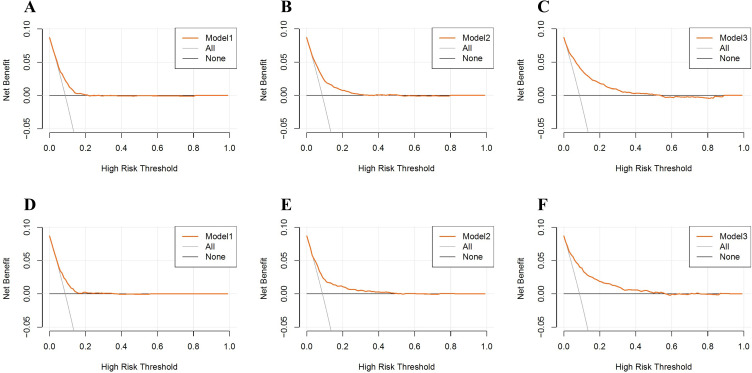
Eligible ICU patients with AECOPD from the eICU database were included in the study. Patients were divided into high-BCR and low-BCR groups on the basis of the optimal cutoff value (22.78) of the ROC curve for predicting in-hospital mortality in AECOPD patients. Propensity score matching (PSM) was used to balance the baseline differences between the high-BCR and low-BCR groups. Multivariate logistic regression was used to analyze the relationship between BCR and in-hospital mortality in ICU patients with AECOPD. Decision curve analysis (DCA) was performed to evaluate the clinical efficacy of each model via multivariate logistic regression.
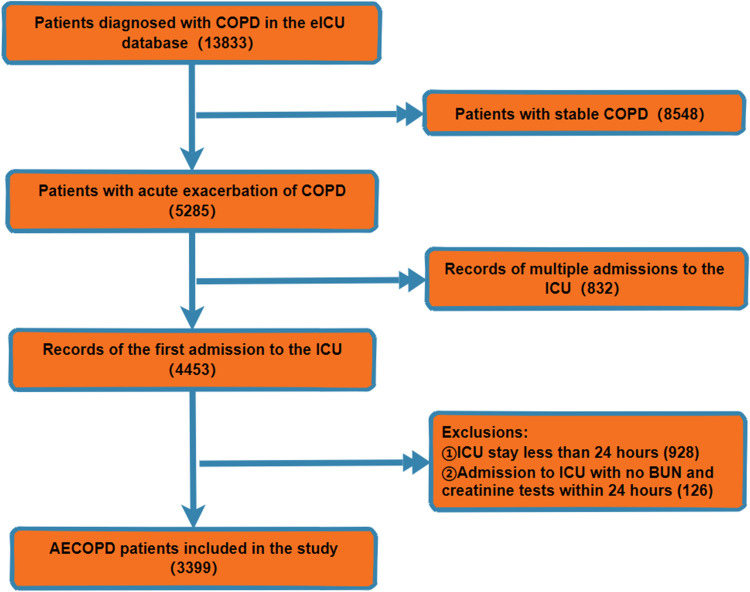
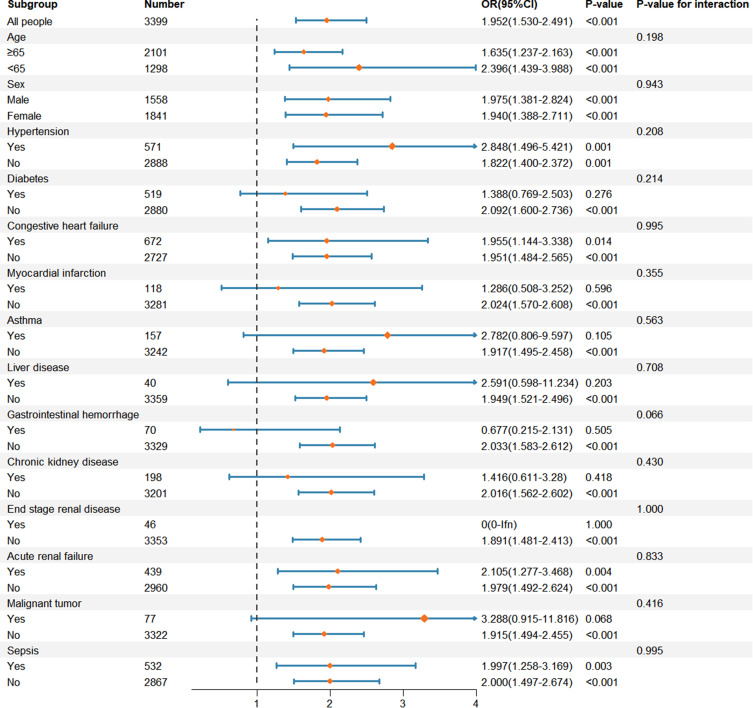
A total of 3399 eligible ICU patients with AECOPD were included in the study, with 1559 patients in the high-BCR group and 1840 patients in the low-BCR group. After propensity score matching (PSM), 1174 pairs of patients were successfully matched. The results of the multivariate logistic regression revealed that the in-hospital mortality rate for AECOPD patients in the high-BCR subgroup was significantly greater than that in the low-BCR subgroup in both the unmatched and matched cohorts after adjusting for multiple factors. Additionally, DCA demonstrated that the models used in the multivariate logistic regression had effective clinical utility.
The blood urea nitrogen/creatinine ratio (BCR) is an effective predictor of in-hospital mortality in ICU patients with AECOPD. Clinicians can use BCR to identify critically ill ICU patients with AECOPD earlier and implement interventions to improve patient outcomes.
血尿素氮/肌酐比值(BCR)是疾病严重程度分层的有效标志物。其有效性已在多种情况下得到证实。本研究旨在探讨慢性阻塞性肺疾病急性加重期(AECOPD)的重症监护病房(ICU)患者中BCR与院内死亡率之间的关系。
本研究纳入了电子ICU数据库中符合条件的AECOPD的ICU患者。根据预测AECOPD患者院内死亡率的ROC曲线的最佳截断值(22.78),将患者分为高BCR组和低BCR组。采用倾向评分匹配(PSM)来平衡高BCR组和低BCR组之间的基线差异。使用多因素逻辑回归分析AECOPD的ICU患者中BCR与院内死亡率之间的关系。进行决策曲线分析(DCA)以通过多因素逻辑回归评估每个模型的临床疗效。
本研究共纳入3399例符合条件的AECOPD的ICU患者,其中高BCR组1559例,低BCR组1840例。经过倾向评分匹配(PSM)后,成功匹配了1174对患者。多因素逻辑回归结果显示,在调整多个因素后,未匹配和匹配队列中,高BCR亚组的AECOPD患者院内死亡率均显著高于低BCR亚组。此外,DCA表明多因素逻辑回归中使用的模型具有有效的临床实用性。
血尿素氮/肌酐比值(BCR)是AECOPD的ICU患者院内死亡率的有效预测指标。临床医生可以使用BCR更早地识别AECOPD的重症ICU患者,并实施干预措施以改善患者预后。