Choi Byung Sun, Won Juneseok, Han Hyuk-Soo
Department of Orthopedic Surgery, Seoul National University Hospital, Seoul, Korea.
Department of Orthopedic Surgery, Seoul National University College of Medicine, Seoul, Korea.
Clin Orthop Surg. 2024 Dec;16(6):897-905. doi: 10.4055/cios23213. Epub 2024 Apr 25.
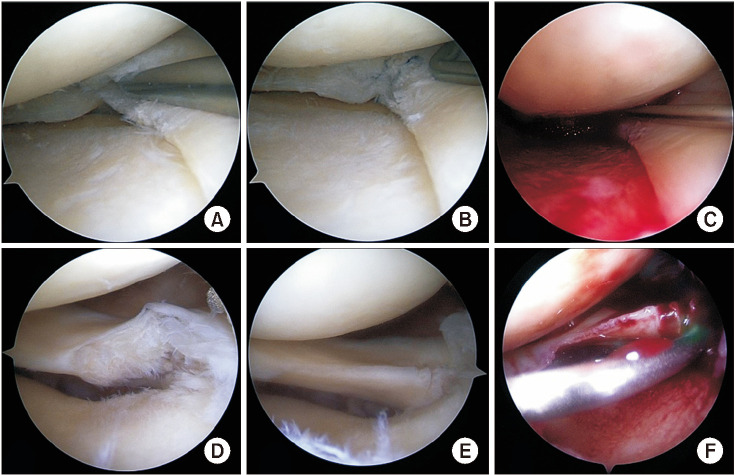
As the importance of meniscus in joint function becomes more apparent, there is a growing interest in meniscus repair techniques. Notably, biological augmentation methods have shown promising results for meniscus healing, despite their challenges in practical implementation. The purpose of this study was to evaluate meniscus healing and clinical outcomes of meniscus repair with bone marrow aspirate for horizontal or radial tears.
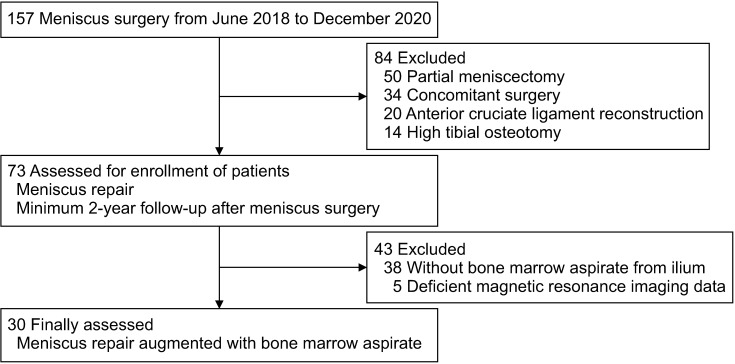
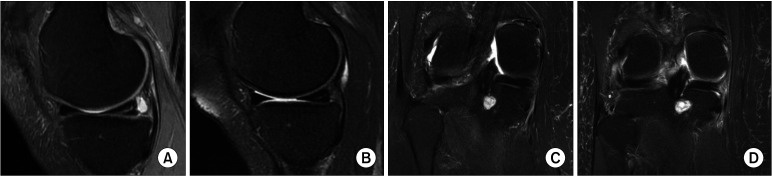
This study retrospectively reviewed patients who underwent arthroscopic meniscal repair with bone marrow aspirate from the iliac crest. A total of 30 patients with horizontal or radial meniscus tears confirmed by magnetic resonance imaging (MRI) were included, excluding those with insufficient data or concurrent surgeries. Patient demographic characteristics, operative data, and clinical outcomes including pain numeric rating scale, International Knee Documentation Committee score, Lysholm score, and Tegner activity scale were evaluated. For radiographic evaluation, knee x-rays, preoperative MRIs, and postoperative 3-month MRIs were evaluated.
Thirty patients (15 women and 15 men) with a mean age of 46.8 ± 15.2 years were followed up for a mean of 25.1 ± 3.4 months. Of these patients, 22 (73%) had horizontal meniscal tears, while 8 (27%) had radial tears. Clinical outcomes were significantly improved over the time from the initial to 2 years after surgery. Meniscus healing was 60% on MRI at 3 months after surgery. There was no correlation between changes in clinical scores and healing rate. Furthermore, there was no statistically significant difference in the healing rate or changes in clinical scores according to tear patterns. Retears were observed in 2 patients, who were non-compliant with rehabilitation and were managed conservatively.
Augmentation with bone marrow aspirate harvested from the iliac crest for meniscal repair of horizontal or radial tears yields favorable healing rates in MRI and clinical outcomes, highlighting its potential for addressing challenging meniscal repair.
随着半月板在关节功能中的重要性日益凸显,人们对半月板修复技术的兴趣与日俱增。值得注意的是,生物增强方法在半月板愈合方面已显示出有前景的结果,尽管其在实际应用中存在挑战。本研究的目的是评估采用骨髓抽吸物修复水平或放射状半月板撕裂的半月板愈合情况及临床结果。
本研究回顾性分析了接受经髂嵴骨髓抽吸物关节镜下半月板修复术的患者。纳入了30例经磁共振成像(MRI)确诊为水平或放射状半月板撕裂的患者,排除数据不足或同期进行其他手术的患者。评估了患者的人口统计学特征、手术数据以及包括疼痛数字评分量表、国际膝关节文献委员会评分、Lysholm评分和Tegner活动量表在内的临床结果。对于影像学评估,对膝关节X线片、术前MRI和术后3个月的MRI进行了评估。
30例患者(15例女性和15例男性),平均年龄46.8±15.2岁,平均随访25.1±3.4个月。其中,22例(73%)为水平半月板撕裂,8例(27%)为放射状撕裂。从手术初始到术后2年,临床结果有显著改善。术后3个月时,MRI显示半月板愈合率为60%。临床评分的变化与愈合率之间无相关性。此外,根据撕裂模式,愈合率或临床评分的变化在统计学上无显著差异。2例患者出现再次撕裂,他们未遵守康复计划,采取了保守治疗。
采用从髂嵴采集的骨髓抽吸物增强修复水平或放射状半月板撕裂,在MRI和临床结果方面均有良好的愈合率,凸显了其在解决具有挑战性的半月板修复方面的潜力。