
脑肿瘤切除术的成像与神经外科技术进展:全面综述
Advancements in Imaging and Neurosurgical Techniques for Brain Tumor Resection: A Comprehensive Review.
作者信息
Vadhavekar Nidhi H, Sabzvari Tara, Laguardia Simone, Sheik Thuslim, Prakash Varsha, Gupta Aseem, Umesh Indra Dhanush, Singla Abhinandan, Koradia Ikhlaq, Ramirez Patiño Brando B, Siddiqui Humza F
机构信息
Department of Internal Medicine, D.Y. Patil University School of Medicine, Navi Mumbai, IND.
Department of Medicine, McMaster University, Hamilton, CAN.
出版信息
Cureus. 2024 Oct 31;16(10):e72745. doi: 10.7759/cureus.72745. eCollection 2024 Oct.
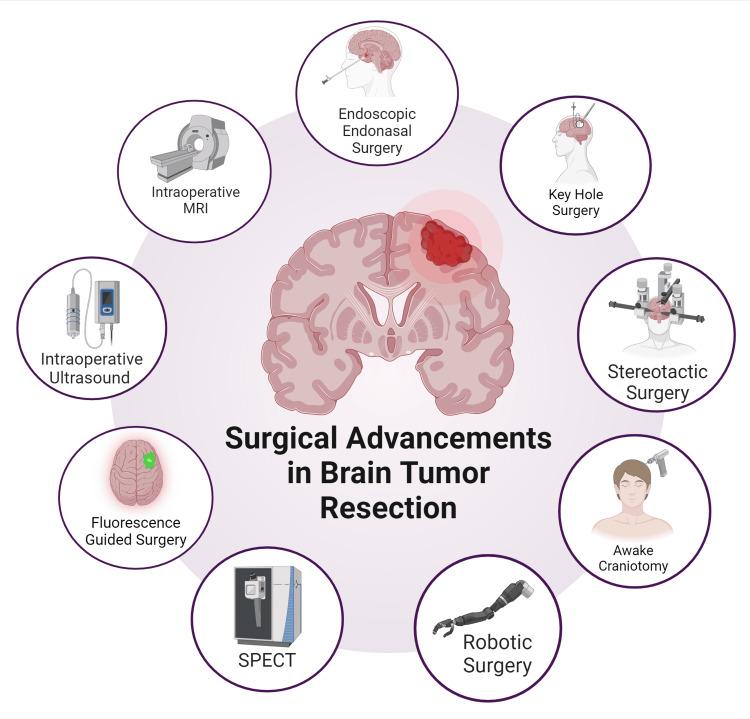
Brain tumor surgery has witnessed significant advancements over the past few decades, resulting in improved patient outcomes. Despite these advancements, brain tumors remain a formidable public health challenge due to their high morbidity and mortality rates. This review explores the evolution of neurosurgical techniques for brain tumor resection, emphasizing the balance between minimizing invasiveness and maximizing precision. Traditional approaches like craniotomy and keyhole surgery remain crucial, but the rise of minimally invasive techniques such as endoscopic endonasal surgery and laser interstitial thermal therapy (LITT) has revolutionized the field. Awake craniotomy has been a substantial stepping stone towards the preservation of neurological function among brain tumor patients. Additionally, the integration of brain mapping technologies including intraoperative MRI, ultrasound and fluorescence-guided surgery has enhanced the precision of tumor resections, particularly in eloquent brain areas. These innovations, while promising, also come with challenges, including steep learning curves and limited access to advanced technology in certain regions. As the field progresses, ongoing research is essential to refine these techniques and improve accessibility, ultimately aiming to increase survival rates and preserve neurological function in patients with brain tumors. The integration of advanced imaging techniques refined surgical tools, and artificial intelligence (AI) in surgical planning is expected to further improve the safety and effectiveness of neurosurgical procedures in the future. This review provides a comprehensive analysis of current surgical strategies and explores potential future directions in brain tumor surgery.
在过去几十年里,脑肿瘤手术取得了显著进展,患者预后得到改善。尽管有这些进展,但由于脑肿瘤的高发病率和死亡率,它们仍然是一个严峻的公共卫生挑战。本综述探讨了脑肿瘤切除神经外科技术的演变,强调了在最小化侵袭性和最大化精确性之间取得平衡。开颅手术和锁孔手术等传统方法仍然至关重要,但诸如内镜鼻内手术和激光间质热疗(LITT)等微创技术的兴起彻底改变了这一领域。清醒开颅手术是脑肿瘤患者保留神经功能的重要垫脚石。此外,包括术中MRI、超声和荧光引导手术在内的脑图谱技术的整合提高了肿瘤切除的精确性,特别是在脑功能区。这些创新虽然很有前景,但也带来了挑战,包括陡峭的学习曲线以及某些地区先进技术的获取有限。随着该领域的发展,持续研究对于完善这些技术和提高可及性至关重要,最终目标是提高脑肿瘤患者的生存率并保留神经功能。先进成像技术、精密手术工具以及人工智能(AI)在手术规划中的整合有望在未来进一步提高神经外科手术的安全性和有效性。本综述对当前的手术策略进行了全面分析,并探讨了脑肿瘤手术潜在的未来发展方向。
 Zotero 插件