Zhang Lili, Jiang Han, Li Lihua, Sun Zhen, Qian Yongjiang, Wang Zhongqun
Department of Cardiology, Affiliated Hospital of Jiangsu University, Institute Cardiovascular Disease of Jiangsu University, Zhenjiang, 212001, People's Republic of China.
Department of Pathology, Affiliated Hospital of Jiangsu University, Zhenjiang, 212001, People's Republic of China.
J Inflamm Res. 2024 Nov 25;17:9683-9696. doi: 10.2147/JIR.S480528. eCollection 2024.
Atherosclerosis (AS) is the major cause of cardiovascular disease. Using integrated single-cell and bulk RNA sequencing data of atherosclerosis, we aimed to investigate the cell phenotype, intercellular communication, and potential therapeutic target in AS.
Single-cell sequencing data from aortic arch of Apoe mice in normal diet (ND) and high fat diet (HFD) groups (obtained from GSE206239) were analyzed by Seurat, singleR, ReactomeGSA, and cellchat package. scRNA-seq dataset GSE159677 from the carotid artery of the patients with carotid endarterectomy were used to validate the distribution of fascin actin-bundling protein 1 (FSCN1) in cell populations. Bulk RNA sequencing data (GSE43292 and GSE28829) were used to analyzed the expression of FSCN1in AS. A cross-sectional clinical study was utilized to examine the association between FSCN1 and AS. Circulating concentrations of FSCN1 were measured using ELISA kits and assessed using logistic regression analysis and receiver operating characteristic (ROC) curves. Apoe mice fed with HFD and MAECs treated with oxidized low-density lipoprotein (ox-LDL) were established to detect the expression of FSCN1. Furthermore, we knocked down FSCN1 in MAECs to observe its influence on pyroptosis and migration.
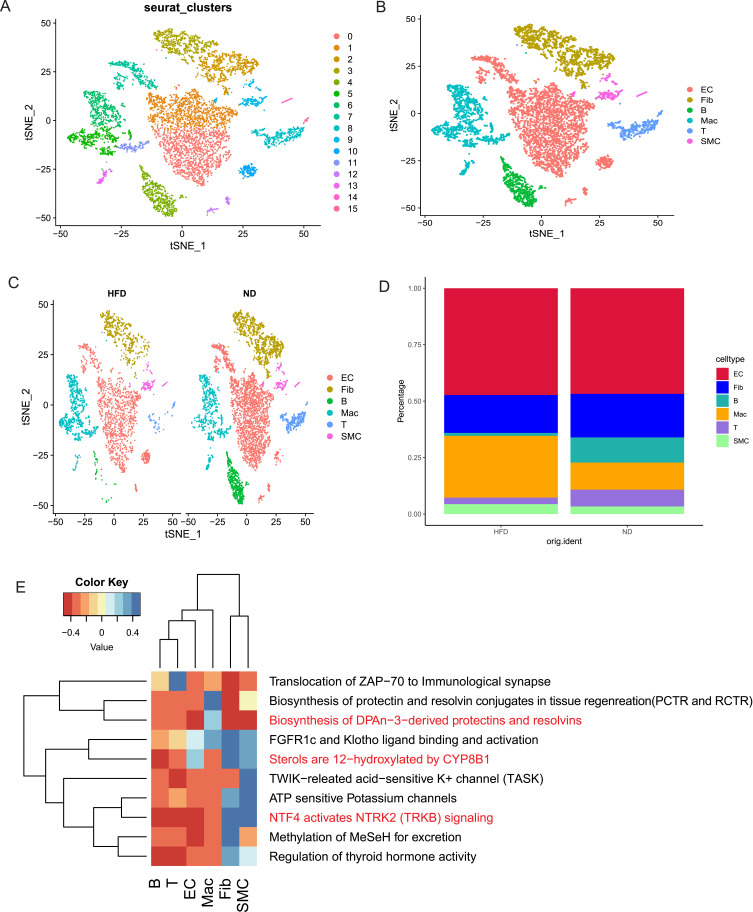
The HFD group had a significantly lower percentage of T cells, fibroblasts, and B cells and a significantly higher percentage of monocytes/macrophages cells. Strong interactions between endothelial cell (EC) and fibroblast in ND groups, while EC interactions with smooth muscle cells (SMC) and T cells were stronger in HFD groups. Semaphorin 7 (SEMA7) mediated signaling pathways were enriched in HFD groups and targeted EC driving by SMC. FSCN1was mainly expressed in EC and had a high expression in human AS samples. The cross-sectional study identified that high level of FSCN1 was associated with increased risk of AS. We also observed that high expression of FSCN1 in ox-LDL-induced MAECs and Apoe mice fed with HFD. Knockdown of FSCN1 reduced pyroptosis and increased the migration in MAECs.
Knockdown of FSCN1 in EC could alleviate the development and progression of AS. FSCN1 may be a potential prognostic biomarker and therapeutic target in AS.
动脉粥样硬化(AS)是心血管疾病的主要病因。利用动脉粥样硬化的单细胞和批量RNA测序综合数据,我们旨在研究AS中的细胞表型、细胞间通讯及潜在治疗靶点。
通过Seurat、singleR、ReactomeGSA和cellchat软件包分析正常饮食(ND)和高脂饮食(HFD)组Apoe小鼠主动脉弓的单细胞测序数据(数据来自GSE206239)。利用颈动脉内膜切除术患者颈动脉的scRNA-seq数据集GSE159677验证丝状肌动蛋白成束蛋白1(FSCN1)在细胞群体中的分布。批量RNA测序数据(GSE43292和GSE28829)用于分析AS中FSCN1的表达。采用横断面临床研究来检验FSCN1与AS之间的关联。使用酶联免疫吸附测定试剂盒测量FSCN1的循环浓度,并通过逻辑回归分析和受试者工作特征(ROC)曲线进行评估。建立高脂饮食喂养的Apoe小鼠和氧化低密度脂蛋白(ox-LDL)处理的人主动脉内皮细胞(MAECs)模型,以检测FSCN1的表达。此外,我们在MAECs中敲低FSCN1,观察其对细胞焦亡和迁移的影响。
高脂饮食组中T细胞、成纤维细胞和B细胞的百分比显著降低,单核细胞/巨噬细胞的百分比显著升高。正常饮食组中内皮细胞(EC)与成纤维细胞之间有强烈的相互作用,而高脂饮食组中EC与平滑肌细胞(SMC)和T细胞的相互作用更强。信号素7(SEMA7)介导的信号通路在高脂饮食组中富集,且由SMC驱动靶向EC。FSCN1主要在内皮细胞中表达,在人类AS样本中表达较高。横断面研究发现,FSCN1水平升高与AS风险增加相关。我们还观察到在ox-LDL诱导的MAECs和高脂饮食喂养的Apoe小鼠中FSCN1表达较高。敲低FSCN1可减少MAECs中的细胞焦亡并增加其迁移。
在内皮细胞中敲低FSCN1可缓解AS的发生和发展。FSCN1可能是AS中一个潜在的预后生物标志物和治疗靶点。