Fu Yueyue, Xing Yuling, Yang Linlin, Liu Jing, Ma Huijuan
Graduate School of North China University of Science and Technology, Tangshan, People's Republic of China.
Department of Endocrinology, Hebei General Hospital, Shijiazhuang, People's Republic of China.
Diabetes Metab Syndr Obes. 2024 Nov 26;17:4469-4477. doi: 10.2147/DMSO.S491560. eCollection 2024.
To explore the correlation between fasting C-peptide to diabetes duration ratio (FCP/DD) and diabetic peripheral neuropathy (DPN).
The study was conducted on 816 patients with type 2 diabetes (T2DM). Subjects were classified into a diabetic peripheral neuropathy group (DPN, n=408) and a non-diabetic peripheral neuropathy group (NDPN, n=408) depending on the presence of DPN. Collected patients' baseline data, calculated the FCP/DD ratio, and analyzed the correlation between FCP/DD and DPN.
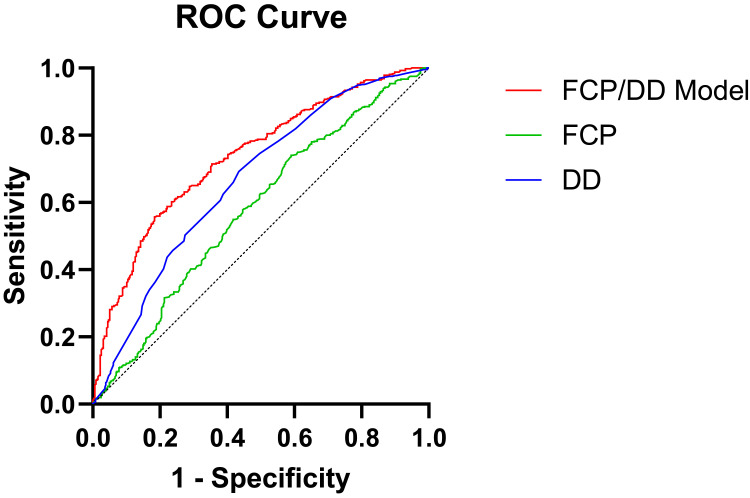
A comparative analysis of general characteristics revealed that the DPN group exhibited higher values for age, DD, proportion of hypertension, proportion of DN, and proportion of DR compared to the NDPN group, Conversely, the DPN group demonstrated lower proportions of eGFR, FCP/DD, FCP, and fatty liver relative to the NDPN group, with all differences achieving statistical significance (P < 0.05). Compared to the high FCP/DD group, the low FCP/DD group exhibited higher values in age, DD, the proportion of DPN, DN, DR, and hypertension, as well as elevated levels of HDL-C and NEUT (P<0.05). Conversely, the low FCP/DD group demonstrated a lower proportion of patients who smoked and those with fatty liver, along with reduced BMI, ALB, FBG, UA, eGFR, TC, TG, and LDL-C levels (P < 0.05). In patients with T2DM, after adjusting for confounding factors, high levels of FCP/DD were found to be a protective factor for DPN (P < 0.05). The area under the curve of the FCP/DD Model predicting DPN (AUC=0.737) was higher than that of single FCP (AUC=0.587), DD (AUC=0.665).
The high FCP/DD ratio was a protective factor for T2DM with DPN. Additionally, the FCP/DD ratio was found to be a better predictor for the occurrence of DPN in T2DM compared to FCP and DD alone.
探讨空腹C肽与糖尿病病程比值(FCP/DD)与糖尿病周围神经病变(DPN)之间的相关性。
对816例2型糖尿病(T2DM)患者进行研究。根据是否存在DPN将受试者分为糖尿病周围神经病变组(DPN,n = 408)和非糖尿病周围神经病变组(NDPN,n = 408)。收集患者的基线数据,计算FCP/DD比值,并分析FCP/DD与DPN之间的相关性。
一般特征的比较分析显示,与NDPN组相比,DPN组在年龄、病程、高血压比例、糖尿病肾病(DN)比例和糖尿病视网膜病变(DR)比例方面的值更高。相反,与NDPN组相比,DPN组的估算肾小球滤过率(eGFR)、FCP/DD、空腹C肽(FCP)和脂肪肝比例更低,所有差异均具有统计学意义(P < 0.05)。与高FCP/DD组相比,低FCP/DD组在年龄、病程、DPN比例、DN、DR和高血压方面的值更高,以及高密度脂蛋白胆固醇(HDL-C)和中性粒细胞(NEUT)水平升高(P<0.05)。相反,低FCP/DD组吸烟患者和脂肪肝患者的比例较低,同时体重指数(BMI)、白蛋白(ALB)、空腹血糖(FBG)、尿酸(UA)、eGFR、总胆固醇(TC)、甘油三酯(TG)和低密度脂蛋白胆固醇(LDL-C)水平降低(P < 0.05)。在T2DM患者中,校正混杂因素后,发现高水平FCP/DD是DPN的保护因素(P < 0.05)。FCP/DD模型预测DPN的曲线下面积(AUC = 0.737)高于单一FCP(AUC = 0.587)、病程(AUC = 0.665)。
高FCP/DD比值是T2DM合并DPN的保护因素。此外,与单独的FCP和病程相比,发现FCP/DD比值是T2DM中DPN发生的更好预测指标。