Santanumurti Muhammad Browijoyo, Nugraha Muhammad Ar Rozzaaq, Dewi Novi Rosmala, Awaluddin Muhammad, Tang Pei Wen, Pardede Helen Indah, Solami Lafi Al, Sulmartiwi Laksmi, El-Regal Mohamed Ahmed Abu
Department of Aquaculture, Faculty of Fisheries and Marine, Universitas Airlangga, Surabaya, 60115, Indonesia.
Department of Marine Biology, Faculty of Marine Sciences, King Abdulaziz University, Jeddah, 21589, Kingdom of Saudi Arabia.
Vet World. 2024 Oct;17(10):2267-2285. doi: 10.14202/vetworld.2024.2267-2285. Epub 2024 Oct 7.
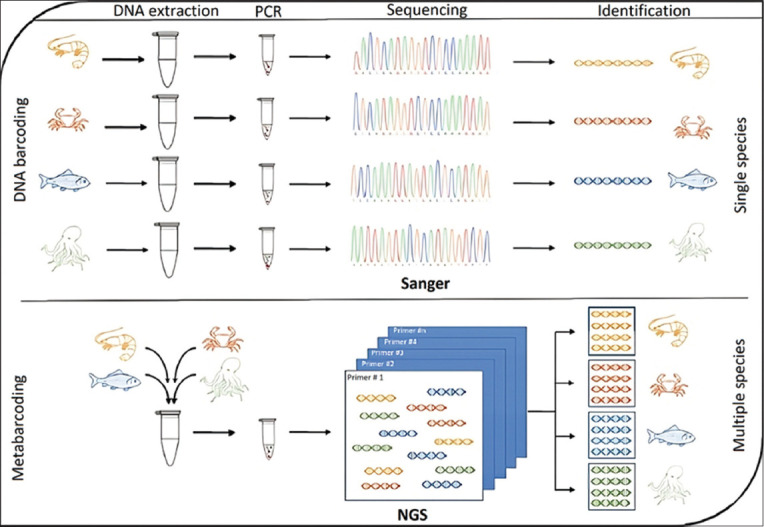
Fish identification in the Red Sea, particularly in Saudi Arabia, has a long history. Because of the vast fish diversity in Saudi Arabia, proper species identification is required. Indeed, identifying fish species is critical for biodiversity conservation, food and drug safety, and sustainable fishery management. Numerous approaches have been used to identify fish species, including conventional morphological identification, next-generation sequencing (NGS), nanopore sequencing, DNA barcoding, and environmental DNA analysis. In this review, we collected as much scientific information as possible on species identification in Saudi Arabia. Our findings suggest that the identification process has advanced and spread rapidly and broadly, as evidenced by the discovery of new fish species in Saudi Arabia. The advantages and disadvantages of each method were discussed as part of a comprehensive comparison. This study aimed to provide further scientific knowledge to promote the growth of fish diversity worldwide.
红海,尤其是沙特阿拉伯的鱼类识别有着悠久的历史。由于沙特阿拉伯鱼类种类繁多,因此需要进行准确的物种识别。事实上,识别鱼类物种对于生物多样性保护、食品和药品安全以及可持续渔业管理至关重要。已经采用了多种方法来识别鱼类物种,包括传统的形态学识别、下一代测序(NGS)、纳米孔测序、DNA条形码和环境DNA分析。在本综述中,我们收集了尽可能多的关于沙特阿拉伯物种识别的科学信息。我们的研究结果表明,识别过程已经取得进展并迅速广泛传播,沙特阿拉伯新鱼类物种的发现就是明证。作为全面比较的一部分,我们讨论了每种方法的优缺点。本研究旨在提供更多科学知识,以促进全球鱼类多样性的增长。