Tosheva Ilona I, Filaire Fabien, Rijnink Willemijn F, de Meulder Dennis, van Kekem Bianca, Bestebroer Theo M, Funk Mathis, Spronken Monique I, Cáceres C Joaquin, Perez Daniel R, Richard Mathilde, Koopmans Marion P G, Fraaij Pieter L A, Fouchier Ron A M, Herfst Sander
Department of Viroscience, Erasmus University Medical Centre, Rotterdam, the Netherlands.
Department of Population Health, College of Veterinary Medicine, University of Georgia, Athens, GA, USA.
Nat Microbiol. 2025 Jan;10(1):14-19. doi: 10.1038/s41564-024-01885-6. Epub 2024 Dec 2.
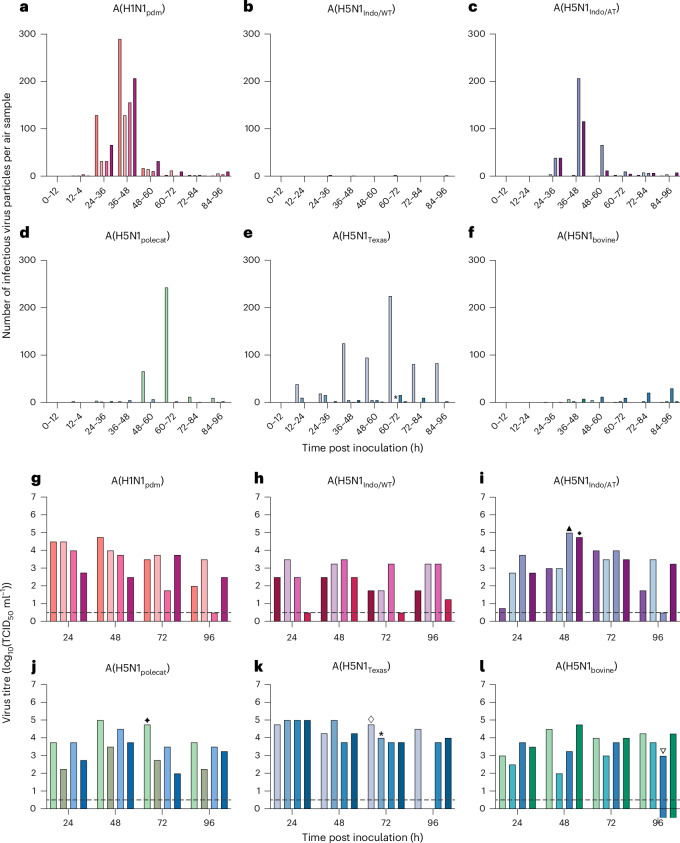
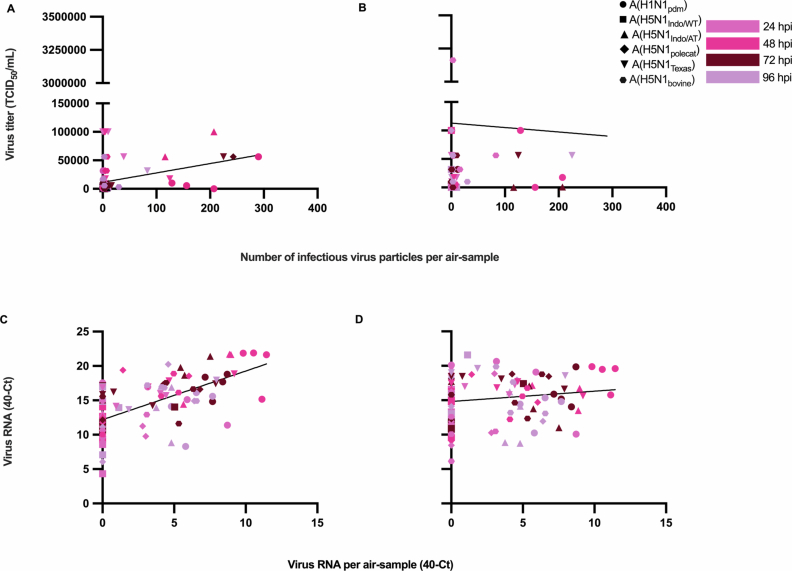
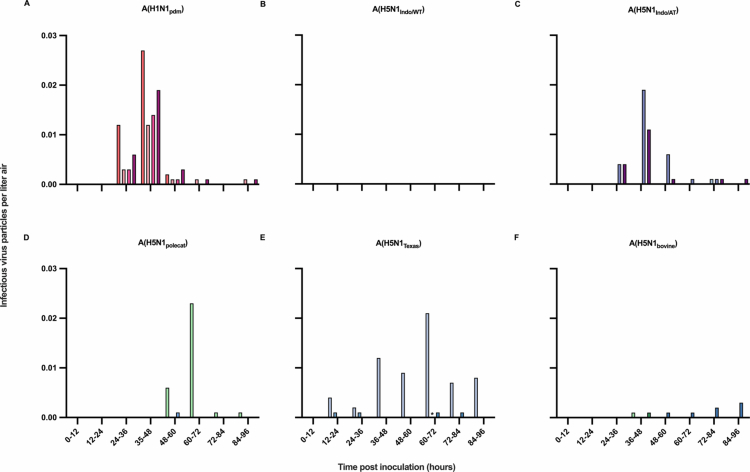
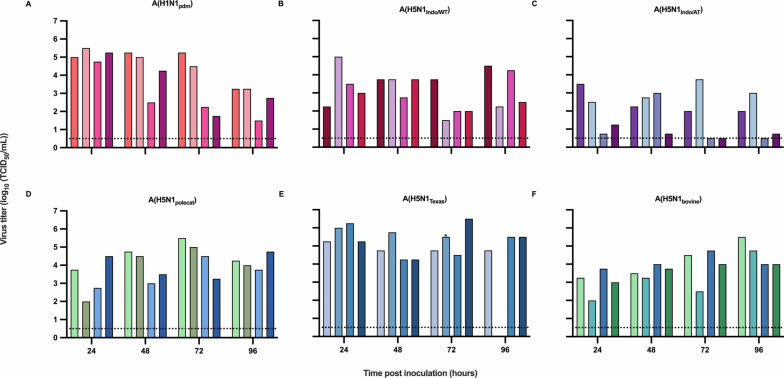
An increase in spillover events of highly pathogenic avian influenza A(H5N1) viruses to mammals suggests selection of viruses that transmit well in mammals. Here we use air-sampling devices to continuously sample infectious influenza viruses expelled by experimentally infected ferrets. The resulting quantitative virus shedding kinetics data resembled ferret-to-ferret transmission studies and indicated that the absence of transmission observed for earlier A(H5N1) viruses was due to a lack of infectious virus shedding in the air, rather than the absence of necessary mammalian adaptation mutations. Whereas infectious human A(H1N1) virus was efficiently shed in the air, infectious 2005 zoonotic and 2024 bovine A(H5N1) viruses were not detected in the air. By contrast, shedding of infectious virus was observed for 1 out of 4 ferrets infected with a 2022 European polecat A(H5N1) virus and a 2024 A(H5N1) virus isolated from a dairy farm worker.
高致病性甲型禽流感(H5N1)病毒向哺乳动物的溢出事件增加,这表明正在选择能在哺乳动物中有效传播的病毒。在这里,我们使用空气采样装置对实验感染雪貂排出的传染性流感病毒进行连续采样。由此获得的定量病毒排出动力学数据类似于雪貂之间的传播研究,并表明早期甲型(H5N1)病毒未观察到传播是由于空气中缺乏传染性病毒排出,而非缺乏必要的哺乳动物适应性突变。传染性人类甲型(H1N1)病毒能有效地在空气中排出,而在空气中未检测到传染性2005年人畜共患的和2024年牛源甲型(H5N1)病毒。相比之下,在感染了2022年欧洲艾鼬甲型(H5N1)病毒和从一名奶农分离出的2024年甲型(H5N1)病毒的4只雪貂中,有1只观察到了传染性病毒的排出。