Vedachalam Srividya K, Siromany Valan A, VanderEnde Daniel, Malpiedi Paul, Vasquez Amber, Dikid Tanzin, Walia Kamini, Mathur Purva
India Epidemic Intelligence Service (EIS) Cell, National Centre for Disease Control (NCDC), New Delhi, India.
South Asia Field Epidemiology and Technology Network (SAFETYNET), New Delhi, India.
Antimicrob Resist Infect Control. 2024 Dec 2;13(1):144. doi: 10.1186/s13756-024-01501-6.
Healthcare-associated bloodstream infections (BSI) threaten patient safety and are the third most common healthcare-associated infection (HAI) in low- and middle-income countries. An intensive-care-unit (ICU) based HAI surveillance network recording BSIs was started in India in 2017. We evaluated this surveillance network's ability to detect BSI to identify best practices, challenges, and opportunities in its implementation.
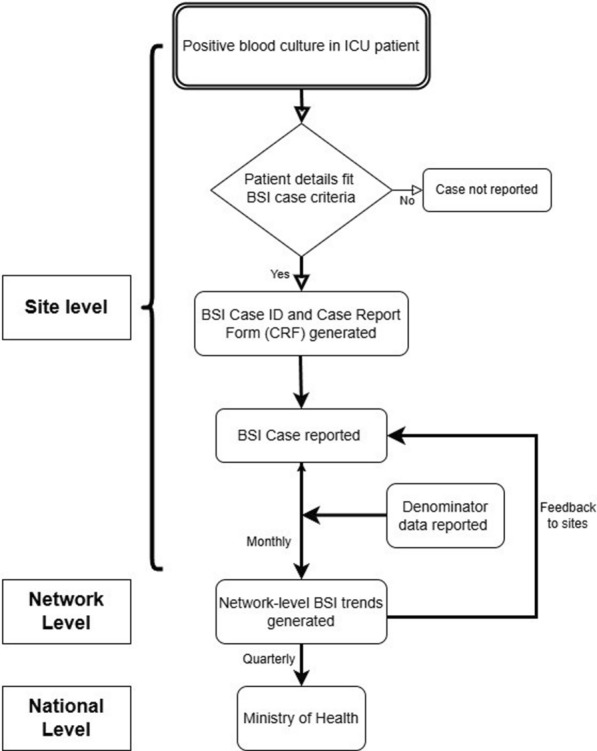
We conducted a mixed-methods descriptive study from January to May 2022 using the CDC guidelines for evaluation. We focused on hospitals reporting BSI surveillance data to the HAI network from May 2017 to December 2021, and collected data through interviews, surveys, record reviews, and site visits. We integrated quantitative and qualitative results and present mixed methods interpretation.
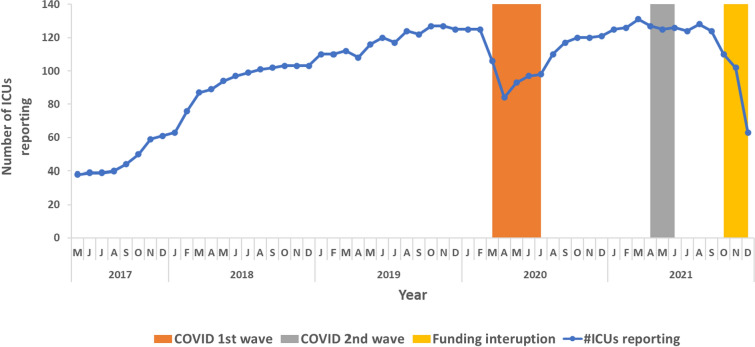
The HAI surveillance network included 39 hospitals across 22 states of India. We conducted 13 interviews, four site visits, and one focus-group discussion and collected 50 survey responses. Respondents included network coordinators, surveillance staff, data entry operators, and ICU physicians. Among surveyed staff, 83% rated the case definitions simple to use. Case definitions were correctly applied in 280/284 (98%) case reports. Among 21 site records reviewed, 24% reported using paper-based forms for laboratory reporting. Interviewees reported challenges, including funding, limited human resources, lack of digitalization, variable blood culture practices, and inconsistent information sharing.
Implementing a standardized HAI surveillance network reporting BSIs in India has been successful, and the case definitions developed were simple. Allocating personnel, digitalizing medical records, improving culturing practices, establishing feedback mechanisms, and funding commitment are crucial for its sustainability.
医疗保健相关血流感染(BSI)威胁患者安全,是低收入和中等收入国家中第三常见的医疗保健相关感染(HAI)。2017年在印度启动了一个基于重症监护病房(ICU)的HAI监测网络,用于记录BSI。我们评估了该监测网络检测BSI的能力,以确定其实施过程中的最佳实践、挑战和机遇。
我们于2022年1月至5月采用美国疾病控制与预防中心的评估指南进行了一项混合方法描述性研究。我们关注2017年5月至2021年12月期间向HAI网络报告BSI监测数据的医院,并通过访谈、调查、记录审查和实地考察收集数据。我们整合了定量和定性结果,并进行了混合方法解读。
HAI监测网络包括印度22个邦的39家医院。我们进行了13次访谈、4次实地考察和1次焦点小组讨论,并收集了50份调查回复。受访者包括网络协调员、监测人员、数据录入操作员和ICU医生。在接受调查的工作人员中,83%认为病例定义易于使用。284份病例报告中有280份(98%)正确应用了病例定义。在审查的21份现场记录中,24%报告使用纸质表格进行实验室报告。受访者报告了一些挑战,包括资金、人力资源有限、缺乏数字化、血培养操作不一以及信息共享不一致。
在印度实施一个报告BSI的标准化HAI监测网络已取得成功,所制定的病例定义很简单。分配人员、将病历数字化、改进培养操作、建立反馈机制和资金投入对其可持续性至关重要。