Aidelbaum Robert, Jagtap Shreya, Rumas Rachel, Shamblaw Amanda L, Best Michael W
Department of Psychological Clinical Science, University of Toronto Scarborough, Toronto, Ontario, Canada.
Centre for Addiction and Mental Health, Toronto, Ontario, Canada.
Early Interv Psychiatry. 2025 Jan;19(1):e13631. doi: 10.1111/eip.13631. Epub 2024 Dec 2.
Evidence highlights the importance of social isolation as a critical yet underserved treatment target for individuals managing psychosis. Schizotypal traits represent a useful model of psychosis, facilitating the assessment of contributors to social isolation without the confounds associated with schizophrenia. This study utilised structural equation modelling to examine the unique predictive capacity of schizotypal traits for subjective and objective indices of social isolation. In addition, the potentially mediating role of negative core schemas and dysfunctional attitudes was assessed.
Structural equation modelling was used to measure and compare the relationships between the constructs of interest simultaneously.
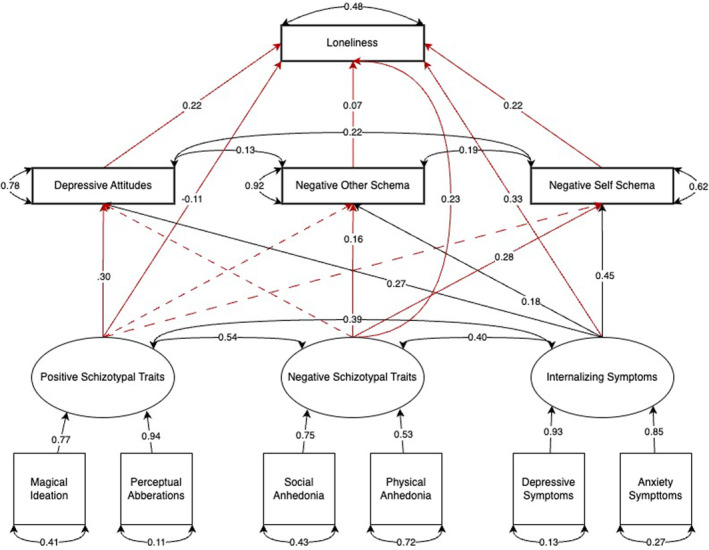
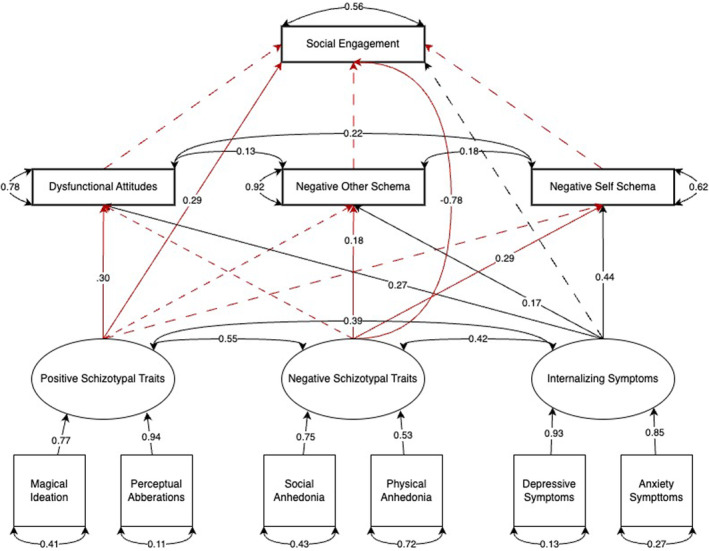
Satisfactory fit indices were attained with separate models predicting loneliness and social engagement. Results support the partial mediation of the relationships between positive and negative traits, internalising symptoms and loneliness. While all three direct pathways were significant, all three were partially mediated. Of note, these mediated effects were not observed in the model predicting social engagement, with the only significant pathways being those directly from positive and negative schizotypal traits.
Schizotypal traits directly predict loneliness and social engagement above that accounted for by internalising symptoms. Cognitive factors partially mediate the relationships between schizotypy and loneliness but not the size of an individual's social network. Cognitive interventions may be well suited for reducing loneliness; however, other approaches may be required to increase social networks for individuals with high levels of schizotypy.
有证据表明,社会隔离作为精神病患者一个关键但未得到充分关注的治疗靶点具有重要意义。分裂型特质是一种有用的精神病模型,有助于在不涉及与精神分裂症相关混淆因素的情况下评估导致社会隔离的因素。本研究利用结构方程模型来检验分裂型特质对社会隔离主观和客观指标的独特预测能力。此外,还评估了消极核心图式和功能失调态度的潜在中介作用。
使用结构方程模型同时测量和比较感兴趣的构念之间的关系。
预测孤独感和社交参与度的单独模型获得了令人满意的拟合指数。结果支持积极和消极特质、内化症状与孤独感之间关系的部分中介作用。虽然所有三条直接路径都具有显著性,但这三条路径均存在部分中介作用。值得注意的是,在预测社交参与度的模型中未观察到这些中介效应,唯一显著的路径是直接来自积极和消极分裂型特质的路径。
分裂型特质直接预测孤独感和社交参与度,其作用超过内化症状所解释的部分。认知因素部分中介了分裂型特质与孤独感之间的关系,但对个体社交网络的规模没有中介作用。认知干预可能非常适合减少孤独感;然而,可能需要其他方法来扩大分裂型特质水平较高个体的社交网络。