Fiori Lorenzo, Davis Randall W, Würsig Bernd, Orbach Dara N
Department of Life Sciences, Texas A&M University-Corpus Christi, Corpus Christi, TX, USA.
Azores Delphis Project, Ponta Delgada, Azores, Portugal.
Sci Rep. 2024 Dec 3;14(1):30056. doi: 10.1038/s41598-024-81920-y.
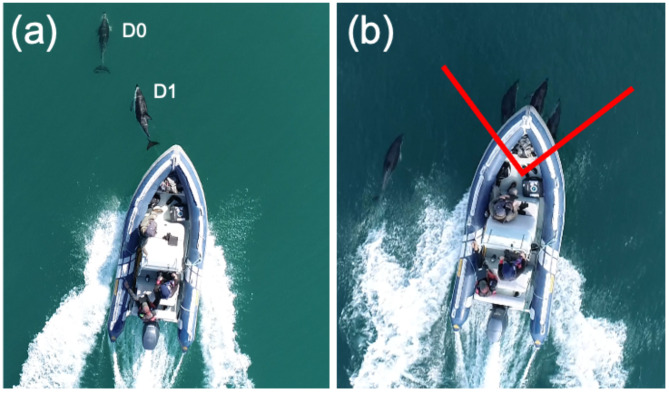
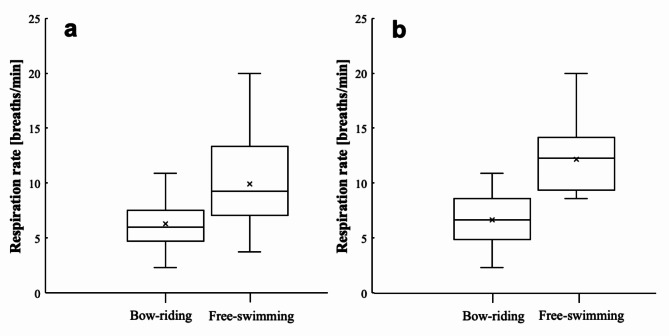
Bow-riding occurs when dolphins swim in the pressure waves at the front of a vessel. Bow-riding is hypothesized to be "fun" for dolphins or to save them energy although the energetics have not been explored. An UAS (Unoccupied Aerial System) was used to follow and video-record adult dusky dolphins (Lagenorhynchus obscurus) bow-riding in front of a research vessel or free-swimming off Kaikoura, New Zealand. Videos of individual dolphins swimming in a linear direction at consistent speeds were analyzed with respiration rate used as a proxy for energy expenditure (bow riding n = 51; free-swimming n = 62). The respiration rates of bow-riding dolphins remained relatively constant across swimming speeds and were 45% lower than free-swimming dolphins at speeds exceeding 4 m/s, indicating substantial energetic savings. The respiration rates of free-swimming dolphins increased exponentially with speed, suggesting that dolphins incur comparatively high energetic expenditures from swimming rapidly. This research advances understanding of the biological function of bow-riding behavior and supports the energy saving hypothesis. Swimming energetics can be used to assess the impacts of anthropogenic disturbances to dolphin energy budgets.
当海豚在船只前方的压力波中游泳时,就会出现乘波现象。尽管尚未对能量学进行研究,但据推测,乘波对海豚来说是“有趣的”,或者能为它们节省能量。使用无人机系统(UAS)跟踪并视频记录了成年暗色斑纹海豚(Lagenorhynchus obscurus)在一艘研究船前乘波或在新西兰凯库拉附近自由游动的情况。对以恒定速度沿直线游动的个体海豚的视频进行了分析,将呼吸频率用作能量消耗的指标(乘波n = 51;自由游动n = 62)。乘波海豚的呼吸频率在不同游泳速度下保持相对恒定,在速度超过4米/秒时,比自由游动的海豚低45% , 这表明能大幅节省能量。自由游动海豚的呼吸频率随速度呈指数增加,这表明海豚快速游动会产生相对较高的能量消耗。这项研究增进了对乘波行为生物学功能的理解,并支持了节能假说。游泳能量学可用于评估人为干扰对海豚能量预算的影响。