Msando Jacob R, Cowen Gill, Harris Sarah A, Kirkham Troy, Murphy Myles C
School of Health Sciences The University of Notre Dame Australia.
Curtin Medical School Curtin University.
Int J Sports Phys Ther. 2024 Dec 2;19(12):1569-1580. doi: 10.26603/001c.125794. eCollection 2024.
The Western Australian Football League (WAFL) introduced a new umpire driven 'blue-card rule' for concussion, but its benefit to the sports medicine team is unknown.
To determine the experiences and perceptions of medical staff within the 2022-2023 Men's and Women's WAFL competitions following the introduction of the 'blue-card rule'.
Cross-sectional study.
An online survey was delivered through Qualtrics to all WAFL medical staff (doctors, physiotherapists, head trainers). The survey contained four sections (demographics, concussion knowledge, concussion exposure and blue-card perceptions) with closed and multiple-answer questions. Standard methods for reporting descriptive data were applied, including mean ± standard deviation (SD) and proportions (%). Between-group differences were assessed using chi-square tests, and significance was accepted at p <0.05.
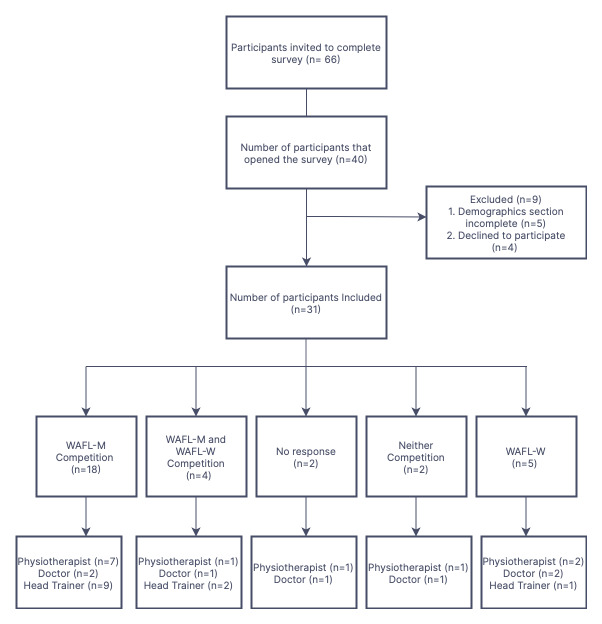
Response rate was 48% (n=7 doctors, n=12 physiotherapists, n=12 head trainers). Most staff (70%) did not agree that the 'blue-card rule' was a helpful concussion policy or should remain within the WAFL. Staff also felt umpires are not qualified to identify suspected concussions on-field (67%). Over two-thirds of medical staff feel the Football Commission needs to provide education about concussion policies before the commencement of each season. Only 33% of medical staff felt completely confident in delivering a sideline assessment, and 17% felt completely confident in their diagnostic capabilities. Relationships between medical and other staff were not substantially impacted by the 'blue-card rule'.
Medical staff within the WAFL reported the 'blue-card rule' as an ineffective concussion identification tool and did not support its continued use for future WAFL seasons. Staff suggested that the Football Commission needs to provide more education on concussion policies before the commencement of each season.
西澳大利亚足球联盟(WAFL)引入了一项由裁判主导的针对脑震荡的“蓝牌规则”,但其对运动医学团队的益处尚不清楚。
确定在引入“蓝牌规则”后,2022 - 2023年WAFL男子和女子比赛中医护人员的经历和看法。
横断面研究。
通过Qualtrics向所有WAFL医护人员(医生、物理治疗师、首席训练师)进行在线调查。该调查包含四个部分(人口统计学、脑震荡知识、脑震荡暴露情况和对蓝牌的看法),设有封闭式和多项选择题。应用报告描述性数据的标准方法,包括均值±标准差(SD)和比例(%)。使用卡方检验评估组间差异,p <0.05时具有统计学意义。
回复率为48%(7名医生、12名物理治疗师、12名首席训练师)。大多数工作人员(70%)不同意“蓝牌规则”是一项有用的脑震荡政策,也不同意该规则应保留在WAFL中。工作人员还认为裁判没有资格在场上识别疑似脑震荡(67%)。超过三分之二的医护人员认为足球委员会需要在每个赛季开始前提供有关脑震荡政策的教育。只有33%的医护人员对进行场边评估完全有信心,17%的医护人员对自己的诊断能力完全有信心。“蓝牌规则”对医护人员与其他工作人员之间的关系没有产生实质性影响。
WAFL的医护人员认为“蓝牌规则”是一种无效的脑震荡识别工具,不支持在未来的WAFL赛季继续使用。工作人员建议足球委员会在每个赛季开始前提供更多有关脑震荡政策的教育。
3级。