Eltyeb Ebtihal E, Alhazmi Sami A, Maafa Shahad H I, Mobarki Sarah J, Sobaikhi Nasser H, Sumayli Rimas A, Alattas Khlood K, Shayani Halah M, Alqahtani Abdullah M, Alhazmi Faris A, Al-Musawa Hafiz I
Pediatrics Department, Faculty of Medicine, Jazan University, Al Maarefah Rd, Jazan, Saudi Arabia.
Medical Students, Faculty of Medicine, Jazan University, Al Maarefah Rd, Jazan, Saudi Arabia.
J Family Med Prim Care. 2024 Oct;13(10):4715-4720. doi: 10.4103/jfmpc.jfmpc_872_24. Epub 2024 Oct 18.
With the advancements in genetic testing, a differentiated evaluation for susceptibility to diseases is becoming applicable to many disorders. Understanding the circumstances and promoting the widespread use of these tests in the Saudi setting requires understanding public opinion and attitudes. This study aimed to determine the perception and attitudes of the public in the Jazan region to genetic testing.
A cross-sectional survey study of 507 participants was conducted in the Jazan region. The data were collected through an online questionnaire containing demographic information and statements assessing public perceptions and attitudes.
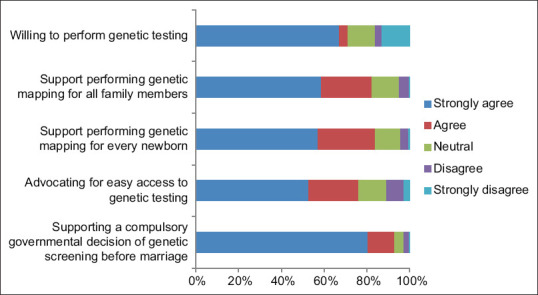
Our findings showed that perspectives toward genetic testing, especially premarital and prenatal testing, are generally positive and consistent with previous research. Approximately 79.1% of the participants had a positive attitude toward supporting a compulsory governmental decision of genetic screening before marriage, and 67.3% were willing to perform such testing in the future. More than half of the participants were willing to allow pregnancy termination if there was a higher probability of genetic disease in the baby. In contrast, only 29.6% agreed with the decision to divorce due to the higher probability of genetic disease in their children. The predictors for a positive attitude to genetic testing were nationality, marital status, and monthly income.
The results of the present study indicate that there are acceptable perspectives and attitudes toward genetic testing, especially premarital and prenatal testing.
随着基因检测技术的进步,针对疾病易感性的差异化评估正适用于多种疾病。了解相关情况并推动这些检测在沙特广泛应用,需要了解公众的意见和态度。本研究旨在确定吉赞地区公众对基因检测的认知和态度。
在吉赞地区对507名参与者进行了横断面调查研究。通过一份包含人口统计学信息以及评估公众认知和态度的陈述的在线问卷收集数据。
我们的研究结果表明,对基因检测,尤其是婚前和产前检测的看法总体上是积极的,与先前的研究一致。约79.1%的参与者对支持政府强制进行婚前基因筛查的决定持积极态度,67.3%的人愿意在未来进行此类检测。超过半数的参与者表示,如果胎儿患遗传病的可能性较高,愿意终止妊娠。相比之下,只有29.6%的人同意因孩子患遗传病可能性较高而决定离婚。对基因检测持积极态度的预测因素是国籍、婚姻状况和月收入。
本研究结果表明,对于基因检测,尤其是婚前和产前检测,存在可接受的观点和态度。