Canu Elisa, Castelnovo Veronica, Aiello Edoardo Nicolò, De Luca Giulia, Sibilla Elisa, Freri Fabiola, Tripodi Chiara, Spinelli Edoardo Gioele, Cecchetti Giordano, Magnani Giuseppe, Caso Francesca, Caroppo Paola, Prioni Sara, Villa Cristina, Tremolizzo Lucio, Appollonio Ildebrando, Verde Federico, Ticozzi Nicola, Silani Vincenzo, Sturm Virginia E, Rankin Katherine P, Gorno-Tempini Maria Luisa, Poletti Barbara, Filippi Massimo, Agosta Federica
Neuroimaging Research Unit, Division of Neuroscience, IRCCS San Raffaele Scientific Institute, Milan, Italy.
Neurology Unit, IRCCS San Raffaele Scientific Institute, Milan, Italy.
Eur J Neurol. 2025 Jan;32(1):e16578. doi: 10.1111/ene.16578.
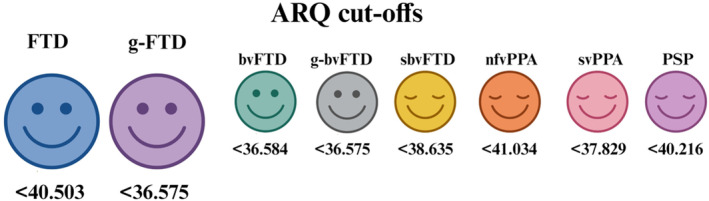
Poor affect recognition is an early sign of frontotemporal dementia (FTD). Here, we applied the abbreviated version of the Comprehensive Affect Testing System (CATS-A) battery to Italian FTD cases and healthy controls (HC) to provide cut-offs of emotional dysfunction in the whole group and in different FTD clinical syndromes.
One hundred thirty-nine FTD patients (60 behavioural variant [bvFTD],13 semantic behavioural variant of FTD [sbvFTD], 28 progressive supranuclear palsy [PSP], 21 semantic [svPPA] and 17 nonfluent [nfvPPA] variants of primary progressive aphasia) and 116 HC were administered the CATS-A, yielding an Affective Recognition Quotient (ARQ), which was used as outcome measure. Age- and education-adjusted, regression-based norms were derived in HC. In patients, the ARQ was assessed for its internal reliability, factorial validity and construct validity by testing its association with another social cognition paradigm, the Story-Based Empath Task (SET). The diagnostic accuracy of the ARQ in discriminating patients from HC, genetic cases from HC and patient groups among each other was tested via ROC analyses.
In the whole FTD cohort, CATS-A proved to be underpinned by a mono-component factor (51.1%) and was internally consistent (McDonald's ω = 0.76). Moreover, the ARQ converged with the SET (r(122) = 0.50; p < 0.001) and optimally discriminated HC from both the whole cohort (AUC = 0.89) and each clinical syndrome (AUC range: 0.83-0.92). Conversely, CATS-A subtests were able to distinguish patient groups.
The ARQ score from the CATS-A distinguishes FTD clinical syndromes from HC with high accuracy, making it an excellent tool for immediate use in clinical practice.
情感识别能力差是额颞叶痴呆(FTD)的早期迹象。在此,我们将综合情感测试系统简版(CATS-A)应用于意大利FTD病例和健康对照(HC),以确定整个群体以及不同FTD临床综合征中情感功能障碍的临界值。
对139例FTD患者(60例行为变异型 [bvFTD]、13例语义行为变异型FTD [sbvFTD]、28例进行性核上性麻痹 [PSP]、21例原发性进行性失语的语义变异型 [svPPA] 和17例非流利型 [nfvPPA] 变异型)和116例HC进行CATS-A测试,得出情感识别商数(ARQ),将其用作结果指标。在HC中得出年龄和教育程度调整后的基于回归的常模。在患者中,通过测试ARQ与另一种社会认知范式——基于故事的共情任务(SET)的关联来评估其内部信度、因子效度和结构效度。通过ROC分析测试ARQ在区分患者与HC、基因病例与HC以及患者群体之间的诊断准确性。
在整个FTD队列中,CATS-A被证明由单成分因子支撑(51.1%)且内部一致(麦克唐纳ω = 0.76)。此外,ARQ与SET相关(r(122) = 0.50;p < 0.001),并能最佳地区分HC与整个队列(AUC = 0.89)以及各临床综合征(AUC范围:0.83 - 0.92)。相反,CATS-A子测试能够区分患者群体。
CATS-A的ARQ分数能高精度地区分FTD临床综合征与HC,使其成为临床实践中可立即使用的优秀工具。