Zhang Xueying, Liu Feiyan, Zhou Yu
College of Life Sciences, TaiKang Center for Life and Medical Sciences, Hubei Key Laboratory of Cell Homeostasis, RNA Institute, Wuhan University, Wuhan 430072, China.
Frontier Science Center for Immunology and Metabolism, Wuhan University, Wuhan 430072, China.
Acta Biochim Biophys Sin (Shanghai). 2024 Dec 3;57(1):22-32. doi: 10.3724/abbs.2024211.
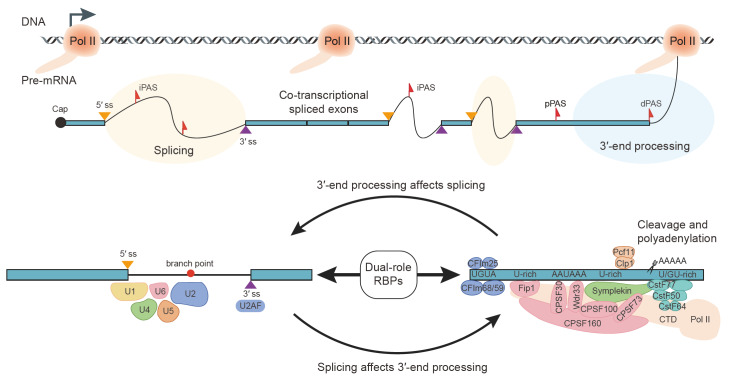
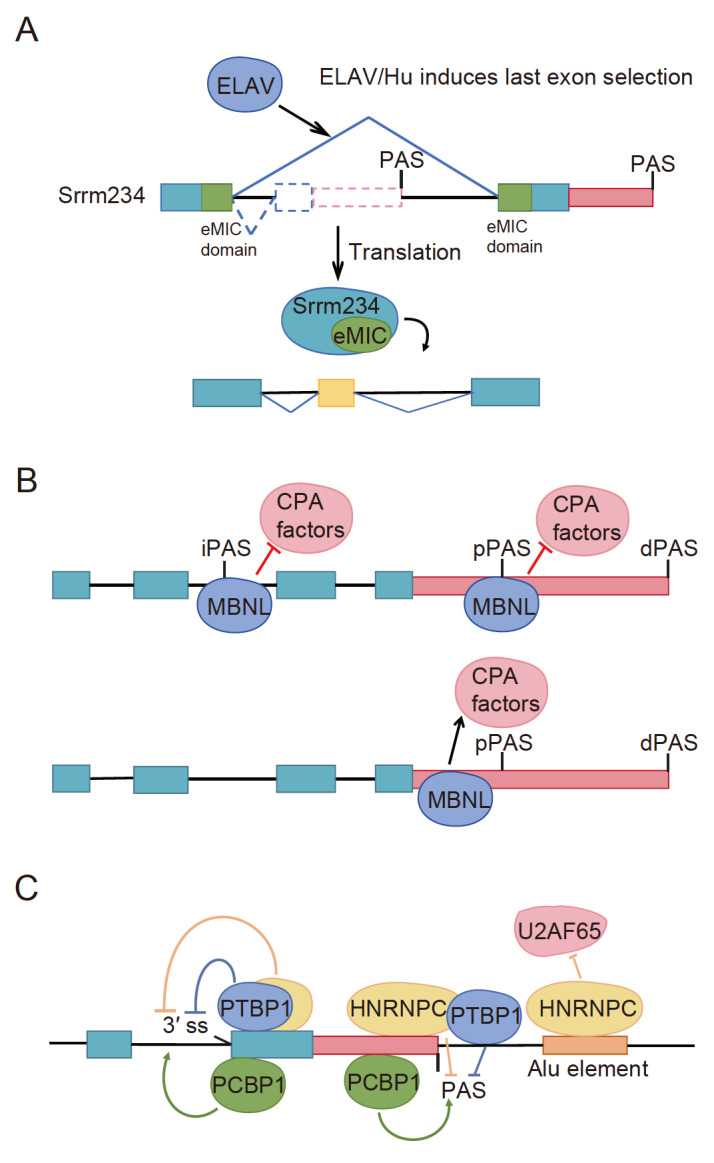
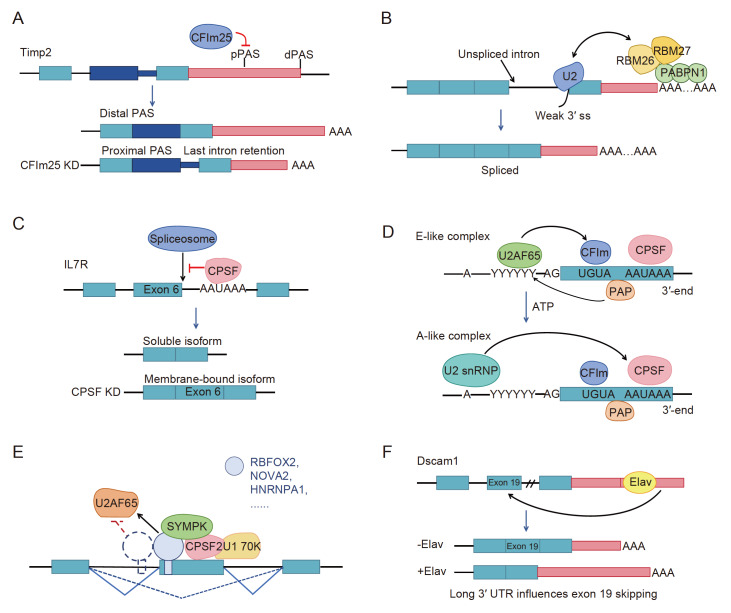
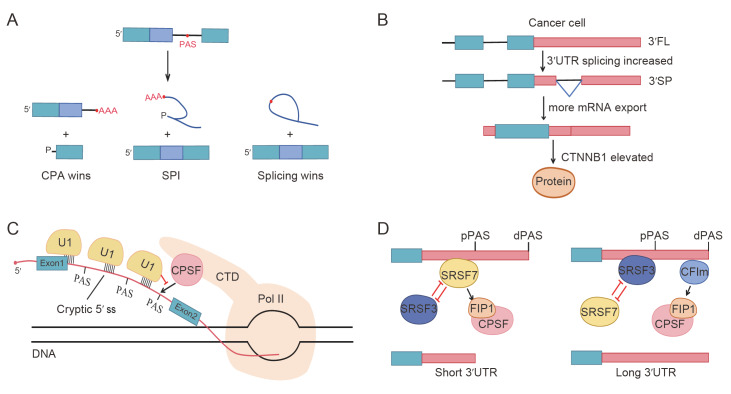
RNA splicing and 3'-cleavage and polyadenylation (CPA) are essential processes for the maturation of RNA. There have been extensive independent studies of these regulated processing events, including alternative splicing (AS) and alternative polyadenylation (APA). However, growing evidence suggests potential crosstalk between splicing and 3'-end processing in regulating AS or APA. Here, we first provide a brief overview of the molecular machines involved in splicing and 3'-end processing events, and then review recent studies on the functions and mechanisms of the crosstalk between the two processes. On the one hand, 3'-end processing can affect splicing, as 3'-end processing factors and CPA-generated polyA tail promote the splicing of the last intron. Beyond that, 3'-end processing factors can also influence the splicing of internal and terminal exons. Those 3'-end processing factors can also interact with different RNA-binding proteins (RBPs) to exert their effects on AS. The length of 3' untranslated region (3' UTR) can affect the splicing of upstream exons. On the other hand, splicing and CPA may compete within introns in generating different products. Furthermore, splicing within the 3' UTR is a significant factor contributing to 3' UTR diversity. Splicing also influences 3'-end processing through the actions of certain splicing factors. Interestingly, some classical RBPs play dual roles in both splicing and 3'-end processing. Finally, we discuss how long-read sequencing technologies aid in understanding the coordination of AS-APA events and envision that these findings may potentially promote the development of new strategies for disease diagnosis and treatment.
RNA剪接以及3'端切割和聚腺苷酸化(CPA)是RNA成熟的关键过程。对这些受调控的加工事件,包括可变剪接(AS)和可变聚腺苷酸化(APA),已经有了广泛的独立研究。然而,越来越多的证据表明,在调控AS或APA过程中,剪接和3'端加工之间可能存在相互作用。在此,我们首先简要概述参与剪接和3'端加工事件的分子机制,然后回顾关于这两个过程之间相互作用的功能和机制的最新研究。一方面,3'端加工可以影响剪接,因为3'端加工因子和CPA产生的聚A尾促进最后一个内含子的剪接。除此之外,3'端加工因子还可以影响内部和末端外显子的剪接。这些3'端加工因子还可以与不同的RNA结合蛋白(RBP)相互作用,从而对AS产生影响。3'非翻译区(3'UTR)的长度可以影响上游外显子的剪接。另一方面,剪接和CPA可能在内含子内竞争以产生不同的产物。此外,3'UTR内的剪接是导致3'UTR多样性的一个重要因素。剪接还通过某些剪接因子的作用影响3'端加工。有趣的是,一些经典的RBP在剪接和3'端加工中都发挥着双重作用。最后,我们讨论了长读长测序技术如何有助于理解AS-APA事件的协调,并设想这些发现可能会推动疾病诊断和治疗新策略的发展。