Guo Lange, Nan Yukui, Liang Kangni, Yao Lizhong, Li Jiuzhi
Department of Urology, People's Hospital of Xinjiang Uygur Autonomous Region, Ürümqi, China.
Graduate School, Zhejiang Chinese Medical University, Hangzhou, China.
Front Nutr. 2024 Nov 20;11:1500705. doi: 10.3389/fnut.2024.1500705. eCollection 2024.
Polyunsaturated fatty acids (PUFAs) play a crucial role in maintaining homeostasis in the body. However, research on the relationship between PUFA intake and estradiol levels is limited. This study aims to investigate the association between dietary PUFA intake and estradiol levels in women in the United States.
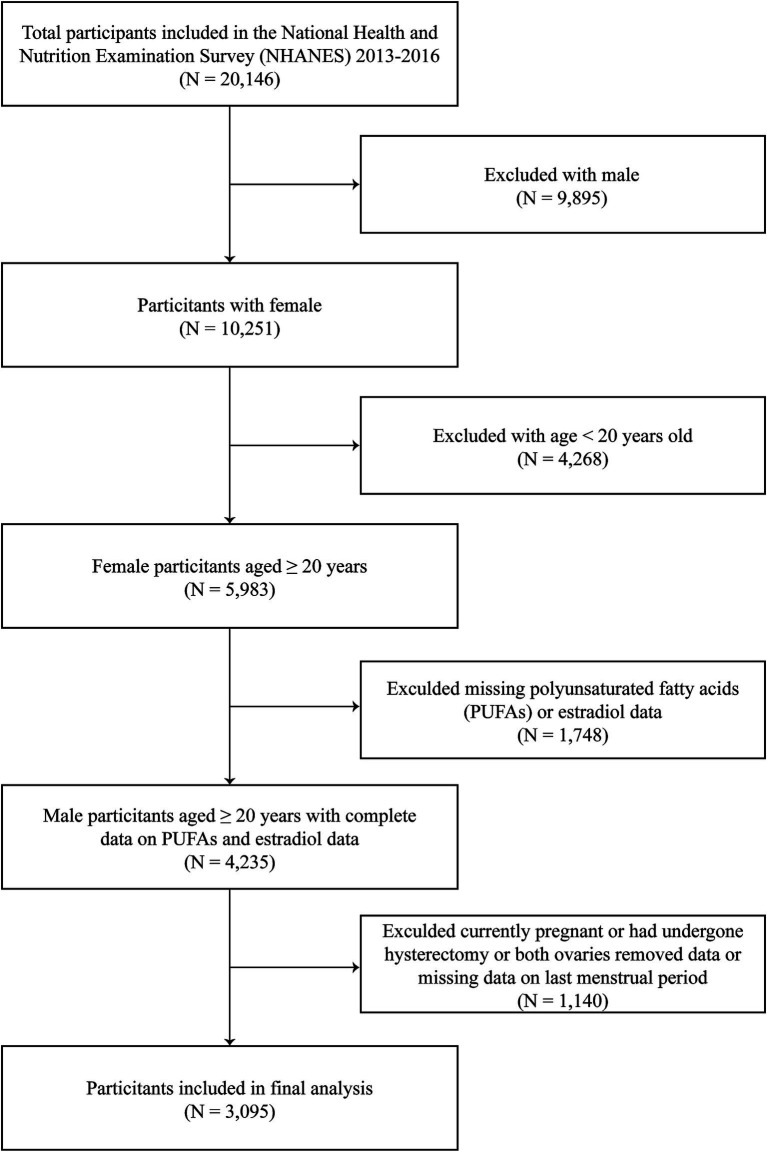
Data on PUFA intake and estradiol levels were drawn from the 2013-2016 National Health and Nutrition Examination Survey (NHANES) for women aged 20 and older. UFA intake was assessed through 24-h dietary interviews, while serum estradiol levels were measured using isotope dilution liquid chromatography-tandem mass spectrometry (ID-LC-MS/MS). Weighted logistic regression models adjusted for covariates were used to analyze the relationship between PUFA intake and estradiol levels. The inflection point of the non-linear relationship between intake of PUFAs and estradiol levels was determined by threshold effects analysis, and a two-part regression model was developed at the inflection point.
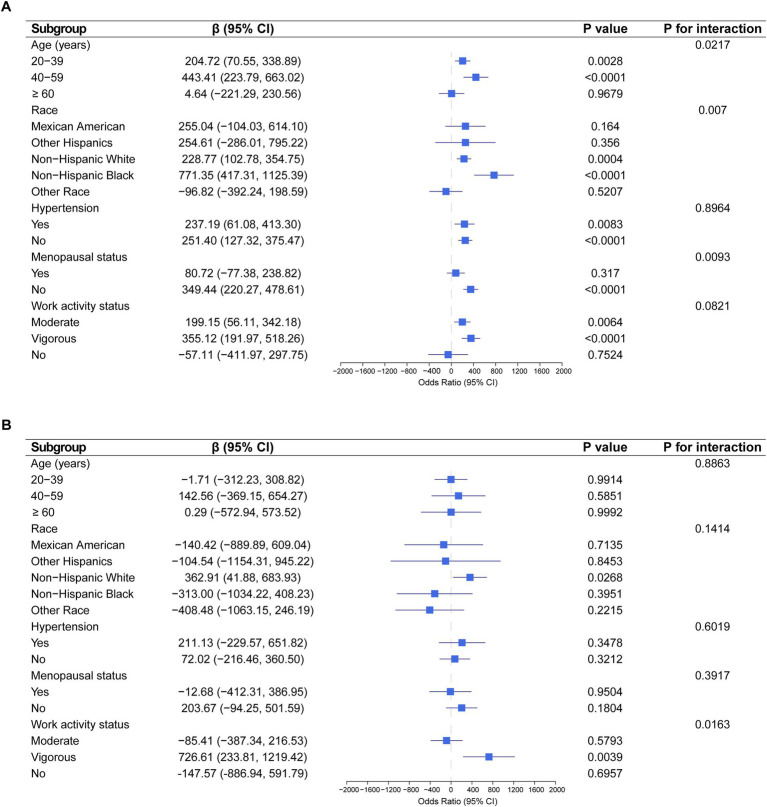
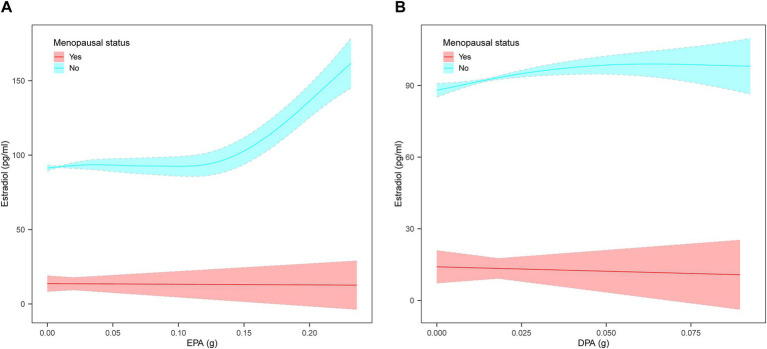
Weighted multivariate linear regressions showed positive associations between eicosapentaenoic acid (EPA) and docosapentaenoic acid (DPA) intake and estradiol levels. Even in the fully adjusted model, EPA intake remained positively associated with estradiol levels in the menopausal ( = 78.08, 95% CI: 33.58, 122.58; = 0.0006), non-menopausal ( = 287.61, 95% CI: 177.29, 397.94; < 0.0001), and total-participant groups ( = 208.38, 95% CI: 139.81, 276.95; < 0.0001), and DPA intake remained positively associated with estradiol levels in the non-menopausal ( = 318.87, 95% CI: 28.93, 608.82; = 0.0313) and total-participant groups ( = 208.03, 95% CI: 22.89, 393.18; = 0.0277). In the two-part regression model, EPA intake greater than 0.09 ( < 0.0001) and DPA intake greater than 0.05 ( = 0.0033) were positively associated with estradiol levels in non-menopausal women.
This study suggests that higher intake of EPA and DPA in non-menopausal women is associated with increased estradiol levels. These findings support the importance of dietary components in regulating female reproductive health and hormone levels.
多不饱和脂肪酸(PUFAs)在维持人体体内平衡方面发挥着关键作用。然而,关于PUFA摄入量与雌二醇水平之间关系的研究有限。本研究旨在调查美国女性饮食中PUFA摄入量与雌二醇水平之间的关联。
关于PUFA摄入量和雌二醇水平的数据取自2013 - 2016年全国健康与营养检查调查(NHANES)中20岁及以上女性的数据。通过24小时饮食访谈评估UFA摄入量,同时使用同位素稀释液相色谱 - 串联质谱法(ID - LC - MS/MS)测量血清雌二醇水平。使用针对协变量进行调整的加权逻辑回归模型来分析PUFA摄入量与雌二醇水平之间的关系。通过阈值效应分析确定PUFAs摄入量与雌二醇水平之间非线性关系的拐点,并在该拐点处建立两部分回归模型。
加权多元线性回归显示,二十碳五烯酸(EPA)和二十二碳五烯酸(DPA)摄入量与雌二醇水平呈正相关。即使在完全调整模型中,EPA摄入量在绝经组(β = 78.08,95% CI:33.58,122.58;P = 0.0006)、非绝经组(β = 287.61,95% CI:177.29,397.94;P < 0.0001)和总参与组(β = 208.38,95% CI:139.81,276.95;P < 0.0001)中仍与雌二醇水平呈正相关,DPA摄入量在非绝经组(β = 318.87,95% CI:28.93,608.82;P = 0.0313)和总参与组(β = 208.03,95% CI:22.89,393.18;P = 0.0277)中仍与雌二醇水平呈正相关。在两部分回归模型中,非绝经女性中EPA摄入量大于0.09(P < 0.0001)和DPA摄入量大于0.05(P = 0.0033)与雌二醇水平呈正相关。
本研究表明,非绝经女性中较高的EPA和DPA摄入量与雌二醇水平升高有关。这些发现支持了饮食成分在调节女性生殖健康和激素水平方面的重要性。