Amber Tazein, Tabassum Saadia, Mahmood Saad Bin Zafar, Ali Syed Ahsan, Javed Umair, Mushtaq Muhammad Zain
Tazein Amber, MBBS, FCPS, SCE(Derm)UK. Section of Dermatology, Department of Medicine, Aga Khan University Hospital, Karachi, Pakistan.
Saadia Tabassum, MBBS, FCPS. Section of Dermatology, Department of Medicine, Aga Khan University Hospital, Karachi, Pakistan.
Pak J Med Sci. 2024 Dec;40(11):2495-2501. doi: 10.12669/pjms.40.11.9360.
BACKGROUND & OBJECTIVE: Blood Stream Infections (BSI) are considered a significant cause of morbidity and mortality in patients with Stevens Johnson Syndrome (SJS) and Toxic Epidermal Necrolysis (TEN). We aimed to identify risk factors for BSI upon admission, highlight clinical and microbiological findings and ascertain the frequency of mortality in patients with BSI in SJS/TEN.
A retrospective cross-sectional study over 12 years (2011-2022) was performed in the department of medicine at a tertiary care hospital in Pakistan. All patients admitted with the diagnosis of SJS or TEN were included: from the health information management system. We included clinical and microbiological details, reviewed medical charts, and filled out a predesigned proforma.
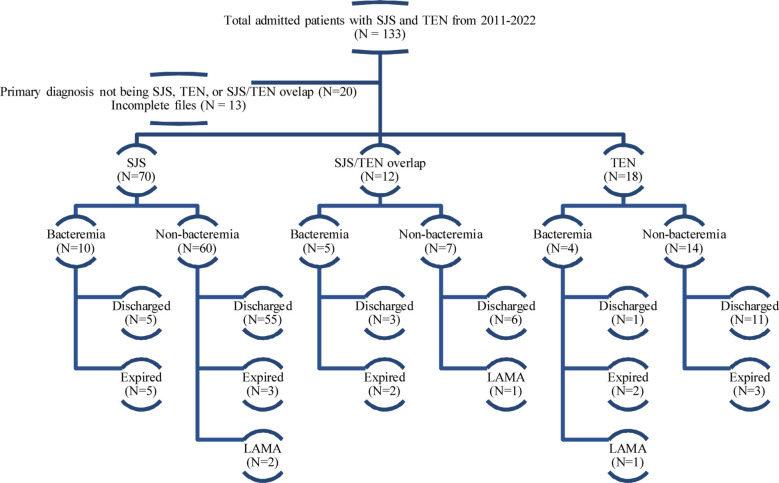
A total of 100 patients were admitted with SJS or TEN. The majority (55%) were of age greater than 40 years and had female preponderance (57%). Sixty five patients had a prior history of using a precipitating drug. BSI was seen in 19 patients; 68.4% had a mono-microbial infection, while 31.5% had a poly-microbial infection. In total, 10 organisms were identified, being the most common isolate followed by . Twelve patients required intensive care monitoring while 33 patients had hospital stays of equal or more than seven days. The overall mortality rate was 15% while it was 60% in those with BSI. SCORTEN score of ≥4 had a significant impact on mortality (60% deaths).
Vigilant monitoring and early detection of BSI in SJS/TEN patients, especially those presenting with high SCORTEN scores can enhance clinical outcomes.
血流感染(BSI)被认为是史蒂文斯-约翰逊综合征(SJS)和中毒性表皮坏死松解症(TEN)患者发病和死亡的重要原因。我们旨在确定入院时BSI的危险因素,突出临床和微生物学发现,并确定SJS/TEN患者中BSI的死亡率。
在巴基斯坦一家三级护理医院的内科进行了一项为期12年(2011 - 2022年)的回顾性横断面研究。纳入所有诊断为SJS或TEN的入院患者:来自健康信息管理系统。我们纳入了临床和微生物学细节,查阅了病历,并填写了预先设计的表格。
共有100例患者因SJS或TEN入院。大多数(55%)年龄大于40岁,女性占优势(57%)。65例患者有使用诱发药物的既往史。19例患者出现BSI;68.4%为单一微生物感染,而31.5%为多微生物感染。总共鉴定出10种微生物, 是最常见的分离株,其次是 。12例患者需要重症监护监测,33例患者住院时间等于或超过7天。总体死亡率为15%,而BSI患者的死亡率为60%。SCORTEN评分≥4对死亡率有显著影响(60%死亡)。
对SJS/TEN患者,尤其是SCORTEN评分高的患者进行BSI的密切监测和早期检测可改善临床结局。