
精神病谱系疾病作为前额叶关键期可塑性障碍。
Psychosis spectrum illnesses as disorders of prefrontal critical period plasticity.
机构信息
Department of Psychiatry & Behavioral Science, University of Minnesota Medical School, Minneapolis, MN, USA.
Department of Neuroscience, University of Minnesota Medical School, Minneapolis, MN, USA.
出版信息
Neuropsychopharmacology. 2023 Jan;48(1):168-185. doi: 10.1038/s41386-022-01451-w. Epub 2022 Sep 30.
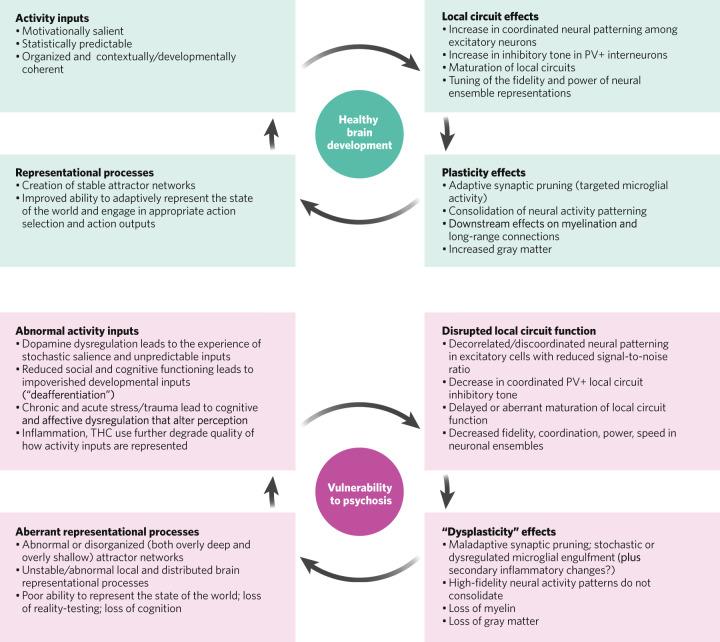
Emerging research on neuroplasticity processes in psychosis spectrum illnesses-from the synaptic to the macrocircuit levels-fill key gaps in our models of pathophysiology and open up important treatment considerations. In this selective narrative review, we focus on three themes, emphasizing alterations in spike-timing dependent and Hebbian plasticity that occur during adolescence, the critical period for prefrontal system development: (1) Experience-dependent dysplasticity in psychosis emerges from activity decorrelation within neuronal ensembles. (2) Plasticity processes operate bidirectionally: deleterious environmental and experiential inputs shape microcircuits. (3) Dysregulated plasticity processes interact across levels of scale and time and include compensatory mechanisms that have pathogenic importance. We present evidence that-given the centrality of progressive dysplastic changes, especially in prefrontal cortex-pharmacologic or neuromodulatory interventions will need to be supplemented by corrective learning experiences for the brain if we are to help people living with these illnesses to fully thrive.
精神分裂症谱系疾病中神经可塑性过程的新兴研究——从突触到宏观回路水平——填补了我们病理生理学模型中的关键空白,并为重要的治疗考虑因素提供了依据。在本次选择性叙述性综述中,我们重点关注三个主题,强调了在青少年时期(前额叶系统发育的关键时期)发生的、与尖峰时间依赖性和海伯可塑性改变有关的内容:(1)神经元集合内活动去相关导致精神分裂症中出现经验依赖性的畸形。(2)可塑性过程双向运作:有害的环境和经验性输入塑造微电路。(3)失调的可塑性过程在规模和时间上相互作用,包括具有发病重要性的代偿机制。我们提出的证据表明——鉴于进行性畸形变化的核心性,特别是在前额叶皮层——如果我们要帮助患有这些疾病的人充分茁壮成长,那么药物或神经调节干预将需要辅以纠正性学习体验。


 Zotero 插件