Felicelli Andrea, Wang Jie, Feng Dudong, Forti Endrina, El Awad Azrak Sami, Peoples Joseph, Youngblood Jeffrey, Chiu George, Ruan Xiulin
School of Mechanical Engineering and Birck Nanotechnology Center, Purdue University, West Lafayette, IN, USA.
Nanophotonics. 2024 Jan 23;13(5):639-648. doi: 10.1515/nanoph-2023-0642. eCollection 2024 Mar.
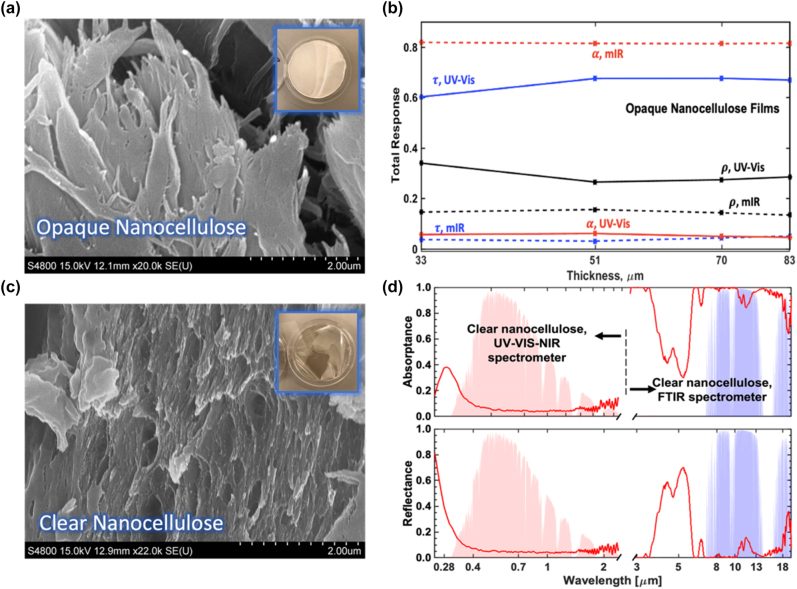
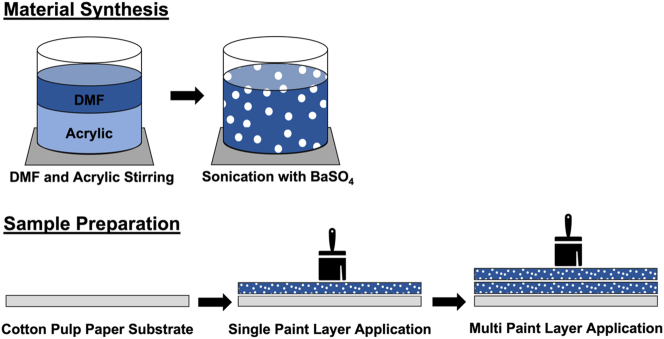
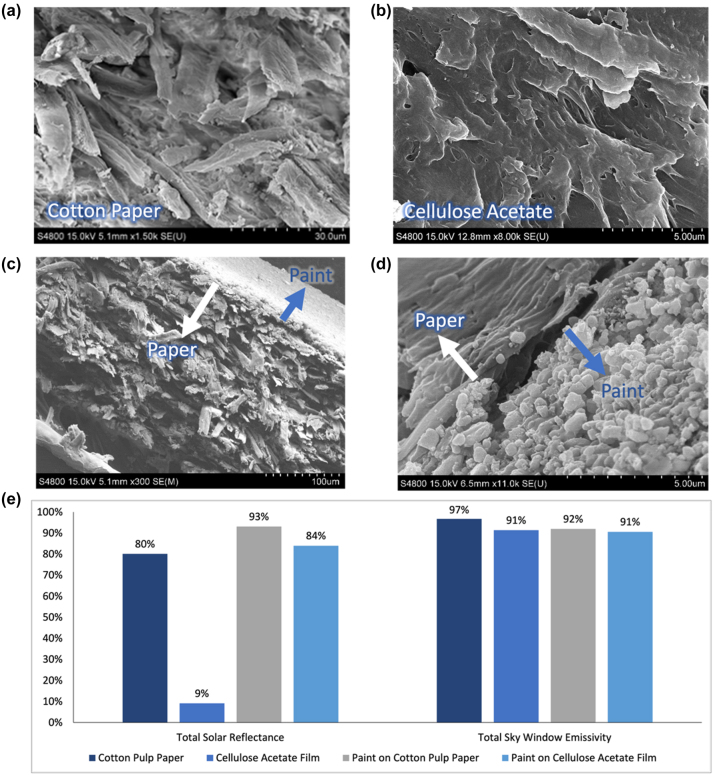
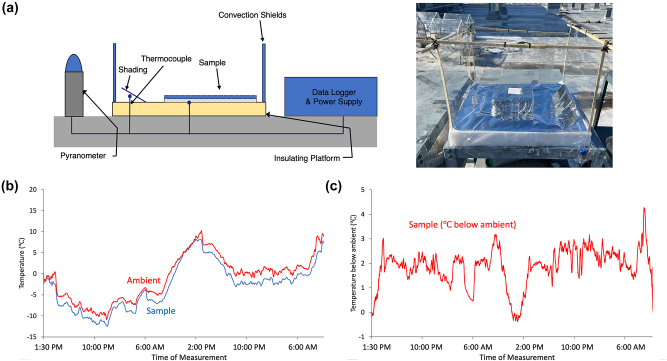
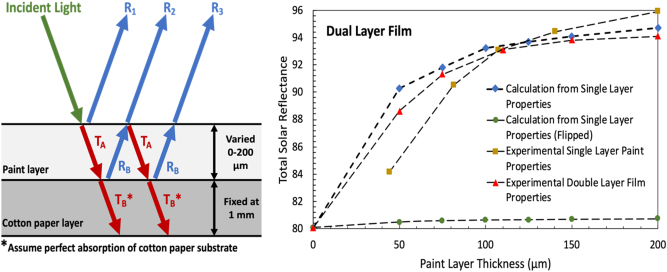
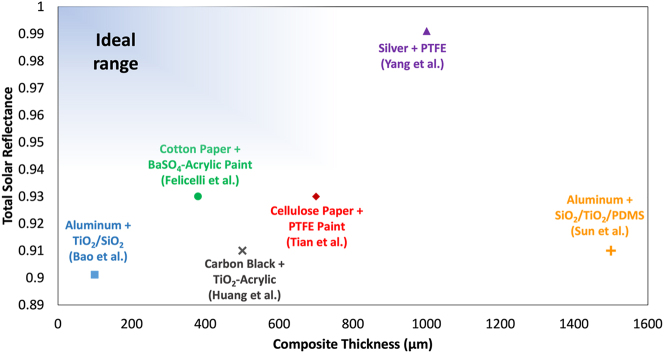
Many materials have been explored for the purpose of creating structures with high radiative cooling potential, such as nanocellulose-based structures and nanoparticle-based coatings, which have been reported with environmentally friendly attributes and high solar reflectance in current literature. They each have their own advantages and disadvantages in practice. It is worth noting that nanocellulose-based structures have an absorption peak in the UV wavelengths, which results in a lower total solar reflectance and, consequently, reduce radiative cooling capabilities. However, the interwoven-fiber structure of cellulose gives high mechanical strength, which promotes its application in different scenarios. The application of nanoplatelet-based coatings is limited due to the need for high volume of nanoparticles to reach their signature high solar reflectance. This requirement weakens the polymer matrix and results in more brittle structures. This work proposes a dual-layer system, comprising of a cellulose-based substrate as the bottom layer and a thin nanoparticle-based radiative cooling paint as the top layer, where both radiative cooling potential and mechanical strength can be maximized. Experimental and theoretical studies are conducted to investigate the relationship between thickness and reflectance in the top coating layer with a consistent thickness of the bottom layer. The saturation point is identified in this relationship and used to determine the optimal thickness for the top-layer to maximize material use efficiency. With the use of cotton paper painted with a 125 μm BaSO-based layer, the cooling performance is enhanced to be 149.6 W/m achieved by the improved total solar reflectance from 80 % to 93 %.
为了制造具有高辐射冷却潜力的结构,人们探索了许多材料,如基于纳米纤维素的结构和基于纳米颗粒的涂层,目前的文献报道它们具有环境友好特性和高太阳反射率。在实际应用中,它们各有优缺点。值得注意的是,基于纳米纤维素的结构在紫外波长处有一个吸收峰,这导致总太阳反射率较低,从而降低了辐射冷却能力。然而,纤维素的交织纤维结构赋予了其较高的机械强度,这促进了它在不同场景中的应用。基于纳米片涂层的应用受到限制,因为需要大量的纳米颗粒才能达到其标志性的高太阳反射率。这一要求削弱了聚合物基体,导致结构更脆。这项工作提出了一种双层系统,由作为底层的纤维素基基材和作为顶层的薄纳米颗粒基辐射冷却涂料组成,在该系统中,辐射冷却潜力和机械强度都可以最大化。进行了实验和理论研究,以研究底层厚度一致时顶层涂层厚度与反射率之间的关系。在这种关系中确定了饱和点,并用于确定顶层的最佳厚度,以最大限度地提高材料使用效率。使用涂有125μm硫酸钡层的棉纸,通过将总太阳反射率从80%提高到93%,冷却性能提高到149.6W/m。