Glass Hannah C, Wood Thomas R, Comstock Bryan A, Numis Adam L, Bonifacio Sonia L, Cornet Marie-Coralie, Gonzalez Fernando F, Morell Adriana, Kolnik Sarah E, Li Yi, Mathur Amit, Mietzsch Ulrike, Wu Tai-Wei, Wusthoff Courtney J, Thoresen Marianne, Heagerty Patrick J, Juul Sandra E, Wu Yvonne W
Department of Neurology, Weill Institute for Neuroscience, University of California, San Francisco.
Department of Pediatrics, UCSF Benioff Children's Hospital, University of California, San Francisco.
JAMA Netw Open. 2024 Dec 2;7(12):e2449188. doi: 10.1001/jamanetworkopen.2024.49188.
Outcomes after hypoxic-ischemic encephalopathy (HIE) are variable. Predicting death or severe neurodevelopmental impairment (NDI) in affected neonates is crucial for guiding management and parent communication.
To predict death or severe NDI in neonates who receive hypothermia for HIE.
DESIGN, SETTING, AND PARTICIPANTS: This prognostic study included participants enrolled in a large US clinical trial conducted in US neonatal intensive care units who were born between January 2017 and October 2019 and followed up to age 2 years. Eligible participants were neonates with moderate-severe HIE born at 36 weeks or more gestation and with 2-year outcome data. Data were analyzed June 2023. External validation was performed with a UK cohort.
Clinical, electroencephalography (EEG), and magnetic resonance imaging (MRI) variables were curated and examined at 24 hours and following cooling.
Death or severe NDI at age 2 years. Severe NDI was defined as Bayley Scales of Infant Toddler Development cognitive score below 70, Gross Motor Function Classification System score of 3 or higher, or quadriparesis. Model performance metrics were derived from training, internal, and external validation datasets.
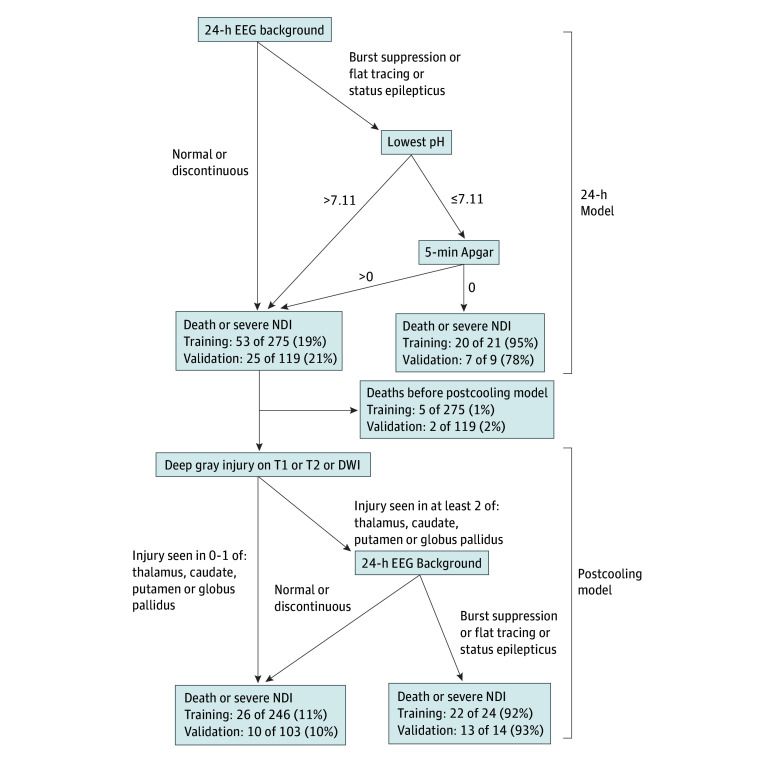
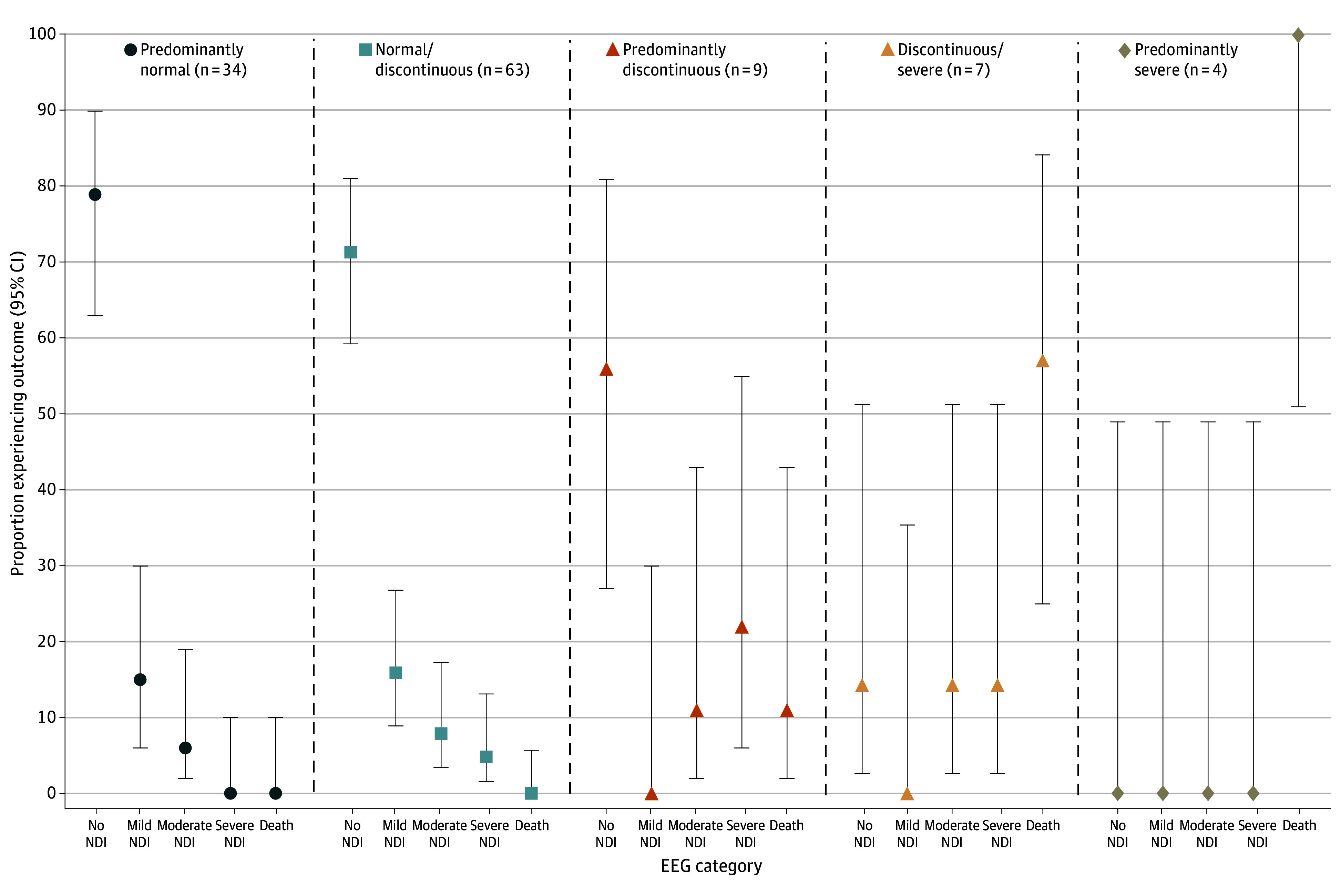
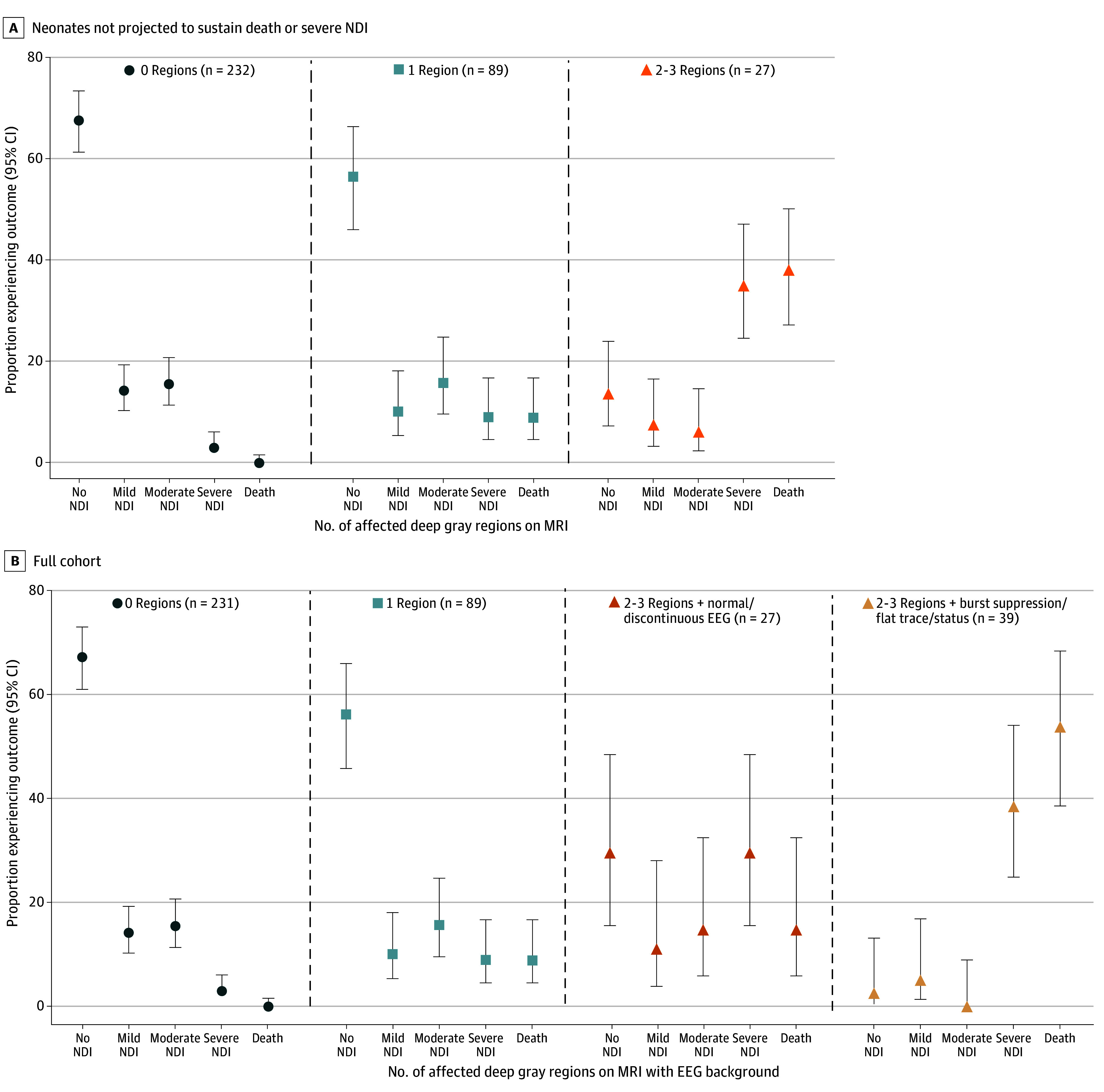
Among 424 neonates (mean [SD] gestational age, 39.1 [1.4] weeks; 192 female [45.3%]; 28 Asian [6.6%], 50 Black [11.8%], 311 White [73.3%]), 105 (24.7%) had severe encephalopathy at enrollment. Overall, 59 (13.9%) died and 46 (10.8%) had severe NDI. In the 24-hour model, the combined presence of 3 clinical characteristics-(1) severely abnormal EEG, (2) pH level of 7.11 or below, and (3) 5-minute Apgar score of 0-had a specificity of 99.6% (95% CI, 97.5%-100%) and a positive predictive value (PPV) of 95.2% (95% CI, 73.2%-99.3%). Validation model metrics were 97.9% (95% CI, 92.7%-99.8%) for internal specificity, with a PPV of 77.8% (95% CI, 43.4%-94.1%), and 97.6% (95% CI, 95.1%-99.0%) for external specificity, with a PPV of 46.2% (95% CI, 23.3%-70.8%). In the postcooling model, specificity for T1, T2, or diffusion-weighted imaging (DWI) abnormality in at least 2 of 3 deep gray regions (ie, thalamus, caudate, putamen and/or globus pallidus) plus a severely abnormal EEG within the first 24 hours was 99.1% (95% CI, 96.8%-99.9%), with a PPV of 91.7% (95% CI, 72.8%-97.8%). Internal specificity in this model was 98.9% (95% CI, 94.1%-100%), with a PPV of 92.9% (95% CI, 64.2%-99.0%); external specificity was 98.6% (95% CI, 96.5%-99.6%), with a PPV of 83.3% (95% CI, 64.1%-93.4%).
In this prognostic study of neonates with moderate or severe HIE who were treated with therapeutic hypothermia, simple models using readily available clinical, EEG, and MRI results during the hospital admission had high specificity and PPV for death or severe NDI at age 2 years.
缺氧缺血性脑病(HIE)后的预后各不相同。预测受影响新生儿的死亡或严重神经发育障碍(NDI)对于指导治疗和与家长沟通至关重要。
预测接受亚低温治疗的HIE新生儿的死亡或严重NDI。
设计、地点和参与者:这项预后研究纳入了参加美国一项大型临床试验的参与者,该试验在美国新生儿重症监护病房进行,研究对象为2017年1月至2019年10月出生且随访至2岁的新生儿。符合条件的参与者为孕36周或以上出生、患有中度至重度HIE且有2年结局数据的新生儿。数据于2023年6月进行分析。使用英国队列进行外部验证。
在24小时及降温后整理并检查临床、脑电图(EEG)和磁共振成像(MRI)变量。
2岁时的死亡或严重NDI。严重NDI定义为贝利婴幼儿发育量表认知得分低于70、粗大运动功能分类系统得分3或更高或四肢瘫痪。模型性能指标来自训练、内部和外部验证数据集。
424例新生儿(平均[标准差]胎龄39.1[1.4]周;192例女性[45.3%];28例亚洲人[6.6%],50例黑人[11.8%],311例白人[73.3%])中,105例(24.7%)在入组时有严重脑病。总体而言,59例(13.9%)死亡,46例(10.8%)有严重NDI。在24小时模型中,3种临床特征同时存在——(1)脑电图严重异常,(2)pH值为7.11或更低,(3)5分钟阿氏评分0——特异性为99.6%(95%CI,97.5%-100%),阳性预测值(PPV)为95.2%(95%CI,73.2%-99.3%)。内部验证模型的特异性为97.9%(95%CI,92.7%-99.8%),PPV为77.8%(95%CI。43.4%-94.1%),外部验证模型的特异性为97.6%(95%CI,95.1%-99.0%),PPV为46.2%(95%CI,23.3%-70.8%)。在降温后模型中,3个深部灰质区域(即丘脑、尾状核、壳核和/或苍白球)中至少2个区域的T1、T2或扩散加权成像(DWI)异常加上入院后24小时内脑电图严重异常的特异性为99.1%(95%CI,96.8%-99.9%),PPV为91.7%(95%CI,72.8%-97.8%)。该模型的内部特异性为98.9%(95%CI,94.1%-100%),PPV为92.9%(95%CI,64.2%-99.0%);外部特异性为98.6%(95%CI,96.5%-99.6%),PPV为83.3%(95%CI,64.1%-93.4%)。
在这项对接受治疗性亚低温治疗的中度或重度HIE新生儿的预后研究中,使用入院时易于获得的临床、EEG和MRI结果建立的简单模型对2岁时的死亡或严重NDI具有高特异性和PPV。