University of Washington, Seattle.
Children's National Health Systems, Washington, DC.
JAMA Netw Open. 2023 Jul 3;6(7):e2322131. doi: 10.1001/jamanetworkopen.2023.22131.
The ability to predict neurodevelopmental impairment (NDI) for infants diagnosed with hypoxic ischemic encephalopathy (HIE) is important for parental guidance and clinical treatment as well as for stratification of patients for future neurotherapeutic studies.
To examine the effect of erythropoietin on plasma inflammatory mediators in infants with moderate or severe HIE and to develop a panel of circulating biomarkers that improves the projection of 2-year NDI over and above the clinical data available at the time of birth.
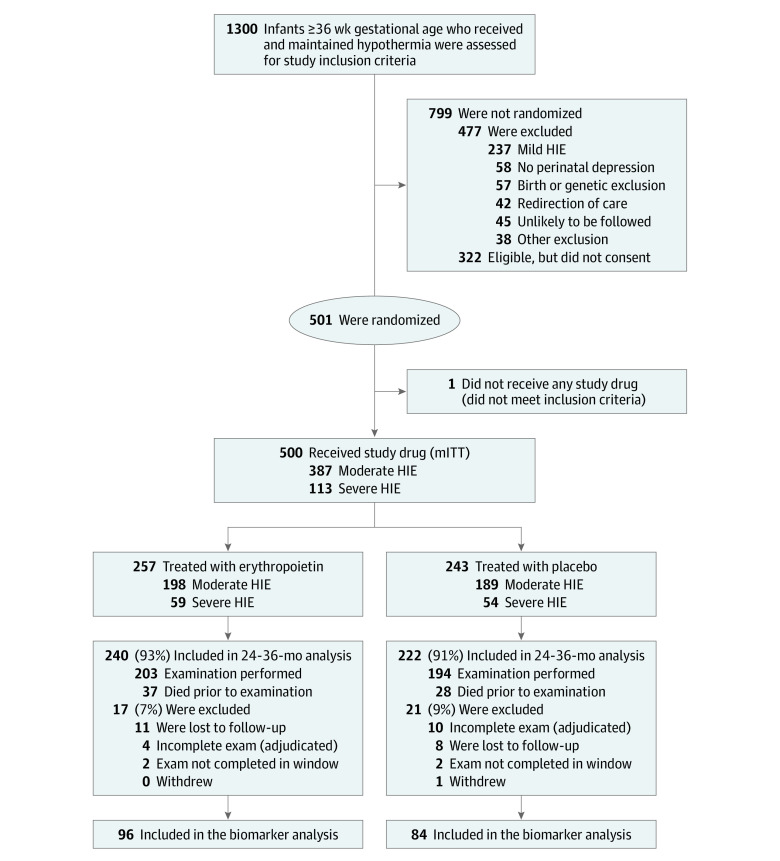
DESIGN, SETTING, AND PARTICIPANTS: This study is a preplanned secondary analysis of prospectively collected data from infants enrolled in the High-Dose Erythropoietin for Asphyxia and Encephalopathy (HEAL) Trial, which tested the efficacy of erythropoietin as an adjunctive neuroprotective therapy to therapeutic hypothermia. The study was conducted at 17 academic sites comprising 23 neonatal intensive care units in the United States between January 25, 2017, and October 9, 2019, with follow-up through October 2022. Overall, 500 infants born at 36 weeks' gestation or later with moderate or severe HIE were included.
Erythropoietin treatment 1000 U/kg/dose on days 1, 2, 3, 4 and 7.
Plasma erythropoietin was measured in 444 infants (89%) within 24 hours after birth. A subset of 180 infants who had plasma samples available at baseline (day 0/1), day 2, and day 4 after birth and either died or had 2-year Bayley Scales of Infant Development III assessments completed were included in the biomarker analysis.
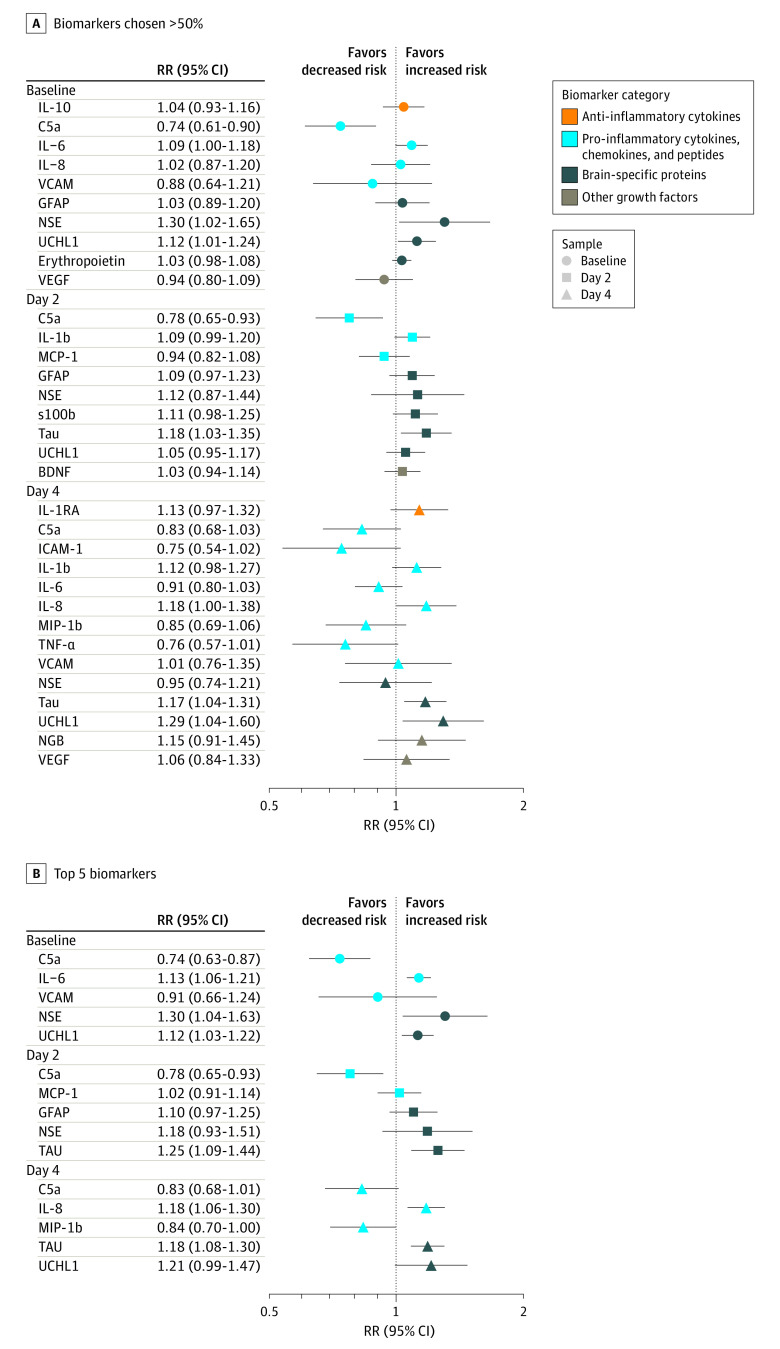
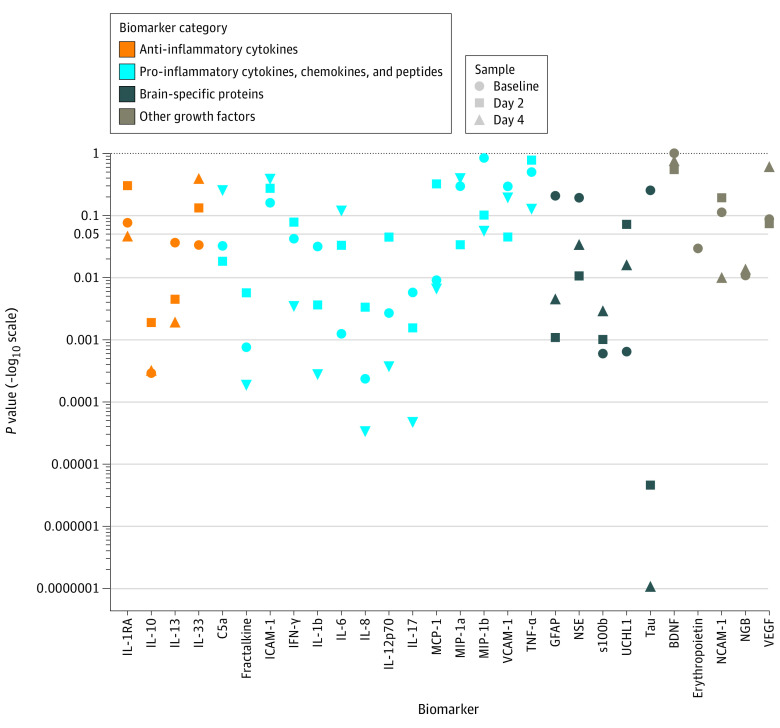
The 180 infants included in this substudy had a mean (SD) gestational age of 39.1 (1.5) weeks, and 83 (46%) were female. Infants who received erythropoietin had increased concentrations of erythropoietin at day 2 and day 4 compared with baseline. Erythropoietin treatment did not alter concentrations of other measured biomarkers (eg, difference in interleukin [IL] 6 between groups on day 4: -1.3 pg/mL; 95% CI, -4.8 to 2.0 pg/mL). After adjusting for multiple comparisons, we identified 6 plasma biomarkers (C5a, interleukin [IL] 6, and neuron-specific enolase at baseline; IL-8, tau, and ubiquitin carboxy-terminal hydrolase-L1 at day 4) that significantly improved estimations of death or NDI at 2 years compared with clinical data alone. However, the improvement was only modest, increasing the AUC from 0.73 (95% CI, 0.70-0.75) to 0.79 (95% CI, 0.77-0.81; P = .01), corresponding to a 16% (95% CI, 5%-44%) increase in correct classification of participant risk of death or NDI at 2 years.
In this study, erythropoietin treatment did not reduce biomarkers of neuroinflammation or brain injury in infants with HIE. Circulating biomarkers modestly improved estimation of 2-year outcomes.
ClinicalTrials.gov Identifier: NCT02811263.
对于诊断为缺氧缺血性脑病 (HIE) 的婴儿,预测神经发育损伤 (NDI) 的能力对于父母指导和临床治疗以及为未来神经治疗研究分层患者都很重要。
研究促红细胞生成素对中重度 HIE 婴儿血浆炎症介质的影响,并开发一组循环生物标志物,以提高在出生时可用的临床数据基础上对 2 年 NDI 的预测。
设计、地点和参与者:这是一项前瞻性收集数据的预先计划的二次分析,纳入了在高剂量促红细胞生成素治疗窒息和脑病 (HEAL) 试验中登记的婴儿,该试验测试了促红细胞生成素作为辅助神经保护治疗与治疗性低温联合应用的疗效。该研究在美国 17 个学术地点进行,包括 23 个新生儿重症监护病房,时间为 2017 年 1 月 25 日至 2019 年 10 月 9 日,随访至 2022 年 10 月。总体上,纳入了 500 名胎龄 36 周或以上、中重度 HIE 的婴儿。
促红细胞生成素治疗 1000 U/kg/dose 于出生后第 1、2、3、4 和 7 天。
在出生后 24 小时内,对 444 名婴儿(89%)测量了血浆促红细胞生成素。有一个亚组 180 名婴儿在基线(第 0/1 天)、第 2 天和第 4 天有血浆样本,并完成了 2 年贝利婴幼儿发育量表 III 评估,他们包括在生物标志物分析中。
本亚研究纳入的 180 名婴儿平均(SD)胎龄为 39.1(1.5)周,83 名(46%)为女性。接受促红细胞生成素治疗的婴儿在第 2 天和第 4 天的促红细胞生成素浓度较基线升高。促红细胞生成素治疗并未改变其他测量的生物标志物的浓度(例如,第 4 天组间白细胞介素 [IL] 6 的差异:-1.3 pg/mL;95%CI,-4.8 至 2.0 pg/mL)。经过多次比较调整后,我们确定了 6 种血浆生物标志物(基线时的 C5a、白细胞介素 [IL] 6 和神经元特异性烯醇化酶;第 4 天的白细胞介素 8、tau 和泛素羧基末端水解酶-L1)与临床数据相比,能显著提高对死亡或 2 年 NDI 的估计。然而,这种改善只是适度的,将 AUC 从 0.73(95%CI,0.70-0.75)提高到 0.79(95%CI,0.77-0.81;P=0.01),即正确分类 2 年死亡或 NDI 风险的参与者比例增加了 16%(95%CI,5%-44%)。
在这项研究中,促红细胞生成素治疗并未降低 HIE 婴儿的神经炎症或脑损伤的生物标志物。循环生物标志物适度提高了对 2 年结局的估计。
ClinicalTrials.gov 标识符:NCT02811263。