Lucas Eric R, Nagi Sanjay C, Kabula Bilali, Batengana Bernard, Kisinza William, Egyir-Yawson Alexander, Essandoh John, Dadzie Sam, Chabi Joseph, Van't Hof Arjen E, Rippon Emily J, Pipini Dimitra, Harding Nicholas J, Dyer Naomi A, Clarkson Chris S, Miles Alistair, Weetman David, Donnelly Martin J
Department of Vector Biology, Liverpool School of Tropical Medicine, Liverpool, United Kingdom.
National Institute for Medical Research, Amani Research Centre, Muheza, Tanzania.
PLoS Biol. 2024 Dec 5;22(12):e3002898. doi: 10.1371/journal.pbio.3002898. eCollection 2024 Dec.
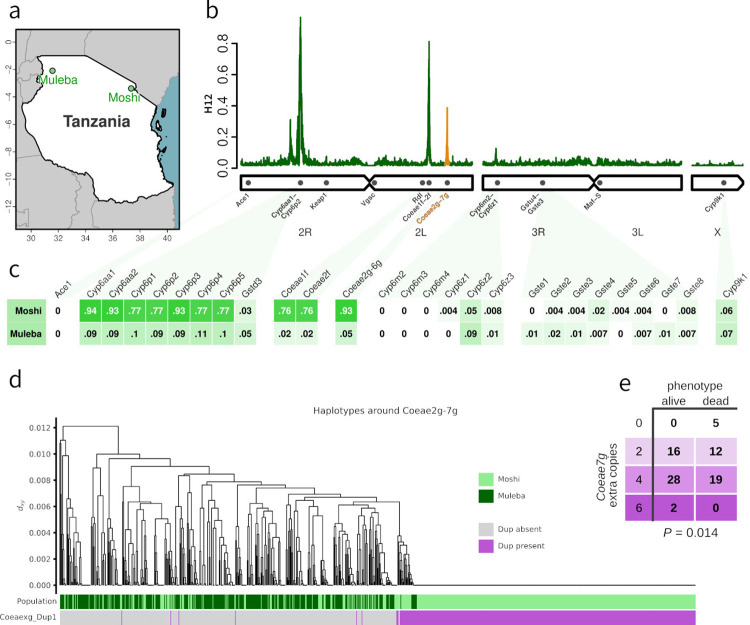
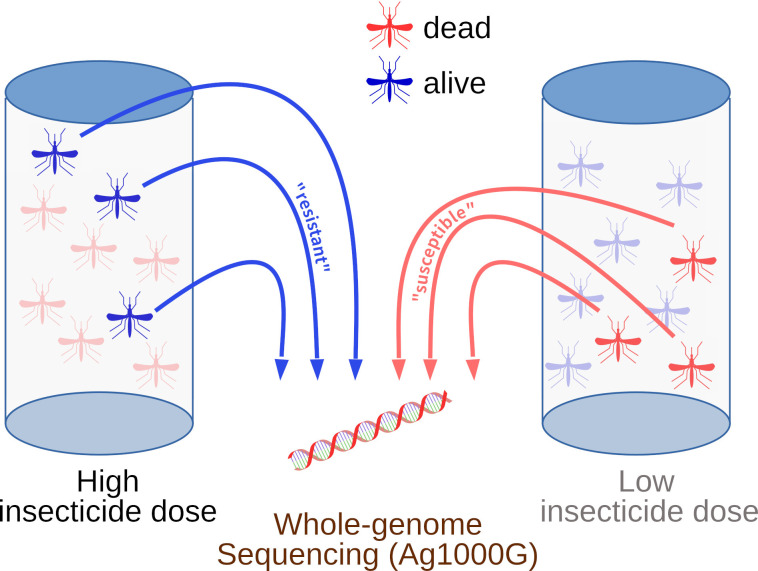
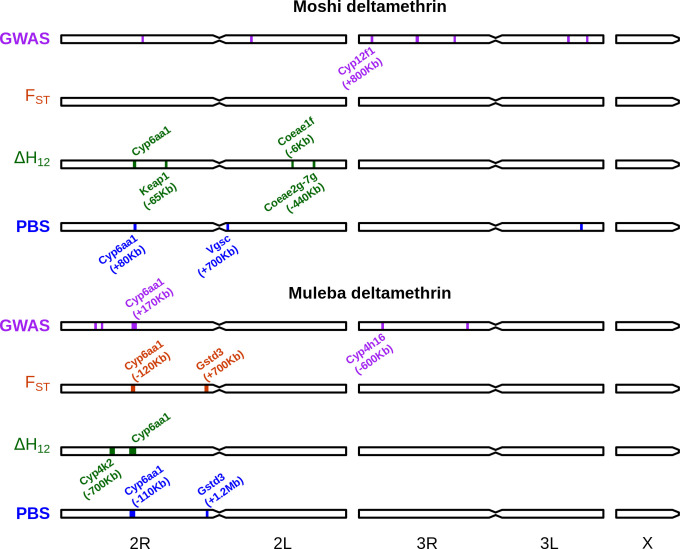
To keep ahead of the evolution of resistance to insecticides in mosquitoes, national malaria control programmes must make use of a range of insecticides, both old and new, while monitoring resistance mechanisms. The outdoor-biting malaria vector Anopheles arabiensis is of increasing concern for malaria transmission because it is apparently less susceptible to many indoor control interventions, yet knowledge of its mechanisms of resistance remains limited. Furthermore, comparatively little is known in general about resistance to non-pyrethroid insecticides such as pirimiphos-methyl (PM), which are crucial for effective control in the context of globally high resistance to pyrethroids. We performed a genome-wide association study to determine the molecular mechanisms of resistance to the pyrethroid deltamethrin (commonly used in bednets) and PM (widespread use for indoor spraying), in An. arabiensis from 2 regions in Tanzania. Genomic regions of positive selection in these populations were largely driven by copy number variants (CNVs) in gene families involved in metabolic resistance. We found evidence of a new gene cluster involved in resistance to PM, identifying a strong selective sweep tied to a CNV in the carboxylesterase genes Coeae2g - Coeae6g. Using complementary data from another malaria vector, An. coluzzii, in Ghana, we show that copy number at this locus is significantly associated with PM resistance. Similarly, for deltamethrin, resistance was strongly associated with a novel CNV allele in the Cyp6aa / Cyp6p cluster (Cyp6aap_Dup33). Against this background of metabolic resistance, resistance caused by mutations in the insecticide target sites was very rare or absent. Mutations in the pyrethroid target site Vgsc were at very low frequency in Tanzania, yet combining these samples with 3 An. arabiensis individuals from West Africa revealed a startling evolutionary diversity, with up to 5 independent origins of Vgsc-995 mutations found within just 8 haplotypes. Thus, despite having been first recorded over 10 years ago, Vgsc resistance mutations in Tanzanian An. arabiensis have remained at stable low frequencies. Overall, our results provide a new copy number marker for monitoring resistance to PM in malaria mosquitoes, and reveal the complex picture of resistance patterns in An. arabiensis.
为了在蚊子对杀虫剂的抗性演变方面保持领先,国家疟疾控制项目必须在监测抗性机制的同时,使用一系列新旧杀虫剂。户外叮咬的疟疾媒介阿拉伯按蚊对疟疾传播的影响日益受到关注,因为它显然对许多室内控制干预措施不太敏感,但其抗性机制的相关知识仍然有限。此外,一般而言,对于诸如甲基嘧啶磷(PM)等非拟除虫菊酯类杀虫剂的抗性了解较少,而这些杀虫剂在全球对拟除虫菊酯高度抗性的背景下对于有效控制至关重要。我们进行了一项全基因组关联研究,以确定坦桑尼亚两个地区的阿拉伯按蚊对拟除虫菊酯溴氰菊酯(常用于蚊帐)和PM(广泛用于室内喷洒)的抗性分子机制。这些种群中的正向选择基因组区域在很大程度上由参与代谢抗性的基因家族中的拷贝数变异(CNV)驱动。我们发现了一个与PM抗性相关的新基因簇的证据,确定了与羧酸酯酶基因Coeae2g - Coeae6g中的一个CNV相关的强烈选择性清除。利用来自加纳另一种疟疾媒介——科氏按蚊的补充数据,我们表明该位点的拷贝数与PM抗性显著相关。同样,对于溴氰菊酯,抗性与Cyp6aa / Cyp6p簇中的一个新的CNV等位基因(Cyp6aap_Dup33)密切相关。在这种代谢抗性的背景下,由杀虫剂靶位点突变引起的抗性非常罕见或不存在。拟除虫菊酯靶位点Vgsc中的突变在坦桑尼亚的频率非常低,但将这些样本与来自西非的3只阿拉伯按蚊个体相结合,揭示了惊人的进化多样性,在仅8个单倍型中发现了多达5个独立起源的Vgsc - 995突变。因此,尽管坦桑尼亚阿拉伯按蚊中的Vgsc抗性突变早在10多年前就已被首次记录,但它们的频率一直稳定在较低水平。总体而言,我们的结果为监测疟疾蚊子对PM的抗性提供了一个新的拷贝数标记,并揭示了阿拉伯按蚊抗性模式的复杂情况。