Muqaddas Hira, Mehmood Naunain, Nigar Maher, Yousaf Farhana, Khokhar Kainat Farooq, Kousar Saba, Aslam Mahnoor, Khan Zafar Iqbal, Giantsis Ioannis A, Swelum Ayman A, Iqbal Furhan
Department of Zoology, The Women University Multan, Multan, Pakistan.
Department of Zoology, University of Sargodha, Sargodha, Pakistan.
PLoS One. 2024 Dec 5;19(12):e0314343. doi: 10.1371/journal.pone.0314343. eCollection 2024.
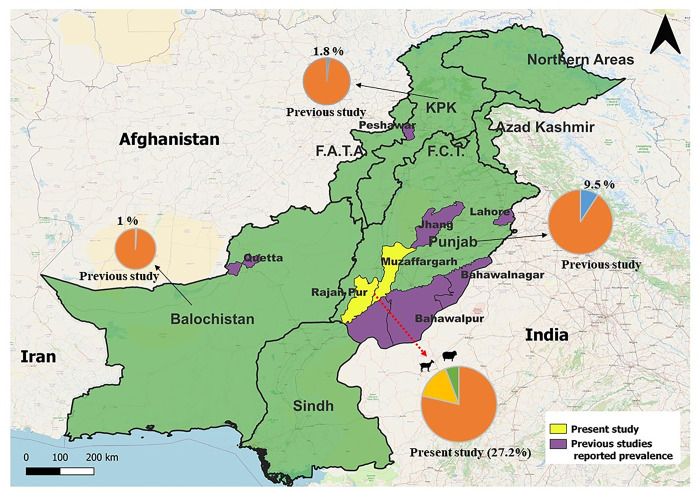
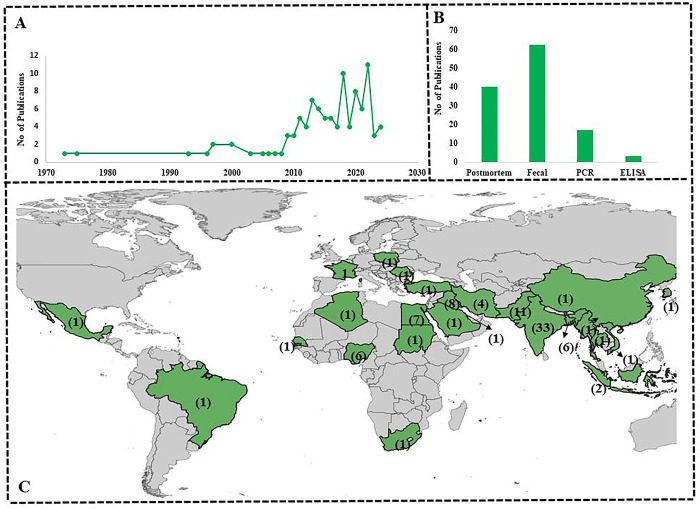
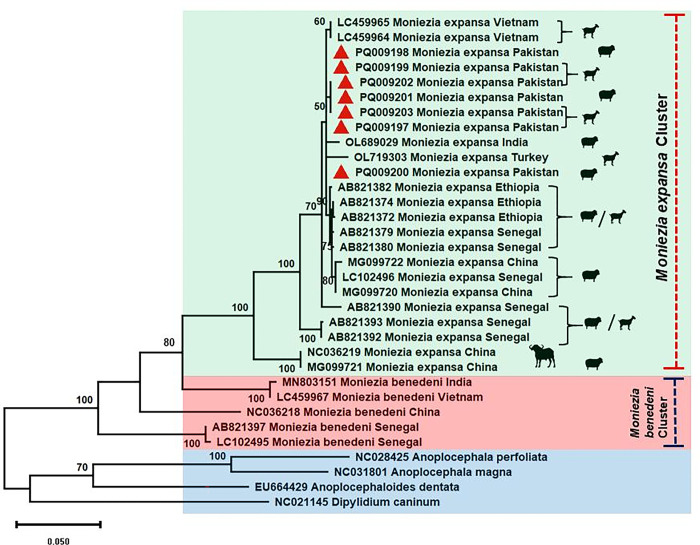
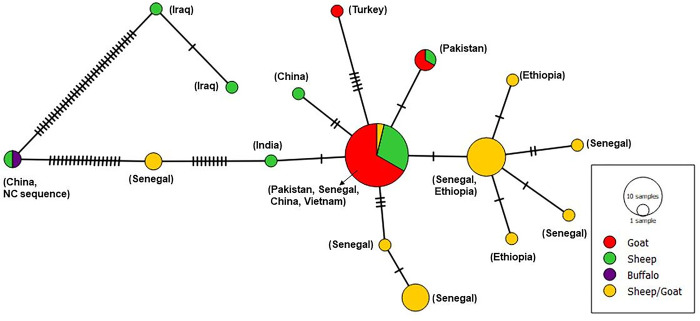
The members of genus Moniezia are the common parasites of livestock in tropical areas. The tapeworm, Moniezia expansa is commonly found in the gastrointestinal tract of the small and large ruminants. The present study focused on reporting the prevalence of M. expansa in small ruminants of southern Punjab: sheep and goats, in relation with epidemiological factors like age and gender. An overall prevalence of 27.2% was estimated for the small ruminants with higher infection rates in males (29.8%) and younger age group (<1 year; 32.9%). Moreover, the molecular characterization and phylogenetic analysis of the isolates based on partial cox1 gene indicated the placement of these sequences in the M. expansa cluster. Two distinct haplotypes, without any host tropism, were identified within the Pakistani isolates. A meta-analysis for M. expansa was run for all available global reports exhibiting an overall pooled prevalence of 21.3% (CI 95%: 13.5-29.0). Additionally, a global dataset encompassing 59 partial cox1 sequences submitted from different geographical locations was also assessed. Moderate haplotype diversity (0.760 ± 0.051) and significantly negative deviations from neutrality were estimated. The median joining haplotype network for these sequences revealed an interesting population structure indicating highly divergent sequences from China and Iraq compared to Pakistan, India, Vietnam, Senegal and Ethiopia. Given inconsistencies in genetic data there is a dire need to carry out molecular studies across the entire distributional range of M. expansa to delineate genetic diversity and population structure of the species. This will also be crucial in reevaluating the taxonomy of genus Moniezia.
莫尼茨绦虫属的成员是热带地区家畜的常见寄生虫。扩展莫尼茨绦虫这种绦虫常见于小型和大型反刍动物的胃肠道中。本研究重点报告了旁遮普邦南部小型反刍动物(绵羊和山羊)中扩展莫尼茨绦虫的流行情况,并分析了其与年龄和性别等流行病学因素的关系。估计小型反刍动物的总体感染率为27.2%,其中雄性感染率较高(29.8%),年龄较小的群体(<1岁;32.9%)感染率更高。此外,基于部分细胞色素氧化酶亚基1(cox1)基因对分离株进行的分子特征分析和系统发育分析表明,这些序列属于扩展莫尼茨绦虫聚类。在巴基斯坦的分离株中鉴定出两种不同的单倍型,且无宿主特异性。对所有可用的全球报告进行了扩展莫尼茨绦虫的荟萃分析,总体合并患病率为21.3%(95%置信区间:13.5 - 29.0)。此外,还评估了一个包含从不同地理位置提交的59条部分cox1序列的全球数据集。估计单倍型多样性适中(0.760 ± 0.051),且显著偏离中性。这些序列的中位数连接单倍型网络显示出有趣的种群结构,表明与巴基斯坦、印度、越南、塞内加尔和埃塞俄比亚相比,来自中国和伊拉克的序列差异很大。鉴于遗传数据存在不一致性,迫切需要在扩展莫尼茨绦虫的整个分布范围内开展分子研究,以描绘该物种的遗传多样性和种群结构。这对于重新评估莫尼茨绦虫属的分类也至关重要。