Ngangue-Siewe Idriss Nasser, Ndjeunia-Mbiakop Paulette, Barembaye Sagna André, Mamadou Maïga Abdoul-Aziz, Bamou Roland, Sanon Antoine, Tombi Jeannette, Mbida Mbida Jean Arthur, Antonio-Nkondjio Christophe, Remoue Franck, Badolo Athanase
Faculty of Science, Department of Animal Biology and Physiology, The University of Douala, Douala, Cameroon.
Malaria Research Laboratory, Organisation de Coordination pour la Lutte Contre les Endémies en Afrique Centrale (OCEAC), Yaoundé, Cameroon.
PLoS One. 2024 Dec 5;19(12):e0314709. doi: 10.1371/journal.pone.0314709. eCollection 2024.
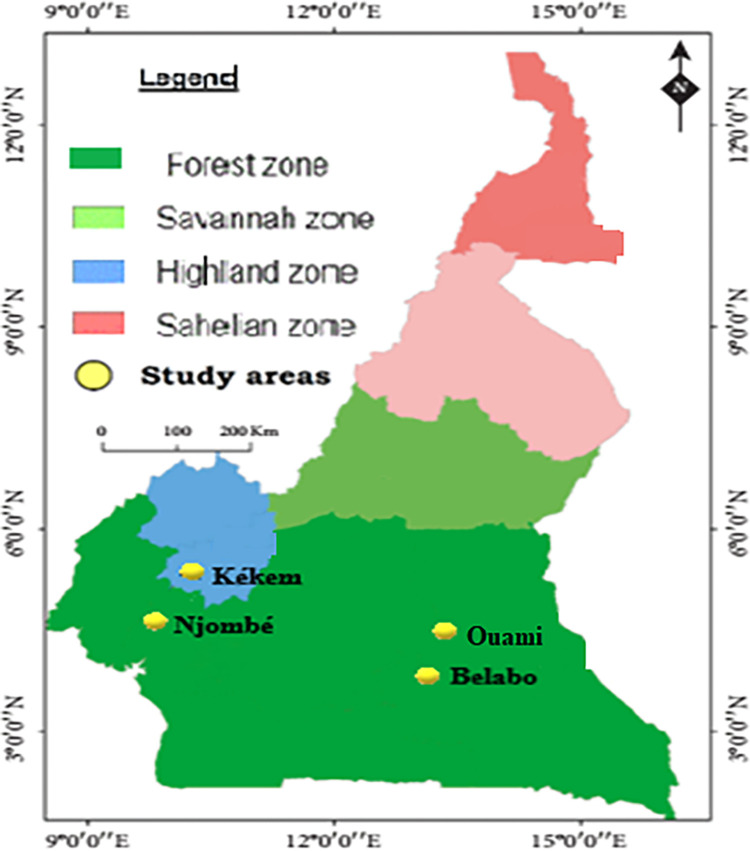
Malaria and Aedes-borne diseases remain major causes of mortality, morbidity, and disability in most developing countries. Surveillance of transmission patterns associated with vector control remains strategic for combating these diseases. Due to the limitions of current surveillance tools used to assess human exposure to mosquito bites, human antibody (Ab) responses to salivary peptides from Anopheles (gSG6-P1) and Aedes (Nterm-34kDa) are increasingly being used to measure direct human-Anopheles or Aedes contact. This study reports on the assessment of Human IgG Ab responses to gSG6-P1 and Nterm-34-kDa salivary peptides as biomarkers to track exposure to Anopheles and Aedes bites, in rural localities of Cameroon. Blood samples were collected between October and November 2022 from 173 individuals residing in four villages: Njombe, Kekem, Belabo, and Ouami. Sociodemographic characteristics and information regarding Long Lasting Insecticide Net (LLIN) ownership, use, and net characteristics were recorded using a questionnaire. The measurement of human IgG levels to gSG6-P1 and Nterm-34kDa peptides was conducted in blood samples using ELISA. The levels of IgG responses to Anopheles gSG6-P1 and Aedes Nterm-34kDa salivary peptides varied significantly across villages (all p<0.05). IgG responses to Anopheles gSG6-P1 were higher in Njombe compared to Belabo and Ouami (all p<0.01), while IgG responses to Aedes Nterm-34kDa were higher in Kekem compared to the other villages (all p<0.0001). Aweak correlation was observed between IgG responses to Anopheles and Aedes salivary peptides (Spearman r = 0.2689, p = 0.0003). However, the median level of IgG to Anopheles gSG6-P1 was higher than IgG to Aedes Nterm-34kDa in Njombé, Belabo, and Ouami. Individuals not using their LLIN, those using damaged bed nets, and those who reported vegetation around their houses developed higher IgG responses to gSG6-P1 and Nterm-34 kDa compared to those who did not (all p<0.05). The immune-epidemiological biomarkers have shown promising potential as indicators for monitoring human exposure to various mosquito bites and their heterogeneity in the same site. However, additional research is needed to validate the efficacy of this technique for surveillance purposes and to assess the effectiveness of vector control interventions.
在大多数发展中国家,疟疾和伊蚊传播疾病仍然是导致死亡、发病和残疾的主要原因。监测与病媒控制相关的传播模式对于抗击这些疾病仍然具有战略意义。由于目前用于评估人类接触蚊虫叮咬情况的监测工具存在局限性,人类对按蚊(gSG6-P1)和伊蚊(Nterm-34kDa)唾液肽的抗体(Ab)反应越来越多地被用于衡量人类与按蚊或伊蚊的直接接触。本研究报告了在喀麦隆农村地区评估人类IgG抗体对gSG6-P1和Nterm-34-kDa唾液肽的反应,以此作为追踪接触按蚊和伊蚊叮咬的生物标志物。2022年10月至11月期间,从居住在四个村庄(Njombe、Kekem、Belabo和Ouami)的173个人身上采集了血样。使用问卷记录社会人口学特征以及关于长效驱虫蚊帐(LLIN)的拥有、使用情况和蚊帐特征的信息。使用酶联免疫吸附测定法(ELISA)对血样中人类对gSG6-P1和Nterm-34kDa肽的IgG水平进行测量。不同村庄对按蚊gSG6-P1和伊蚊Nterm-34kDa唾液肽的IgG反应水平差异显著(所有p<0.05)。与Belabo和Ouami相比,Njombe对按蚊gSG6-P1 的IgG反应更高(所有p<0.01),而与其他村庄相比,Kekem对伊蚊Nterm-34kDa的IgG反应更高(所有p<0.0001)。观察到对按蚊和伊蚊唾液肽的IgG反应之间存在微弱的相关性(斯皮尔曼r = 0.2689,p = 0.0003)。然而,在Njombé、Belabo和Ouami,对按蚊gSG6-P1的IgG中位数水平高于对伊蚊Nterm-34kDa的IgG水平。与未使用LLIN的人、使用破损蚊帐的人以及报告房屋周围有植被的人相比,不使用LLIN 的人、使用破损蚊帐的人以及报告房屋周围有植被的人对gSG6-P1和Nterm-34 kDa的IgG反应更高(所有p<0.05)。这些免疫流行病学生物标志物作为监测人类接触各种蚊虫叮咬及其在同一地点的异质性的指标显示出了有前景的潜力。然而,需要进一步的研究来验证该技术用于监测目的的有效性,并评估病媒控制干预措施的效果。