
测量胞质溶胶和线粒体中谷胱甘肽还原酶消耗NADPH的速率。
Measuring the rate of NADPH consumption by glutathione reductase in the cytosol and mitochondria.
作者信息
Ting Kenneth K Y, Floro Eric, Dow Riley, Jongstra-Bilen Jenny, Cybulsky Myron I, Rocheleau Jonathan V
机构信息
Department of Immunology, University of Toronto, Toronto, ON, Canada.
Toronto General Hospital Research Institute, University Health Network, Toronto, ON, Canada.
出版信息
PLoS One. 2024 Dec 5;19(12):e0309886. doi: 10.1371/journal.pone.0309886. eCollection 2024.
BACKGROUND
NADPH is an essential co-factor supporting the function of enzymes that participate in both inflammatory and anti-inflammatory pathways in myeloid cells, particularly macrophages. Although individual NADPH-dependent pathways are well characterized, how these opposing pathways are co-regulated to orchestrate an optimized inflammatory response is not well understood. To investigate this, techniques to track the consumption of NADPH need to be applied. Deuterium tracing of NADPH remains the gold standard in the field, yet this setup of mass-spectrometry is technically challenging and not readily available to most research groups. Furthermore, NADPH pools are compartmentalized in various organelles with no known membrane transporters, suggesting that NADPH-dependent pathways are regulated in an organelle-specific manner. Conventional methods such as commercial kits are limited to quantifying NADPH in whole cells and not at the resolution of specific organelles. These limitations reflect the need for a novel assay that can readily measure the consumption rate of NADPH in different organelles.
METHODS
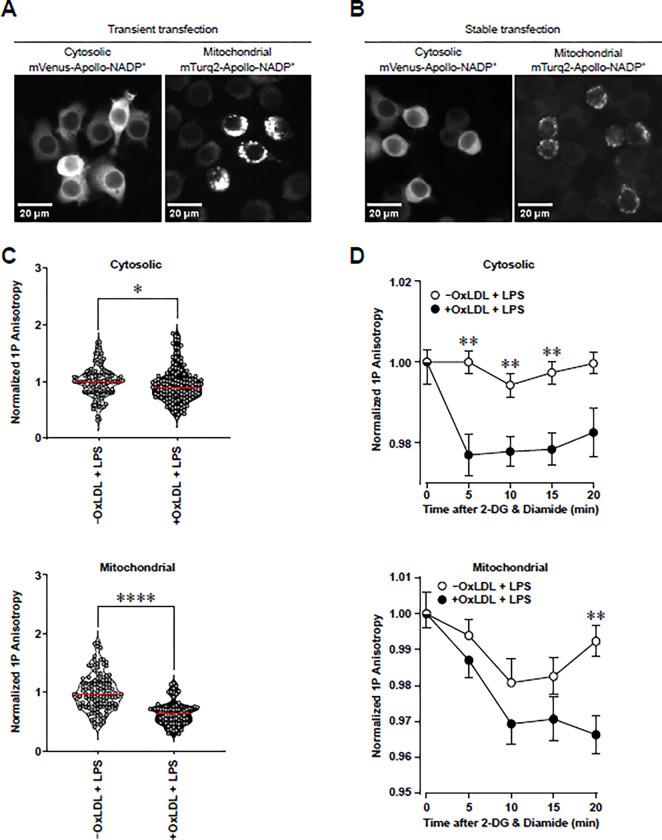
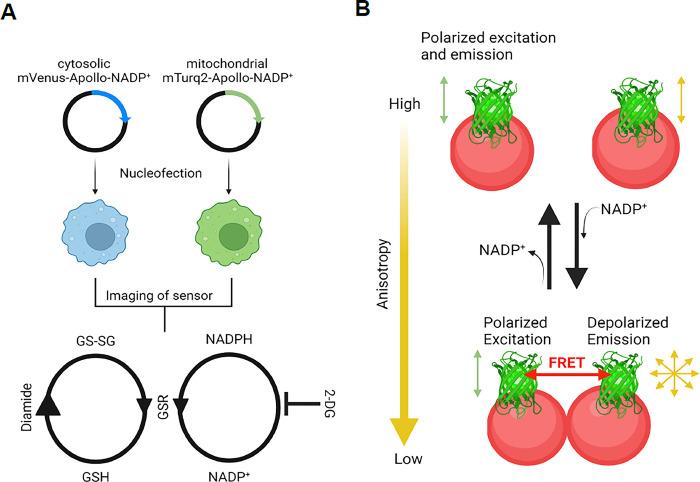
We devised an assay that measures the consumption rate of NADPH by glutathione-disulfide reductase (GSR) in the mitochondria and the cytosol of RAW264.7 macrophage cell lines. RAW264.7 cells were transfected with Apollo-NADP+ sensors targeted to the mitochondria or the cytosol, followed by the treatment of 2-deoxyglucose and diamide. Intravital imaging over time then determined GSR-dependent NADPH consumption in an organelle-specific manner.
DISCUSSION
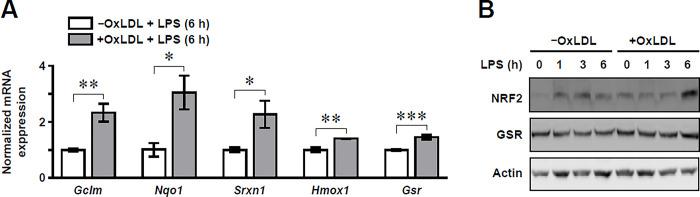
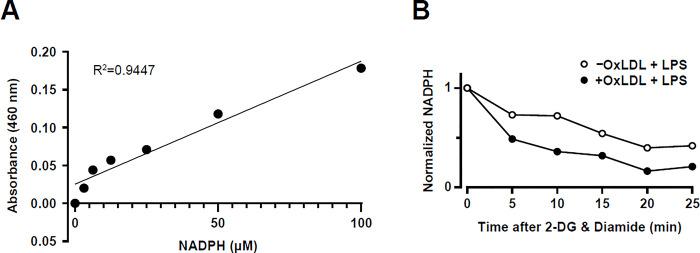
In lipopolysaccharide (LPS)-stimulated RAW264.7 cells, cytosolic and mitochondrial NADPH was consumed by GSR in a time-dependent manner. This finding was cross validated with a commercially available NADPH kit that detects NADPH in whole cells. Loading of RAW264.7 cells with oxidized low-density lipoprotein followed by LPS stimulation elevated GSR expression, and this correlated with a more rapid drop in cytosolic and mitochondrial NADPH in our assay. The current limitation of our assay is applicability to transfectable cell lines, and higher expression of plasmid-encoded sensors relative to endogenous glucose-6-phosphate dehydrogenase.
背景
NADPH是一种重要的辅助因子,可支持参与髓系细胞(尤其是巨噬细胞)炎症和抗炎途径的酶的功能。尽管单个NADPH依赖性途径已得到充分表征,但这些相反的途径如何共同调节以协调优化的炎症反应尚不清楚。为了研究这一点,需要应用追踪NADPH消耗的技术。NADPH的氘追踪仍然是该领域的金标准,但这种质谱设置在技术上具有挑战性,大多数研究小组无法轻易获得。此外,NADPH池在各种细胞器中被分隔,没有已知的膜转运蛋白,这表明NADPH依赖性途径以细胞器特异性方式受到调节。传统方法如商业试剂盒仅限于定量全细胞中的NADPH,而无法在特定细胞器的分辨率下进行。这些局限性反映了需要一种能够轻松测量不同细胞器中NADPH消耗率的新型检测方法。
方法
我们设计了一种检测方法,用于测量RAW264.7巨噬细胞系线粒体和细胞质中谷胱甘肽二硫化物还原酶(GSR)对NADPH的消耗率。将靶向线粒体或细胞质的Apollo-NADP+传感器转染到RAW264.7细胞中,然后用2-脱氧葡萄糖和二酰胺处理。随时间进行活体成像,然后以细胞器特异性方式确定GSR依赖性NADPH消耗。
讨论
在脂多糖(LPS)刺激的RAW264.7细胞中,细胞质和线粒体中的NADPH被GSR以时间依赖性方式消耗。这一发现通过市售的检测全细胞中NADPH的试剂盒进行了交叉验证。用氧化低密度脂蛋白加载RAW264.7细胞,然后进行LPS刺激,可提高GSR表达,这与我们检测中细胞质和线粒体NADPH更快下降相关。我们检测方法目前的局限性是适用于可转染细胞系,以及质粒编码传感器相对于内源性葡萄糖-6-磷酸脱氢酶的表达较高。
 Zotero 插件