Han Guohao, Xing Lixian, Gu Tiantian, Jin Yuli, Shi Fengyu, Yan Hanwen, Zhuo Shiyu, Shi Zhipeng, Wang Jing, Zhou Yilin, Liu Wei, Zhang Yelun, An Diaoguo
Center for Agricultural Resources Research, Institute of Genetics and Developmental Biology, Chinese Academy of Sciences, Shijiazhuang, 050022, China.
State Key Laboratory for Biology of Plant Diseases and Insect Pests, Institute of Plant Protection, Chinese Academy of Agricultural Sciences, Beijing, 100193, China.
BMC Plant Biol. 2024 Dec 6;24(1):1169. doi: 10.1186/s12870-024-05884-x.
Powdery mildew, caused by Blumeria graminis f. sp. tritici (Bgt), is one of the most destructive wheat diseases worldwide. Durum wheat (Triticum turgidum L. var. durum Desf.) is a crucial gene donor for improving common wheat.
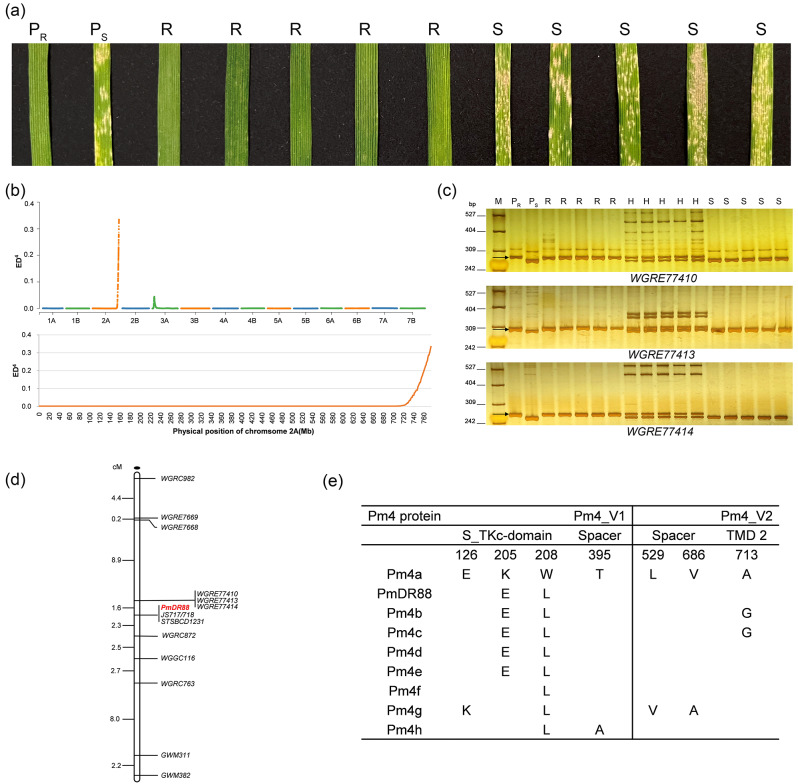
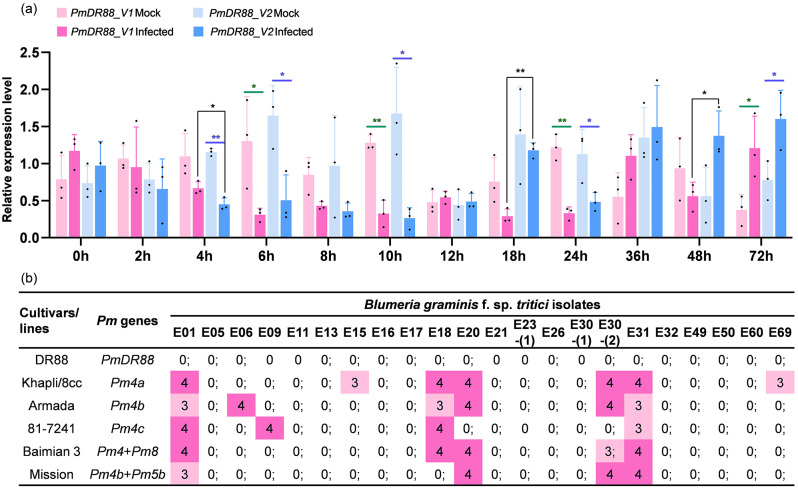
In this study, we investigated a durum wheat accession, DR88, which exhibits broad and high levels of resistance to powdery mildew. Using bulked segregant RNA-Seq (BSR-Seq), we identified a dominant gene, tentatively designated PmDR88, and localized it to 743-776 Mb interval on chromosome arm 2AL according to the reference genome of durum wheat cv. Svevo. Subsequently, PmDR88 was mapped in a genetic region of 3.9 cM flanked by the markers WGRE77410 and WGRC872 at genetic distances of 1.6 and 2.3 cM, respectively; it also co-segregated with JS717×JS718, the diagnostic marker for the Pm4 locus. Genotyping of a large population comprising 5,174 F families using JS717×JS718 confirmed that PmDR88 is located at the Pm4 locus on 2AL. Sequence alignment revealed that PmDR88 shares identical amino acid sequences with Pm4d, while qRT-PCR analysis suggested distinct expression patterns for PmDR88 compared with previously reported Pm4 alleles. Two complementary DNA markers, including the dominant co-segregating marker JS717×JS718 and a newly developed closely-linked co-dominant marker WGRE77410, were confirmed to be available for efficiently transferring PmDR88 into the tested wheat backgrounds by marker-assisted selection (MAS) strategy.
PmDR88 was mapped in the Pm4 locus. Despite sharing identical amino acid sequences with Pm4d, PmDR88 exhibits distinct expression patterns. Moreover, DR88 shows broad and high levels of resistance to powdery mildew. Two complementary DNA markers were identified for MAS breeding. The molecular identification of PmDR88 will facilitate transfer of this Pm4 allele into susceptible cultivars for resistance improvement or into resistant cultivars for resistance-enhanced pyramiding breeding.
由小麦白粉病菌(Blumeria graminis f. sp. tritici,Bgt)引起的白粉病是全球最具破坏性的小麦病害之一。硬粒小麦(Triticum turgidum L. var. durum Desf.)是改良普通小麦的关键基因供体。
在本研究中,我们调查了一个硬粒小麦种质DR88,它对白粉病表现出广泛且高水平的抗性。利用混合分离群体RNA测序(BSR-Seq),我们鉴定出一个显性基因,暂定名为PmDR88,并根据硬粒小麦品种斯韦沃(Svevo)的参考基因组将其定位到2AL染色体臂上743 - 776 Mb区间。随后,PmDR88被定位在一个3.9 cM的遗传区域,两侧分别是标记WGRE77410和WGRC872,遗传距离分别为1.6和2.3 cM;它还与Pm4位点的诊断标记JS717×JS718共分离。使用JS717×JS718对包含5174个F家系的大群体进行基因分型,证实PmDR88位于2AL染色体上的Pm4位点。序列比对显示PmDR88与Pm4d具有相同的氨基酸序列,而qRT-PCR分析表明PmDR88与先前报道的Pm4等位基因具有不同的表达模式。两个互补DNA标记,包括显性共分离标记JS717×JS718和新开发的紧密连锁共显性标记WGRE77410,被证实可通过标记辅助选择(MAS)策略有效地将PmDR88导入测试的小麦背景中。
PmDR88被定位在Pm4位点。尽管与Pm4d具有相同的氨基酸序列,但PmDR88表现出不同的表达模式。此外,DR88对白粉病表现出广泛且高水平的抗性。鉴定出两个用于MAS育种的互补DNA标记。PmDR88的分子鉴定将有助于将这个Pm4等位基因导入感病品种以提高抗性,或导入抗病品种以进行抗性增强的聚合育种。