Zhu Di, Lin Ye-Ding, Yao Yan-Zhu, Qi Xiang-Jun, Qian Kai, Lin Li-Zhu
Guangzhou University of Chinese Medicine, Guangzhou, Guangdong, China.
Shenzhen Bao'an Chinese Medicine Hospital, Shenzhen, Guangdong, China.
BMC Cancer. 2024 Dec 5;24(1):1499. doi: 10.1186/s12885-024-13261-y.
The CALLY index, which is derived from C-reactive protein (CRP) content, serum albumin level, and total lymphocyte count, reflects the immune, nutritional, and inflammatory status of the body. Lack of sufficient evidence on the correlation between the CALLY index and the prognosis of cancer patients with various cancer forms. This study seeks to elucidate the association between the CALLY index and mortality from all causes as well as specific causes in cancer patients within a U.S.
This investigation encompassed 3511 cancer-afflicted adults from the National Health and Nutritional Examination Surveys (NHANES) spanning 1999 to 2018. The CALLY index was measured at baseline only. The relationship between the CALLY index and mortality from both all causes and cancer specifically was examined using Cox proportional hazards models. Additionally, restricted cubic spline, piecewise linear regression, and various subgroup and sensitivity analyses were employed.
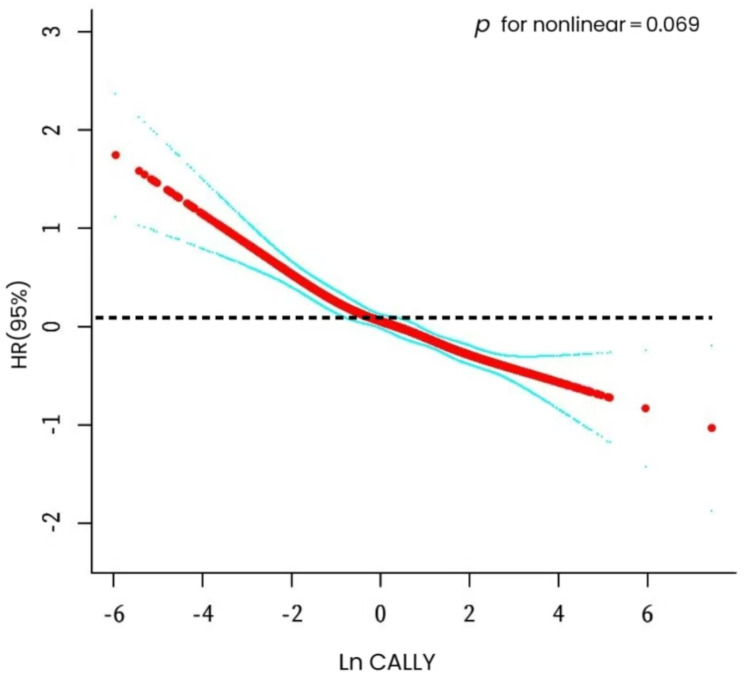
Over a median follow-up of 103 months, 1,355 deaths occurred, and the incidence of all-cause mortality for these participants was 38.34%. Our findings indicate that an elevated CALLY index correlates with a diminished risk of all-cause mortality. Upon applying a natural logarithmic transformation to the CALLY index, the comprehensively adjusted model revealed that each one-unit increment in ln CALLY corresponded to a 18% decrease in all-cause mortality risk among cancer patients (HR = 0.82, 95% CI:0.79-0.86). Analyses of mortality due to cardiac and cancer-related causes yielded consistent results, which were robust across various subgroup and sensitivity analyses.
The CALLY index demonstrated a linear and negative association with all-cause mortality, as well as mortality caused by cancer and cardiac conditions, highlighting its significant prognostic value in patients with oncological conditions.
CALLY指数由C反应蛋白(CRP)含量、血清白蛋白水平和总淋巴细胞计数得出,反映了身体的免疫、营养和炎症状态。关于CALLY指数与各种癌症形式的癌症患者预后之间的相关性,缺乏充分的证据。本研究旨在阐明美国癌症患者中CALLY指数与全因死亡率以及特定原因死亡率之间的关联。
这项调查涵盖了1999年至2018年美国国家健康和营养检查调查(NHANES)中的3511名成年癌症患者。仅在基线时测量CALLY指数。使用Cox比例风险模型检查CALLY指数与全因死亡率和癌症特异性死亡率之间的关系。此外,还采用了受限立方样条、分段线性回归以及各种亚组和敏感性分析。
在中位随访103个月期间,发生了1355例死亡,这些参与者的全因死亡率为38.34%。我们的研究结果表明,CALLY指数升高与全因死亡率风险降低相关。对CALLY指数进行自然对数转换后,综合调整模型显示,ln CALLY每增加一个单位,癌症患者的全因死亡风险就会降低18%(HR = 0.82,95% CI:0.79 - 0.86)。对心脏和癌症相关原因导致的死亡率分析得出了一致的结果,在各种亚组和敏感性分析中都很稳健。
CALLY指数与全因死亡率以及癌症和心脏疾病导致的死亡率呈线性负相关,突出了其在肿瘤患者中的重要预后价值。