McCarthy Lisa M, Farrell Barbara J, Metge Colleen, Jeffs Lianne, Toenjes Sameera, Rodriguez M Christine
Leslie Dan Faculty of Pharmacy, University of Toronto, Toronto, ON, Canada.
Institute for Better Health, Trillium Health Partners, Mississauga, ON, Canada.
Implement Sci Commun. 2024 Dec 5;5(1):137. doi: 10.1186/s43058-024-00673-x.
Prescribing cascades, which occur when a medication is used to treat the side effect of another medication, are important contributors to polypharmacy. There is an absence of studies that evaluate interventions to address them. We describe an application of the Behaviour Change Wheel (BCW) to design theory-informed interventions for addressing prescribing cascades within interprofessional primary care teams.
The BCW framework was applied to guide intervention development. This report describes the first seven steps. Three behaviours were developed based on data collected from two qualitative studies exploring why and how cascades occur across practice settings. A target behaviour was selected and the COM-B model was applied to identify relevant factors for interprofessional primary care teams. Relevant intervention types, policy options, and corresponding behaviour change techniques (BCTs) were identified, and intervention examples drafted. Prioritization of behaviours and intervention examples were guided by the APEASE criteria.
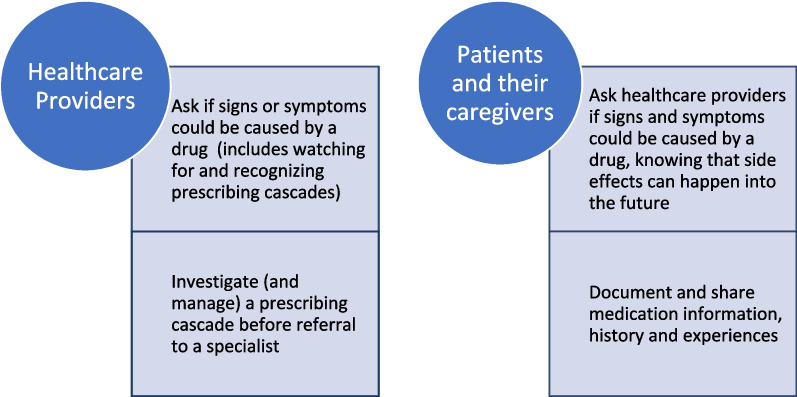
The three behaviours involved supporting: (1) healthcare providers (HCPs) to ask about, investigate and manage cascades, (2) the public to ask about prescribing cascades, and (3) the public to share medication histories and experiences with HCPs. The team selected the HCP behaviour, A-I-D (ask, investigate, deprescribe), for intervention development. Psychological capability and physical opportunity were the most relevant COM-B components. Ten intervention options comprised of BCTs were developed, which are ready for further prioritization by stakeholders. These can be grouped into: provision of educational materials for use by HCPs; provision of consultation or training to support HCPs; and knowledge mobilization strategies. Through the process, the team identified that development of a practice guidance tool, which assists HCPs to investigate and manage prescribing cascades, is needed to support further intervention development.
The BCW framework guided the design of intervention examples to support primary HCPs practicing in interprofessional teams to address prescribing cascades. When identifying interventions for future consultation, creation of a practice guidance tool was prioritized as it underpins all proposed interventions for addressing prescribing cascades in practice. Further research is needed to determine what primary HCPs would need in this practice guidance tool and how it will be used in practice, to support its development.
当一种药物用于治疗另一种药物的副作用时会出现处方级联,这是多重用药的重要促成因素。目前缺乏评估解决这些问题的干预措施的研究。我们描述了行为改变轮(BCW)在跨专业初级保健团队中设计基于理论的干预措施以解决处方级联方面的应用。
应用BCW框架指导干预措施的制定。本报告描述了前七个步骤。基于从两项定性研究中收集的数据制定了三种行为,这两项定性研究探讨了级联在不同实践环境中发生的原因和方式。选择了一个目标行为,并应用COM-B模型确定跨专业初级保健团队的相关因素。确定了相关的干预类型、政策选项和相应的行为改变技术(BCT),并起草了干预示例。行为和干预示例的优先级由APEASE标准指导。
这三种行为包括支持:(1)医疗保健提供者(HCP)询问、调查和管理级联情况;(2)公众询问处方级联情况;(3)公众与HCP分享用药史和用药经历。该团队选择了HCP行为A-I-D(询问、调查、停用不必要药物)来进行干预措施的制定。心理能力和身体机会是最相关的COM-B组成部分。制定了由BCT组成的十种干预选项,可供利益相关者进一步确定优先级。这些选项可分为:为HCP提供教育材料;为HCP提供咨询或培训;以及知识传播策略。通过这个过程,该团队确定需要开发一种实践指导工具,以帮助HCP调查和管理处方级联情况,以支持进一步的干预措施开发。
BCW框架指导了干预示例的设计,以支持在跨专业团队中执业的初级HCP解决处方级联问题。在确定未来咨询的干预措施时,创建实践指导工具被列为优先事项,因为它是所有提议的在实践中解决处方级联问题的干预措施的基础。需要进一步研究以确定初级HCP在这种实践指导工具中需要什么以及它将如何在实践中使用,以支持其开发。