Faulkner Matthew, Andrews Fraser, Scrutton Nigel
Manchester Institute of Biotechnology and Department of Chemistry, The University of Manchester, 131 Princess Street, Manchester, M1 7DN, UK.
Biotechnol Biofuels Bioprod. 2024 Dec 5;17(1):143. doi: 10.1186/s13068-024-02589-z.
Cyanobacteria have long been suggested as an industrial chassis for the conversion of carbon dioxide to products as part of a circular bioeconomy. The slow growth, carbon fixation rates, and limits of carbon partitioning between biomass and product in cyanobacteria must be overcome to fully realise this industrial potential. Typically, flux towards heterologous pathways is limited by the availability of core metabolites. Citramalate is produced in a single enzymatic step through the condensation of the central metabolites pyruvate and acetyl-CoA; improvements in citramalate productivity can, therefore, be used as a measure of overcoming this limitation. Furthermore, citramalate is a useful biomaterial precursor and provides a route to renewable methyl methacrylate and poly(methyl methacrylate), which is often traded as Perspex or Plexiglas.
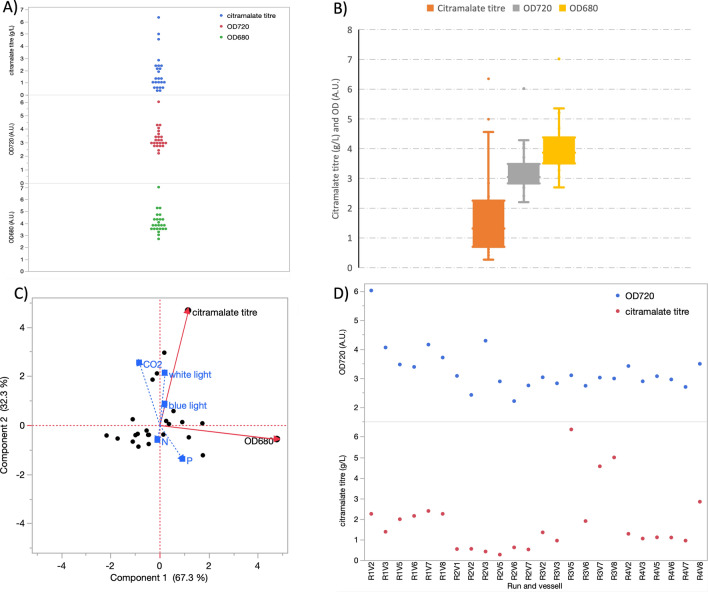
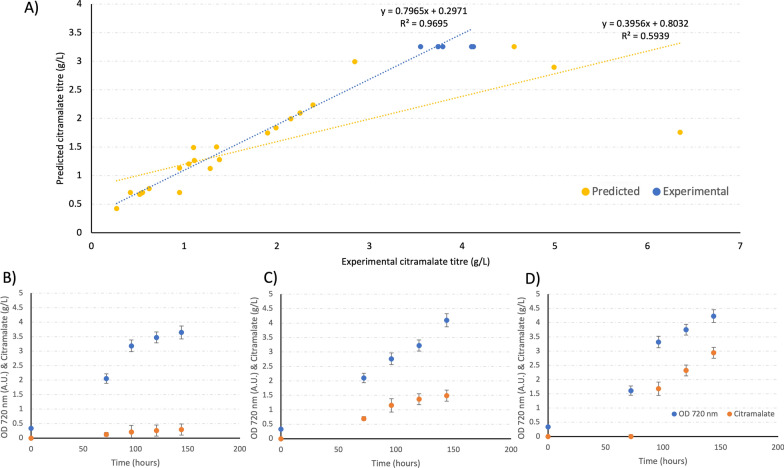
Here, we describe a phenomenon where the concerted optimisation of process parameters significantly increased citramalate production in Synechocystis sp. PCC 6803. Design of experiment principles were used to determine the optima for each parameter and the interplay between multiple parameters. This approach facilitated a ~ 23-fold increase in citramalate titre from initial unoptimised experiments. The process of scale-up from batch cultures to 0.5, 2, and 5 L photobioreactors is described. At the 2-L scale, citramalate titres from carbon dioxide reached 6.35 g/L with space-time yields of 1.59 g/L/day whilst 5-L PBRs yielded 3.96 ± 0.23 g/L with a productivity of 0.99 ± 0.06 g/L/day. We believe the decrease in productivity from 2-L to 5-L scale was likely due to the increased pathlength and shading for light delivery reducing incident light per cell. However, changes in productivity and growth characteristics are not uncommon when scaling up biotechnology processes and have numerous potential causes.
This work demonstrates that the use of a process parameter control regime can ameliorate precursor limitation and enhance citramalate production. Since pyruvate and/or acetyl-CoA give rise to numerous products of biotechnological interest, the workflow presented here could be employed to optimise flux towards other heterologous pathways. Understanding the factors controlling and thus increasing carbon partitioning to product will help progress cyanobacteria as part of a carbon-neutral circular bioeconomy. This is the first study using design of experiment to optimise overall carbon fixation rate and carbon partitioning to product, with the goal of improving the performance of a cyanobacterium as a host for biological carbon capture.
长期以来,蓝藻一直被视为将二氧化碳转化为产品的工业底盘,作为循环生物经济的一部分。必须克服蓝藻生长缓慢、碳固定率以及生物量与产品之间碳分配的限制,才能充分实现这一工业潜力。通常,通向异源途径的通量受到核心代谢物可用性的限制。柠苹酸是通过中央代谢物丙酮酸和乙酰辅酶A的缩合在单一酶促步骤中产生的;因此,柠苹酸生产力的提高可作为克服这一限制的一种衡量标准。此外,柠苹酸是一种有用的生物材料前体,为可再生甲基丙烯酸甲酯和聚(甲基丙烯酸甲酯)提供了一条途径,聚(甲基丙烯酸甲酯)通常以有机玻璃或亚克力的名称进行交易。
在此,我们描述了一种现象,即工艺参数的协同优化显著提高了集胞藻PCC 6803中柠苹酸的产量。实验设计原理用于确定每个参数的最佳值以及多个参数之间的相互作用。这种方法使柠苹酸滴度比最初未优化的实验提高了约23倍。描述了从分批培养放大到0.5、2和5升光生物反应器的过程。在2升规模下,来自二氧化碳的柠苹酸滴度达到6.35克/升,时空产率为1.59克/升/天,而5升光生物反应器的产量为3.96±0.23克/升,生产力为0.99±0.06克/升/天。我们认为,从2升规模到5升规模生产力的下降可能是由于光程增加和光传输遮光导致每个细胞接收到的入射光减少。然而,在扩大生物技术过程规模时,生产力和生长特性的变化并不罕见,且有许多潜在原因。
这项工作表明,使用工艺参数控制制度可以改善前体限制并提高柠苹酸产量。由于丙酮酸和/或乙酰辅酶A会产生许多具有生物技术意义的产品,本文介绍的工作流程可用于优化通向其他异源途径的通量。了解控制并因此增加碳向产品分配的因素将有助于推动蓝藻作为碳中性循环生物经济的一部分向前发展。这是第一项使用实验设计来优化整体碳固定率和碳向产品分配的研究,目标是提高蓝藻作为生物碳捕获宿主的性能。