Shin Wook, Hou Yaning, Wang Xin, Yang Zhongyue J
Department of Chemistry, Vanderbilt University, Nashville, Tennessee 37235, United States.
Henan-Macquarie University Joint Centre for Biomedical Innovation, School of Life Sciences, Henan University, Kaifeng, Henan 475004, China.
J Chem Theory Comput. 2024 Dec 24;20(24):10942-10951. doi: 10.1021/acs.jctc.4c01138. Epub 2024 Dec 6.
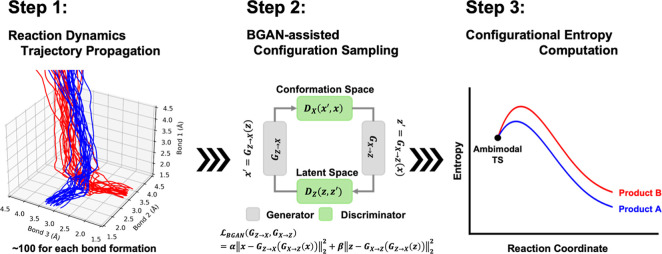
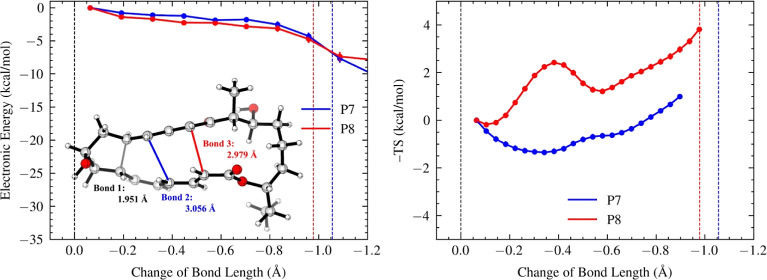
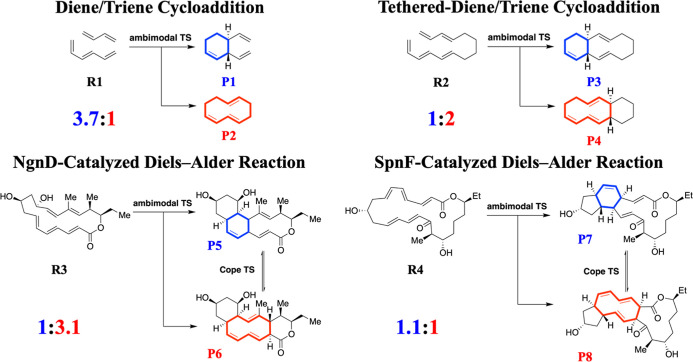
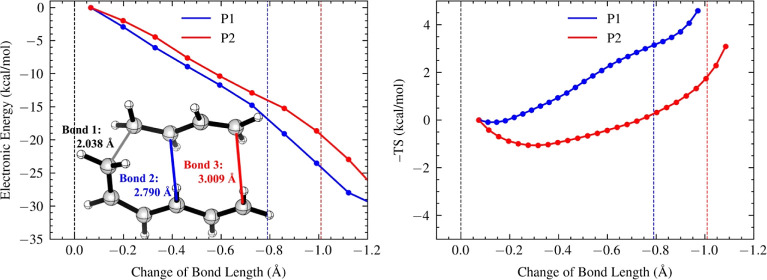
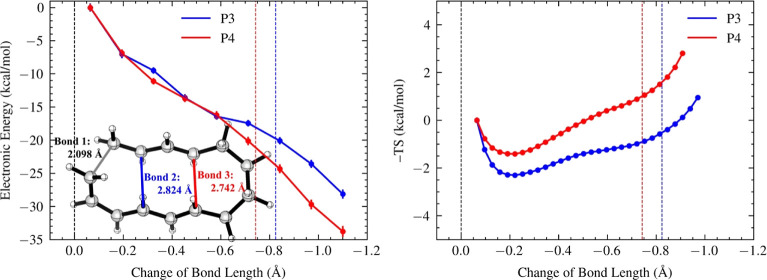
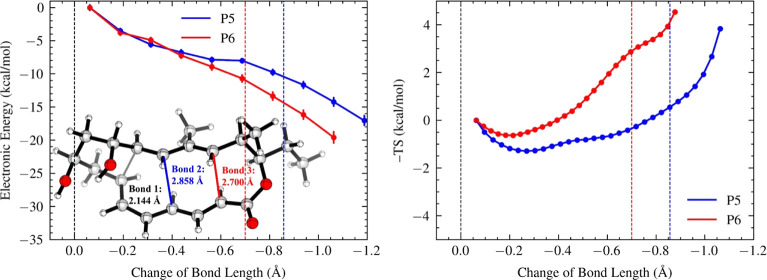
One ambimodal transition state can lead to the formation of multiple products. However, it remains fundamentally unknown how the energy and entropy along the post-TS pathways mediate ambimodal selectivity. Here, we investigated the energy and entropy profiles along the post-TS pathways in four [4 + 2]/[6 + 4] cycloadditions. We observe that the pathway leading to the minor product involves a more pronounced entropic trap. These entropic traps, resulting from the conformational change in the dynamic course of ring closure, act as a reservoir of longer-lived dynamic intermediates that roam on the potential energy surface and have a higher likelihood of redistributing to form the other product. The SpnF-catalyzed Diels-Alder reaction produces [4 + 2] and [6 + 4] adducts with nearly equal product distribution and relatively flat energy profiles, in contrast to other cycloadditions. Unexpectedly, the entropy profiles for these two adducts are distinctly different. The formation of the [6 + 4] adduct encounters an entropic barrier acting as a dynamical bottleneck, while the [4 + 2] adduct involves a substantial entropic trap to maintain long-lived intermediates. These opposing effects hinder both product formations and likely cancel each other out so that an equal product distribution is observed.
一个双模态过渡态可导致多种产物的形成。然而,沿过渡态后反应途径的能量和熵如何介导双模态选择性,从根本上来说仍然未知。在此,我们研究了四种[4 + 2]/[6 + 4]环加成反应中沿过渡态后反应途径的能量和熵分布。我们观察到,导致次要产物的反应途径涉及一个更为明显的熵阱。这些熵阱是由闭环动态过程中的构象变化产生的,它们充当了寿命更长的动态中间体的储存库,这些中间体在势能面上游动,更有可能重新分布以形成另一种产物。与其他环加成反应不同,SpnF催化的狄尔斯-阿尔德反应产生的[4 + 2]和[6 + 4]加合物具有几乎相等的产物分布和相对平缓的能量分布。出乎意料的是,这两种加合物的熵分布明显不同。[6 + 4]加合物的形成遇到一个作为动力学瓶颈的熵垒,而[4 + 2]加合物则涉及一个相当大的熵阱以维持长寿命中间体。这些相反的效应阻碍了两种产物的形成,并且可能相互抵消,从而观察到产物分布相等的情况。