Hirschler Valeria, Molinari Claudia, Gonzalez Claudio D
Argentine Diabetes Society, Epidemiology Department, Buenos Aires, Argentina.
UBA School of Pharmacy and Biochemistry, Mathematics, Buenos Aires, Argentina.
J Pediatr Clin Pract. 2024 Oct 15;14:200130. doi: 10.1016/j.jpedcp.2024.200130. eCollection 2024 Dec.
To evaluate changes in hemoglobin A1c (HbA1c) levels and -height over 3 years based on continuous glucose monitoring (CGM) usage among children with new-onset type 1 diabetes (T1DM) from various Latin American centers.
Data on -height, CGM access, and HbA1c (%) were collected for Latin American children aged 6 months to 18 years with T1DM onset from 19 centers in a retrospective analysis of medical records, from 2020 to 2023. A 2-way ANOVA method with repeated measures and multiple regression analyses were performed.
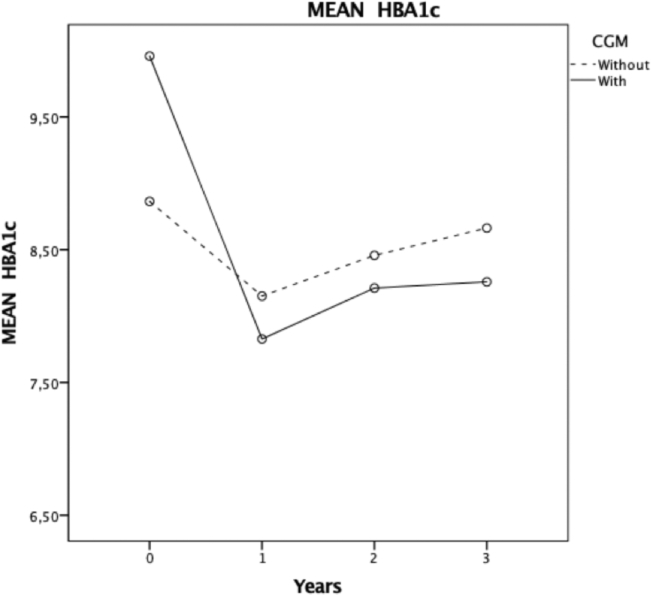
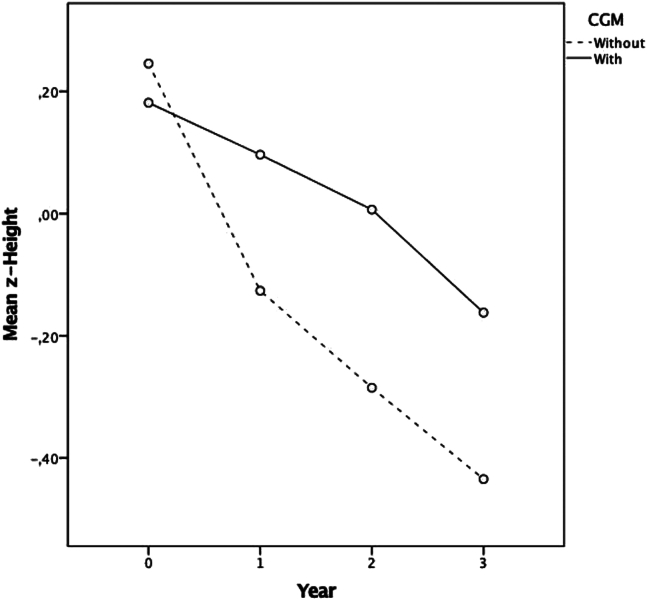
We included 433 children (46.0% female) aged 8.7 ± 3.7 years; 199 (45.9%) used CGM. The mean HbA1c was significantly lower in years 1, 2, and 3 than at baseline in children with CGM, but not those without CGM. The -height decreased significantly with the years in both groups. However, the CGM users showed a significantly greater height in years 2 and 3 than the nonusers. Multiple linear regression analysis showed that CGM users exhibited a significantly lower incremental area under the curve (AUC) for HbA1c during follow-up than nonusers. Furthermore, a lower incremental AUC for HbA1c was associated with a smaller decremental AUC for -height ( = 0.19). Multiple logistic regression analysis revealed that children with CGM were 80% more likely (OR, 0.22; 95% CI, 0.1-0.6) to achieve an HbA1c of <7% in the third year of follow-up.
This study reveals a significant association between CGM use and lower HbA1c from the onset of T1DM over a 3-year follow-up in Latin American children. Further prospective studies should be performed to confirm this finding.
基于不同拉丁美洲中心新诊断1型糖尿病(T1DM)儿童使用持续葡萄糖监测(CGM)的情况,评估3年内糖化血红蛋白(HbA1c)水平和身高的变化。
对2020年至2023年期间来自19个中心的6个月至18岁T1DM发病的拉丁美洲儿童的身高、CGM使用情况和HbA1c(%)数据进行回顾性病历分析收集。采用重复测量的双向方差分析方法和多元回归分析。
我们纳入了433名年龄为8.7±3.7岁的儿童(46.0%为女性);199名(45.9%)使用CGM。使用CGM的儿童在第1年、第2年和第3年的平均HbA1c显著低于基线水平,但未使用CGM的儿童则不然。两组儿童的身高均随时间显著下降。然而,在第2年和第3年,使用CGM的儿童身高显著高于未使用者。多元线性回归分析显示,在随访期间,使用CGM的儿童HbA1c的曲线下增量面积(AUC)显著低于未使用者。此外,HbA1c的较低增量AUC与身高的较小减量AUC相关(r = 0.19)。多元逻辑回归分析显示,在随访的第三年,使用CGM的儿童达到HbA1c<7%的可能性高出80%(OR,0.22;95%CI,0.1 - 0.6)。
本研究揭示了拉丁美洲儿童在T1DM发病后的3年随访中,使用CGM与较低的HbA1c之间存在显著关联。应进行进一步的前瞻性研究以证实这一发现。