Begashaw Tesfaye Derbie, Andualem Fantahun
Department of Psychiatry, College of Medicine and Health Science, Aksum University, Axum, Ethiopia.
Department of Psychiatry, College of Medicine and Health Science, University of Gondar, Gondar, Ethiopia.
Front Public Health. 2024 Nov 21;12:1393581. doi: 10.3389/fpubh.2024.1393581. eCollection 2024.
Depression is becoming a significant burden and a potential cause of disability worldwide. According to a World Health Organization (WHO) study conducted in both developed and developing countries, the prevalence of depression is 10.4%. There are differences in the prevalence of depression among the population based on a number of variables, including concomitant medical problems, substance abuse, employment environment, and demographics. The purpose of this study was to evaluate the prevalence of depression and its associated risk factors among textile industrial workers.
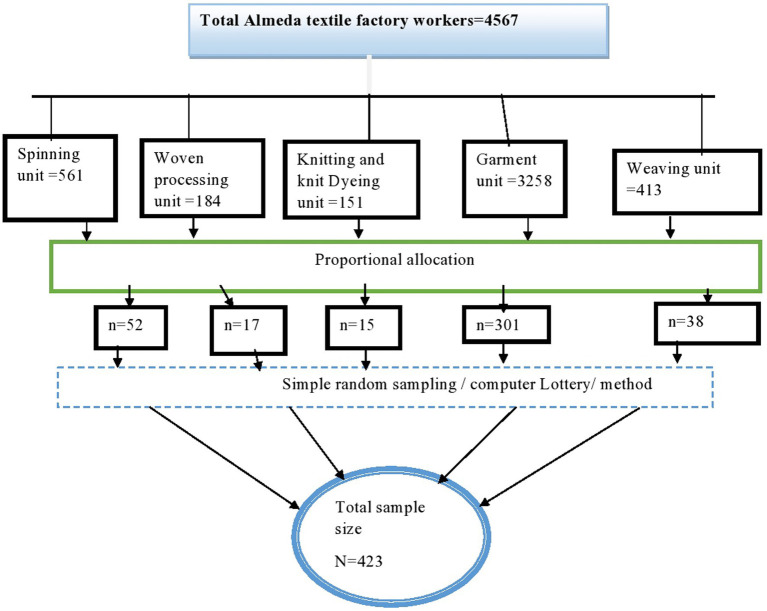
A cross-sectional study was conducted on 409 workers from the Almeda Textile Factory in Adwa from May to June 2020. The outcome variable was depression, assessed using the Patient Health Questionnaire-9 (PHQ-9). Variables with -values of <0.25 in the bivariate analysis were included in the multivariate analysis. An adjusted odds ratio with a 95% confidence interval was computed. Statistical significance was determined at a -value of <0.05.
The total prevalence of depression at a PHQ-9 cutoff score of 10, PHQ-9(10+), was 24.4%. At a cutoff score of 5, PHQ-9(5+) was 51.1%. In the multivariate analysis, low social support, working rotating day and night shifts, and having a physical injury at the workplace were significantly associated with depression at both PHQ-9(5+) and PHQ-9(10+). In addition, advanced age of 45 years and above and being diagnosed with chronic medical disease were significantly associated with depression at PHQ-9(10+) ( < 0.05).
The prevalence of depression varied based on the PHQ-9 cutoff score, and it is high at both PHQ-9(5+) and PHQ-9(10+). Low social support, working rotating day and night shifts, physical injury at the workplace, advanced age, and chronic medical disease were significantly associated with depression. Our findings suggest that the workers at the Almeda Textile Factory should be screened and managed accordingly.
抑郁症正成为全球一项重大负担和潜在的致残原因。根据世界卫生组织(WHO)在发达国家和发展中国家开展的一项研究,抑郁症的患病率为10.4%。基于一些变量,包括伴随的医疗问题、药物滥用、就业环境和人口统计学特征,人群中抑郁症的患病率存在差异。本研究的目的是评估纺织工业工人中抑郁症的患病率及其相关危险因素。
2020年5月至6月,对阿德瓦市阿尔梅达纺织厂的409名工人进行了一项横断面研究。结局变量为抑郁症,采用患者健康问卷-9(PHQ-9)进行评估。双变量分析中P值<0.25的变量纳入多变量分析。计算调整后的比值比及95%置信区间。以P值<0.05确定统计学显著性。
PHQ-9临界值为10时(PHQ-9(10+)),抑郁症的总患病率为24.4%。临界值为5时(PHQ-9(5+)),患病率为51.1%。在多变量分析中,低社会支持、昼夜轮班工作以及在工作场所受过身体伤害,在PHQ-9(5+)和PHQ-9(10+)时均与抑郁症显著相关。此外,45岁及以上的高龄以及被诊断患有慢性疾病在PHQ-9(10+)时与抑郁症显著相关(P<0.05)。
抑郁症的患病率因PHQ-9临界值而异,在PHQ-9(5+)和PHQ-9(10+)时均较高。低社会支持、昼夜轮班工作、工作场所身体伤害、高龄和慢性疾病与抑郁症显著相关。我们的研究结果表明,阿尔梅达纺织厂的工人应接受相应的筛查和管理。