Koemel Nicholas A, Senior Alistair M, Laouali Nasser, Celermajer David S, Grech Amanda, Parker Helen M, Simpson Stephen J, Raubenheimer David, Gill Timothy P, Skilton Michael R
Charles Perkins Centre, The University of Sydney, Level 2, John Hopkins Drive, Sydney, NSW, 2006, Australia.
Sydney Medical School, The University of Sydney, Sydney, Australia.
Eur J Nutr. 2024 Dec 7;64(1):41. doi: 10.1007/s00394-024-03523-7.
Dietary macronutrients significantly impact cardiometabolic health, yet research often focuses on individual macronutrient relationships. This study aimed to explore the associations between dietary macronutrient composition and cardiometabolic health.
This study included 33,681 US adults (49.7 ± 18.3 years; 52.5% female) from the National Health and Nutrition Examination Survey during 1999-2014. Dietary data was derived from 1 to 2 separate 24-hour recalls and cardiometabolic health included lipid profile, glycemic control, blood pressure, and adiposity collected in a mobile examination center. Associations between dietary macronutrient composition and cardiometabolic health were examined using generalized additive models adjusted for age, socio-demographics, lifestyle, and diet quality.
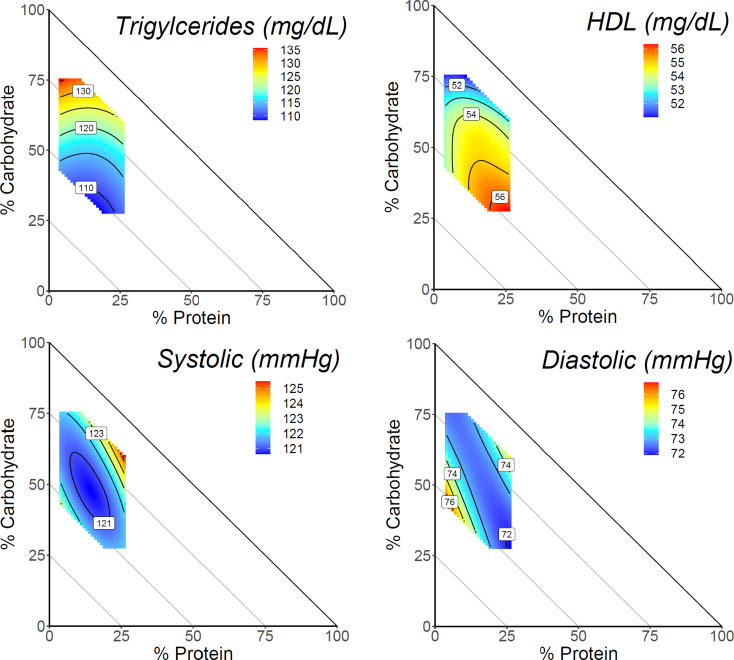
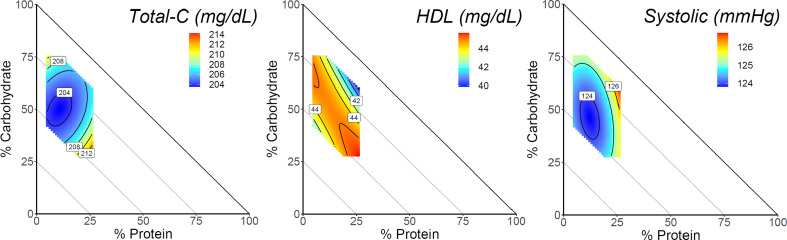
In females, triglycerides (P < 0.01) and HDL cholesterol (P < 0.01) were the least optimal in diets containing lower fat (10%) and higher carbohydrate (75%). In males, HDL cholesterol was positively associated with fat (P < 0.01) and no association with triglycerides was detected. Total-C associations were male specific (P = 0.01) and highest in diets composed of 25% protein, 30% carbohydrate, and 45% fat. In both sexes, systolic blood pressure (P ≤ 0.02) was highest in diets containing lower fat (10%) coupled with moderate protein (25%). Diastolic blood pressure associations were female specific (P < 0.01) with higher values in those consuming the upper range of fat (55%). There were no associations of macronutrient composition with glycemic control or adiposity.
This study revealed sex-specific relationships between macronutrient composition and cardiometabolic health. Future research is needed to explore these relationships across age groups.
膳食中的宏量营养素对心脏代谢健康有显著影响,但研究往往侧重于单个宏量营养素之间的关系。本研究旨在探讨膳食宏量营养素组成与心脏代谢健康之间的关联。
本研究纳入了1999年至2014年美国国家健康与营养检查调查中的33681名成年人(49.7±18.3岁;52.5%为女性)。膳食数据来自1至2次独立的24小时饮食回忆,心脏代谢健康指标包括在移动检查中心收集的血脂谱、血糖控制、血压和肥胖情况。使用经年龄、社会人口统计学、生活方式和饮食质量调整的广义相加模型,检验膳食宏量营养素组成与心脏代谢健康之间的关联。
在女性中,脂肪含量较低(10%)且碳水化合物含量较高(75%)的饮食中,甘油三酯(P<0.01)和高密度脂蛋白胆固醇(P<0.01)的水平最不理想。在男性中,高密度脂蛋白胆固醇与脂肪呈正相关(P<0.01),未检测到与甘油三酯的关联。总胆固醇的关联具有男性特异性(P=0.01),在蛋白质含量为25%、碳水化合物含量为30%、脂肪含量为45%的饮食中最高。在男女两性中,脂肪含量较低(10%)且蛋白质含量适中(25%)的饮食中,收缩压最高(P≤0.02)。舒张压的关联具有女性特异性(P<0.01),在脂肪摄入量处于较高范围(55%)的人群中舒张压较高。宏量营养素组成与血糖控制或肥胖之间无关联。
本研究揭示了宏量营养素组成与心脏代谢健康之间的性别特异性关系。未来需要开展研究以探讨不同年龄组之间的这些关系。