Patel Rushil V, Johnston Emily E
Division of Hematology-Oncology, Department of Medicine, University of Alabama at Birmingham, Birmingham, AL.
Institute for Cancer Outcomes and Survivorship, University of Alabama at Birmingham, Birmingham, AL.
Hematology Am Soc Hematol Educ Program. 2024 Dec 6;2024(1):355-362. doi: 10.1182/hematology.2024000561.
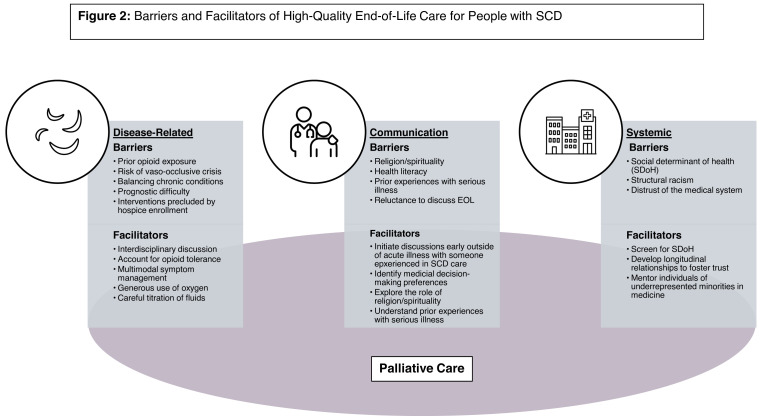
End-of-life (EOL) care is a critical part of sickle cell disease (SCD) management. However, barriers to high-quality EOL care remain, including (1) disease-related barriers (prior opioid exposure, risk of vaso-occlusive crises, chronic conditions with conflicting needs, and limitations of receiving disease-directed therapy on hospice); (2) communication-related barriers (challenges of identifying and responding to religious and spiritual concerns, limited health literacy, and previous health care system experience); (3) systemic issues (social determinants of health, structural racism, and mistrust of the medical system). However, palliative care and interdisciplinary collaboration can overcome many of these barriers. In addition, we can improve EOL care by accounting for opioid exposures, multimodal symptom management, and exploring (1) who people want involved in decision-making, (2) the role of religion and spirituality in decision-making, and (3) previous experiences with EOL. Systemic barriers can be addressed through the social determinants of health screening, minimizing financial burdens of care, and building longitudinal relationships with people with SCD. This requires the continued education of SCD providers about primary palliative care and palliative care providers about SCD. With such strategies, high-quality EOL care is possible for this vulnerable population.
临终关怀是镰状细胞病(SCD)管理的关键部分。然而,高质量临终关怀的障碍依然存在,包括:(1)与疾病相关的障碍(先前使用阿片类药物、血管闭塞性危机风险、需求相互冲突的慢性病以及临终关怀时接受疾病针对性治疗的局限性);(2)与沟通相关的障碍(识别和回应宗教及精神问题的挑战、健康素养有限以及既往医疗系统经历);(3)系统性问题(健康的社会决定因素、结构性种族主义以及对医疗系统的不信任)。然而,姑息治疗和跨学科协作可以克服其中许多障碍。此外,我们可以通过考虑阿片类药物暴露情况、多模式症状管理以及探究以下方面来改善临终关怀:(1)人们希望谁参与决策;(2)宗教和灵性在决策中的作用;(3)既往临终关怀经历。系统性障碍可以通过健康的社会决定因素筛查、减轻护理经济负担以及与镰状细胞病患者建立长期关系来解决。这需要对镰状细胞病医护人员持续开展初级姑息治疗教育,并对姑息治疗医护人员进行镰状细胞病相关教育。通过这些策略,为这一弱势群体提供高质量临终关怀是有可能的。