Center of Excellence in Health Equity, Training and Research, Baylor College of Medicine, Houston, Texas, USA
Department of Medicine, Section of Geriatrics and Palliative Medicine, Baylor College of Medicine, Houston, Texas, USA.
BMJ Open. 2022 Aug 16;12(8):e057361. doi: 10.1136/bmjopen-2021-057361.
Sickle cell disease (SCD) is a highly morbid condition notable for recurrent hospitalisations due to vaso-occlusive crises and complications of end organ damage. Little is known about the use of inpatient palliative care services in adult patients with SCD. This study aims to evaluate inpatient palliative care use during SCD-related hospitalisations overall and during terminal hospitalisations. We hypothesise that use of palliative care is low in SCD hospitalisations.
A retrospective cross-sectional study using data from the National Inpatient Sample from 2008 to 2017 was conducted.
US hospitals from 47 states and the District of Columbia.
Patients >18 years old hospitalised with a primary or secondary International Classification of Diseases, Ninth Revision, Clinical Modification (ICD-9-CM) or ICD-10-CM diagnosis of SCD were included.
Palliative care service use (documented by ICD-9-CM and ICD-10-CM diagnosis codes V66.7 and Z51.5).
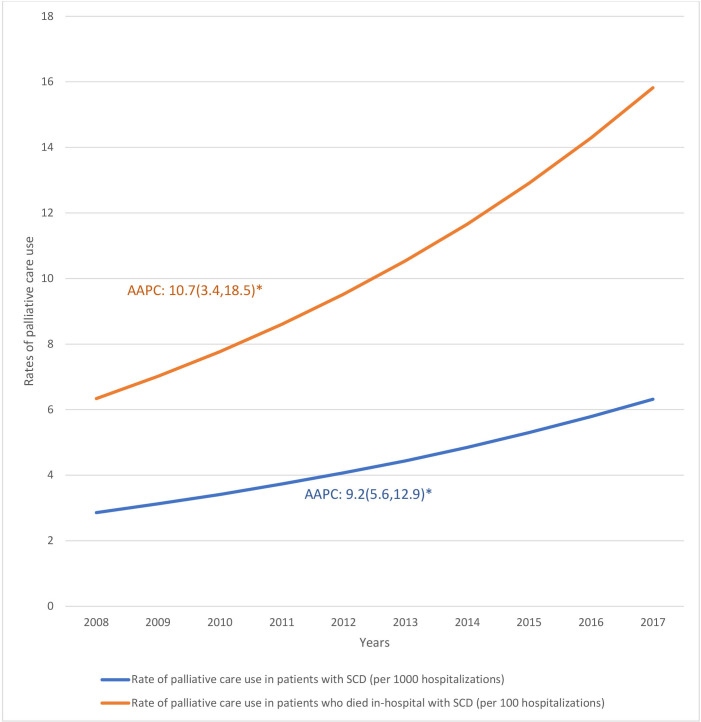
987 555 SCD-related hospitalisations were identified, of which 4442 (0.45%) received palliative care service. Palliative care service use increased at a rate of 9.2% per year (95% CI 5.6 to 12.9). NH-black and Hispanic patients were 33% and 53% less likely to have palliative care services compared with NH-white patients (OR 0.67; 95% CI 0.45 to 0.99 and OR 0.47; 95% CI 0.26 to 0.84). Female patients (OR 0.40; 95% CI 0.21 to 0.76), Medicaid use (OR 0.40; 95% CI 0.21 to 0.78), rural (OR 0.47; 95% CI 0.28 to 0.79) and urban non-teaching hospitals (OR 0.61; 95% CI 0.47 to 0.80) each had a lower likelihood of palliative care services use.
Use of palliative care during SCD-related hospitalisations is increasing but remains low. Disparities associated with race and gender exist for use of palliative care services during SCD-related hospitalisation. Further studies are needed to guide evidence-based palliative care interventions for more comprehensive and equitable care of adult patients with SCD.
镰状细胞病(SCD)是一种高度病态的疾病,由于血管阻塞性危象和终末器官损伤的并发症,经常需要住院治疗。目前对于成年 SCD 患者住院期间使用姑息治疗服务的情况知之甚少。本研究旨在评估 SCD 相关住院治疗期间和终末期住院治疗期间姑息治疗服务的使用情况。我们假设 SCD 住院患者使用姑息治疗的比例较低。
回顾性横断面研究,使用了 2008 年至 2017 年国家住院患者样本的数据。
美国 47 个州和哥伦比亚特区的医院。
纳入年龄大于 18 岁,伴有原发性或继发性国际疾病分类,第 9 修订版,临床修正(ICD-9-CM)或 ICD-10-CM 镰状细胞病诊断的住院患者。
姑息治疗服务的使用(通过 ICD-9-CM 和 ICD-10-CM 诊断代码 V66.7 和 Z51.5 记录)。
共确定了 987555 例 SCD 相关住院患者,其中 4442 例(0.45%)接受了姑息治疗服务。姑息治疗服务的使用每年以 9.2%的速度增长(95%CI 5.6 至 12.9)。NH-黑人患者和西班牙裔患者接受姑息治疗服务的可能性分别比 NH-白人患者低 33%和 53%(OR 0.67;95%CI 0.45 至 0.99 和 OR 0.47;95%CI 0.26 至 0.84)。女性患者(OR 0.40;95%CI 0.21 至 0.76)、使用医疗补助(OR 0.40;95%CI 0.21 至 0.78)、农村(OR 0.47;95%CI 0.28 至 0.79)和城市非教学医院(OR 0.61;95%CI 0.47 至 0.80)接受姑息治疗服务的可能性也较低。
SCD 相关住院患者姑息治疗服务的使用正在增加,但仍然较低。在 SCD 相关住院治疗期间,种族和性别相关的差异与姑息治疗服务的使用有关。需要进一步的研究来指导基于证据的姑息治疗干预措施,以更全面和公平地照顾成年 SCD 患者。