Ren Huiming, Ma Junrong, Guo Xu, Zhang Ruijie, Pu Liyuan, Zhao Tian, Zeng Fangfang, Shu Chang, Han Liyuan, Wang Yunzhi, Li Qiang, Wang Xiaojie
Department of Rehabilitation Medicine, Ningbo No. 2 Hospital, Ningbo, China.
Department of Public Health and Preventive Medicine, School of Medicine, Jinan University, Guangzhou City, Guangdong Province, China.
Arch Med Sci. 2024 Oct 28;20(5):1472-1483. doi: 10.5114/aoms/178269. eCollection 2024.
The aim of this study was to assess differences in the effects of income level on the primary and secondary prevention of stroke in the Chinese population.
This was a population-based study using data from a China Kadoorie Biobank survey that began in 2004 in 10 geographical regions. Community residents ( = 512,715) aged 30-79 years were recruited. Stroke was determined by the self-reporting of a doctor's diagnosis, and participants with a high risk of stroke were identified using the model developed in the Prediction for ASCVD Risk in China study.
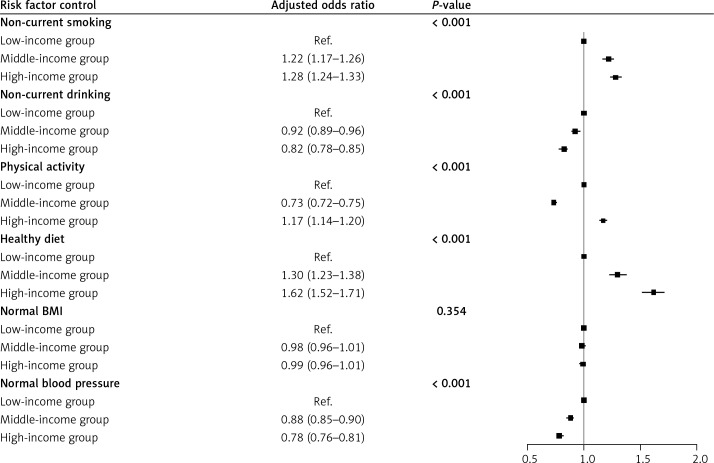
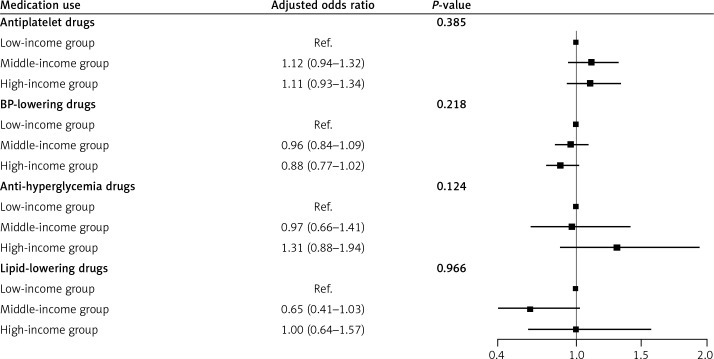
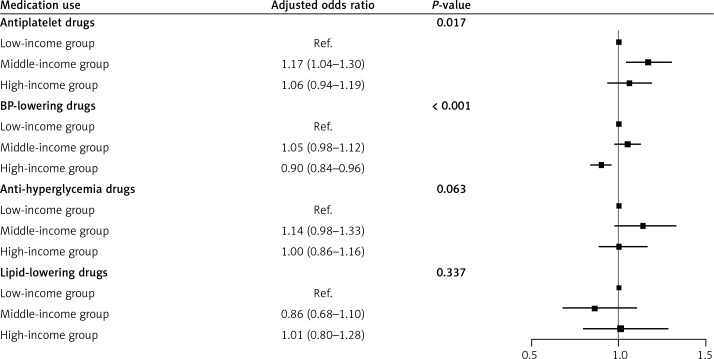
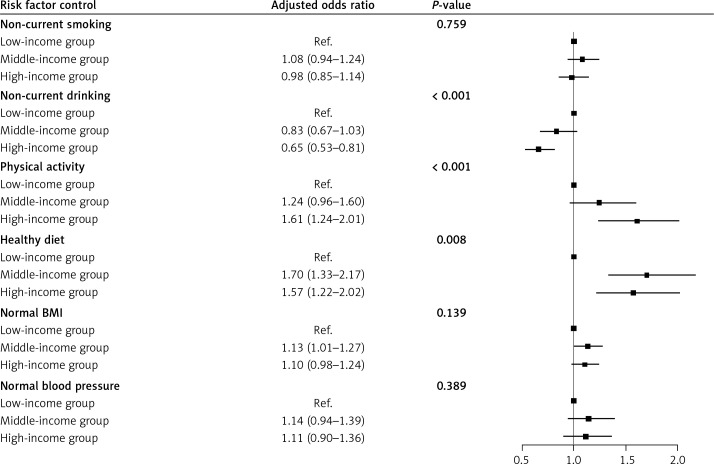
The final numbers of people included in this study were 8,884 with stroke and 218,972 with a high risk of stroke. The participants' income level was positively associated with high levels of physical activity and the consumption of a healthy diet, but negatively associated with the control of alcohol consumption (all < 0.05). In addition, positive associations were observed between the control of smoking and the use of antiplatelet and antihypertensive medication for primary prevention (all < 0.05), but there was a negative association with the control of blood pressure ( < 0.001).
Low-income individuals were less likely to control smoking and their diet and use preventive medications, while high-income individuals were less likely to control their alcohol consumption and blood pressure. Moreover, medication use was low for both primary and secondary prevention in high-income individuals.
本研究旨在评估收入水平对中国人群中风一级和二级预防效果的差异。
这是一项基于人群的研究,使用了2004年在中国10个地理区域开展的中国嘉道理生物银行调查的数据。招募了年龄在30 - 79岁的社区居民(n = 512,715)。中风通过医生诊断的自我报告来确定,并且使用中国动脉粥样硬化性心血管疾病风险预测研究中开发的模型来识别中风高危参与者。
本研究纳入的最终人数为8884例中风患者和218,972例中风高危患者。参与者的收入水平与高水平的身体活动和健康饮食的消费呈正相关,但与酒精消费的控制呈负相关(均P < 0.05)。此外,在一级预防中,吸烟的控制与抗血小板和抗高血压药物的使用之间存在正相关(均P < 0.05),但与血压的控制呈负相关(P < 0.001)。
低收入个体控制吸烟、饮食和使用预防性药物的可能性较小,而高收入个体控制酒精消费和血压的可能性较小。此外,高收入个体在一级和二级预防中的药物使用都较低。