Center for Human Nutrition, Department of International Health, Johns Hopkins Bloomberg School of Public Health, Baltimore, MD, United States of America.
Social System Design Lab, Brown School of Social Work, Washington University in St. Louis, St. Louis, MO, United States of America.
PLoS One. 2019 May 14;14(5):e0216985. doi: 10.1371/journal.pone.0216985. eCollection 2019.
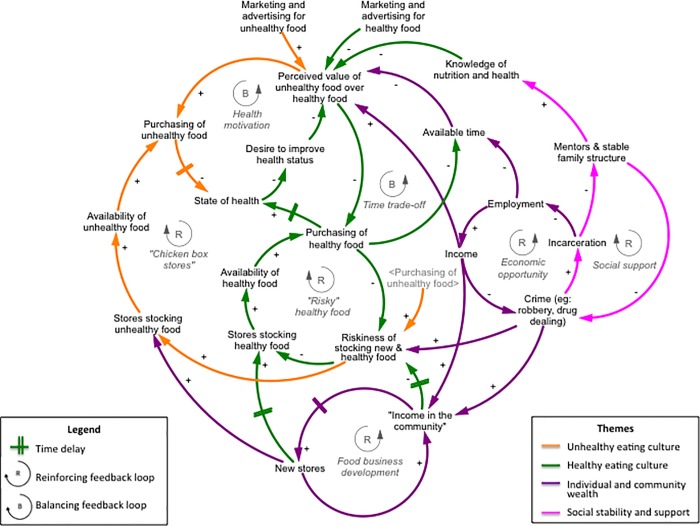
Little is known about the mechanisms through which neighborhood-level factors (e.g., social support, economic opportunity) relate to suboptimal availability of healthy foods in low-income urban communities. We engaged a diverse group of chain and local food outlet owners, residents, neighborhood organizations, and city agencies based in Baltimore, MD. Eighteen participants completed a series of exercises based on a set of pre-defined scripts through an interactive, iterative group model building process over a two-day community-based workshop. This process culminated in the development of causal loop diagrams, based on participants' perspectives, illustrating the dynamic factors in an urban neighborhood food system. Synthesis of diagrams yielded 21 factors and their embedded feedback loops. Crime played a prominent role in several feedback loops within the neighborhood food system: contributing to healthy food being "risky food," supporting unhealthy food stores, and severing social ties important for learning about healthy food. Findings shed light on a new framework for thinking about barriers related to healthy food access and pointed to potential new avenues for intervention, such as reducing neighborhood crime.
关于邻里环境因素(如社会支持、经济机会)与低收入城市社区中健康食品供应不足之间的关系机制,我们知之甚少。我们邀请了来自马里兰州巴尔的摩的多元化的连锁和当地食品店店主、居民、社区组织和城市机构的代表参与。18 名参与者通过在为期两天的基于社区的研讨会上进行的一系列互动、迭代的团体模型构建过程,根据一组预先定义的脚本完成了一系列练习。这一过程最终生成了因果关系图,基于参与者的观点,展示了城市邻里食品系统中的动态因素。对这些图的综合分析得出了 21 个因素及其内在的反馈循环。在邻里食品系统的几个反馈循环中,犯罪都扮演了重要角色:导致健康食品成为“风险食品”,支持不健康食品商店,并切断了获取健康食品的重要社会联系。研究结果为思考与获得健康食品相关的障碍提供了一个新的框架,并指出了潜在的新干预途径,例如减少社区犯罪。