Department of Neurology, Xuanwu Hospital of Capital Medical University, Beijing, China.
Department of Epidemiology, School of Public Health, Sun Yat-sen University, Guangzhou, China.
Lancet Public Health. 2021 Dec;6(12):e897-e906. doi: 10.1016/S2468-2667(21)00228-0.
Understanding the temporal trend of the disease burden of stroke and its attributable risk factors in China, especially at provincial levels, is important for effective prevention strategies and improvement. The aim of this analysis from the Global Burden of Diseases, Injuries, and Risk Factors Study (GBD) is to investigate the disease burden of stroke and its risk factors at national and provincial levels in China from 1990 to 2019.
Following the methodology in the GBD 2019, the incidence, prevalence, mortality, and disability-adjusted life-years (DALYs) of stroke cases in the Chinese population were estimated by sex, age, year, stroke subtypes (ischaemic stroke, intracerebral haemorrhage, and subarachnoid haemorrhage), and across 33 provincial administrative units in China from 1990 to 2019. Attributable mortality and DALYs of underlying risk factors were calculated by a comparative risk assessment.
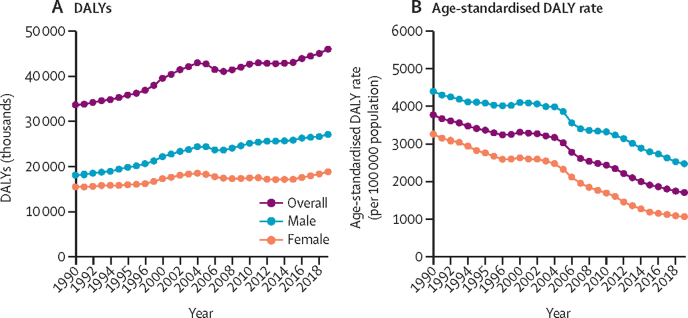
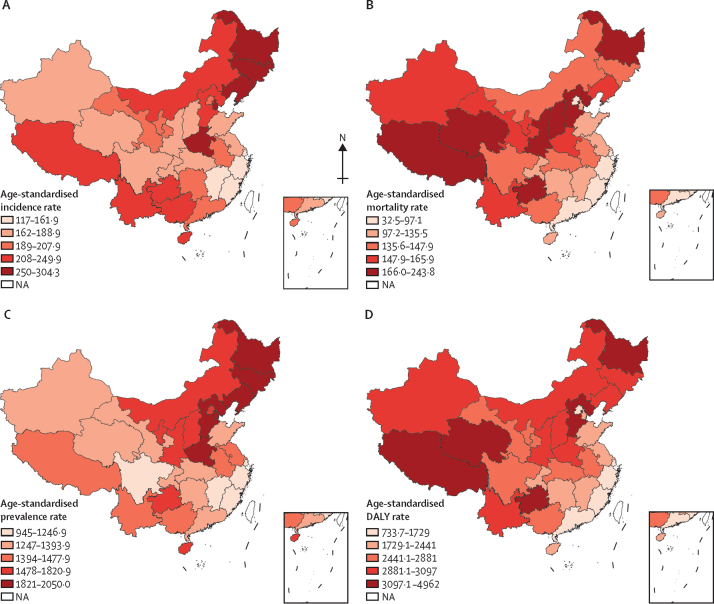
In 2019, there were 3·94 million (95% uncertainty interval 3·43-4·58) new stroke cases in China. The incidence rate of stroke increased by 86·0% (73·2-99·0) from 1990, reaching 276·7 (241·3-322·0) per 100 000 population in 2019. The age-standardised incidence rate declined by 9·3% (3·3-15·5) from 1990 to 2019. Among 28·76 million (25·60-32·21) prevalent cases of stroke in 2019, 24·18 million (20·80-27·87) were ischaemic stroke, 4·36 million (3·69-5·05) were intracerebral haemorrhage, and 1·58 million (1·32-1·91) were subarachnoid haemorrhage. The prevalence rate increased by 106·0% (93·7-118·8) and age-standardised prevalence rate increased by 13·2% (7·7-19·1) from 1990 to 2019. In 2019, there were 2·19 million (1·89-2·51) deaths and 45·9 million (39·8-52·3) DALYs due to stroke. The mortality rate increased by 32·3% (8·6-59·0) from 1990 to 2019. Over the same period, the age-standardised mortality rate decreased by 39·8% (28·6-50·7) and the DALY rate decreased by 41·6% (30·7-50·9). High systolic blood pressure, ambient particulate matter pollution exposure, smoking, and diet high in sodium were four major risk factors for stroke burden in 2019. Moreover, we found marked differences of stroke burden and attributable risk factors across provinces in China from 1990 to 2019.
The disease burden of stroke is still severe in China, although the age-standardised incidence and mortality rates have decreased since 1990. The stroke burden in China might be reduced through blood pressure management, lifestyle interventions, and air pollution control. Moreover, because substantial heterogeneity of stroke burden existed in different provinces, improved health care is needed in provinces with heavy stroke burden.
National Key Research and Development Program of China and Taikang Yicai Public Health and Epidemic Control Fund.
了解中国脑卒中疾病负担及其归因风险因素的时间趋势,特别是在省级层面,对于制定有效的预防策略和改善措施非常重要。本研究旨在利用全球疾病、伤害和风险因素研究(GBD)的方法,调查中国脑卒中的疾病负担及其在国家和省级层面的风险因素。
根据 GBD 2019 的方法,我们估计了中国 1990 年至 2019 年期间的脑卒中发病率、患病率、死亡率和伤残调整生命年(DALYs),并按性别、年龄、年份、脑卒中亚型(缺血性脑卒中、颅内出血和蛛网膜下腔出血)和中国 33 个省级行政区进行了分类。通过比较风险评估,计算了潜在风险因素的归因死亡率和 DALYs。
2019 年,中国有 394 万(95%不确定性区间为 343 万至 458 万)新发脑卒中病例。1990 年以来,脑卒中的发病率增加了 86.0%(73.2-99.0),2019 年达到每 10 万人 276.7 例(241.3-322.0)。1990 年至 2019 年,年龄标准化发病率下降了 9.3%(3.3-15.5)。在 2019 年 2876 万例脑卒中患者中,2418 万例(2080 万至 2787 万例)为缺血性脑卒中,436 万例(369 万至 505 万例)为颅内出血,158 万例(132 万至 191 万例)为蛛网膜下腔出血。1990 年至 2019 年,患病率增加了 106.0%(93.7-118.8),年龄标准化患病率增加了 13.2%(7.7-19.1)。2019 年,有 219 万人(189 万至 251 万)死于脑卒中,4590 万人(3980 万至 5230 万)患有脑卒中伤残调整生命年(DALYs)。1990 年至 2019 年,死亡率增加了 32.3%(8.6-59.0)。同期,年龄标准化死亡率下降了 39.8%(28.6-50.7),DALY 率下降了 41.6%(30.7-50.9)。高收缩压、环境颗粒物污染暴露、吸烟和高钠饮食是 2019 年脑卒中负担的四个主要风险因素。此外,我们发现,1990 年至 2019 年期间,中国各省份脑卒中负担及其归因风险因素存在显著差异。
尽管自 1990 年以来,中国脑卒中的年龄标准化发病率和死亡率有所下降,但脑卒中的疾病负担仍然很严重。通过血压管理、生活方式干预和控制空气污染,可能会降低中国的脑卒中负担。此外,由于不同省份脑卒中负担存在显著差异,因此需要在脑卒中负担较重的省份加强卫生保健。
国家重点研发计划和泰康溢彩公共卫生与流行病防控基金。