Hillen Florence, Locquet Laurent
School of Veterinary Medicine and Science, University of Nottingham, Sutton Bonington Campus, Leicestershire, UK.
Dick White Referrals, Station Farm, London Road, Six Mile Bottom, Cambridgeshire, UK.
JFMS Open Rep. 2024 Dec 6;10(2):20551169241291841. doi: 10.1177/20551169241291841. eCollection 2024 Jul-Dec.
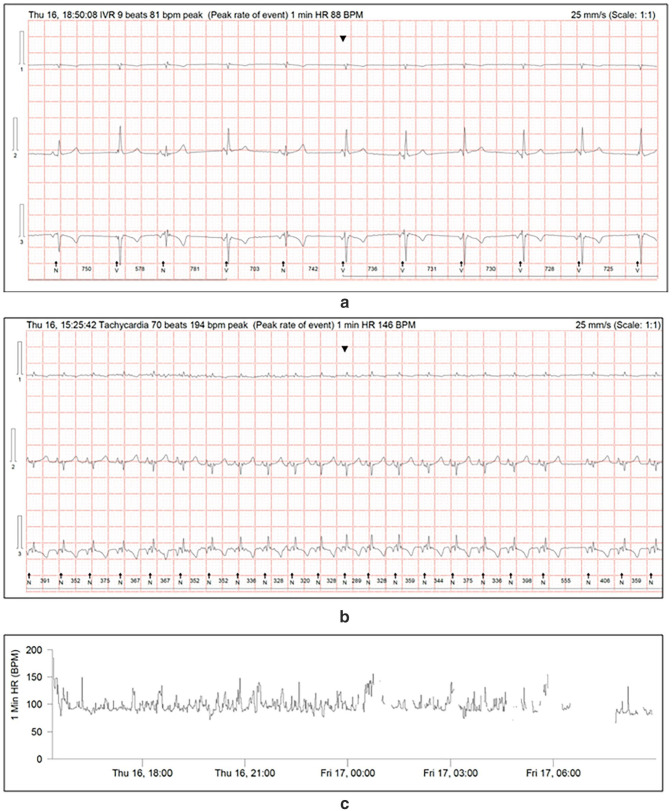
A 6-month-old male entire domestic shorthair cat was presented to the ophthalmology department for nasolacrimal duct cannulation and flushing, and castration under general anaesthesia. On pre-anaesthetic assessment, the cat had a heart rate of 90 beats/min (bpm). Clinical examination was unremarkable, although the cat appeared stressed. The echocardiogram was within normal limits. An ambulatory electrocardiogram (ECG) monitor was fitted overnight, and analysis of the ECG revealed a sinus rhythm with a lower than normal heart rate. The mean 1 min rate was 98 bpm. There was a slower than normal sinus rhythm and frequent ventricular escape beats. Differential diagnoses included increased vagal tone and sinoatrial node dysfunction (SND). The latter was suspected as the cat demonstrated signs of stress although an atropine response test was not performed.
SND is relatively common in dogs but extremely rare in cats. To the authors' knowledge, there is only one affected cat mentioned in the literature. In both dogs and humans, most cases described are in middle-aged and elderly patients. Although the condition is recognised in human infants and fetuses, it has not been reported in dogs under 2 years of age. This case is unusual because SND was suspected in an immature cat. On analysis of the ECG, the heart rate was considerably lower than those previously reported in hospitalised cats; however, findings on physical examination were subtle, highlighting the importance of pre-anaesthetic examination in identifying unexpected abnormalities.
一只6个月大的雄性未绝育家养短毛猫因鼻泪管插管冲洗及全身麻醉下的去势手术被送至眼科。麻醉前评估时,该猫心率为90次/分钟(bpm)。临床检查未见明显异常,尽管猫看起来很紧张。超声心动图结果正常。夜间安装了动态心电图(ECG)监测仪,对心电图的分析显示为窦性心律,心率低于正常。平均1分钟心率为98次/分钟。窦性心律较正常慢且频繁出现室性逸搏。鉴别诊断包括迷走神经张力增加和窦房结功能障碍(SND)。尽管未进行阿托品反应试验,但由于猫表现出应激迹象,怀疑为后者。
SND在犬中相对常见,但在猫中极为罕见。据作者所知,文献中仅提及一只患病猫。在犬和人类中,大多数描述的病例为中年和老年患者。尽管该病症在人类婴儿和胎儿中已得到认识,但在2岁以下的犬中尚未有报道。该病例不同寻常,因为在一只未成熟的猫中怀疑有SND。分析心电图时,心率明显低于先前报道的住院猫;然而,体格检查结果不明显,突出了麻醉前检查在识别意外异常方面的重要性。