Politte-Corn Madison, Pegg Samantha, Dickey Lindsay, Kujawa Autumn
Department of Psychology, The Pennsylvania State University, 140 Moore Building, University Park, PA USA.
Department of Psychology and Human Development, Vanderbilt University, Nashville, TN USA.
Affect Sci. 2024 May 22;5(4):281-294. doi: 10.1007/s42761-024-00237-1. eCollection 2024 Dec.
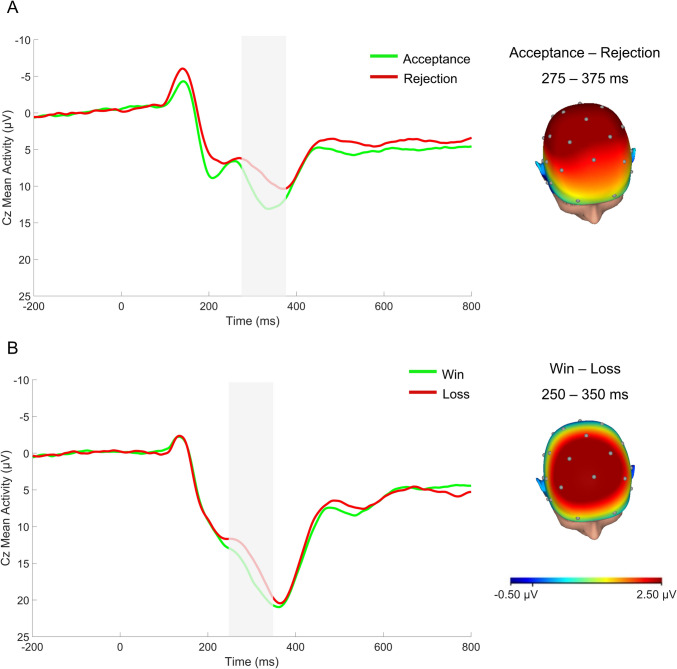
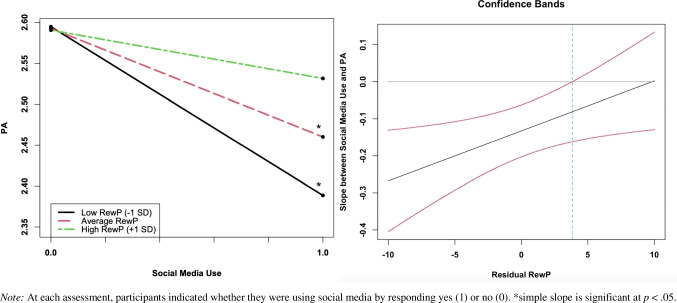
Peer relationships take on increasing importance during adolescence, and there has been considerable debate about the effects of social media use on adolescent emotional health. Little work has examined individual differences in brain function that might impact these associations. In this study, we examined the reward positivity (RewP) to social and monetary reward as a moderator of the relation between social media use and concurrent momentary affect in adolescents. Participants were 145 adolescents aged 14-17 ( = 15.23; = 1.08; 64.1% female; 71.7% White) at varying risk for depression (47 high-risk based on maternal depression history, 50 low-risk, 48 currently depressed). Measures of social media use, positive affect (PA), and negative affect (NA) were obtained through ecological momentary assessment. In a laboratory session, adolescents completed a computerized peer feedback task and a monetary reward task to elicit the RewP to social and monetary reward feedback. Multilevel models indicated that social media use and a smaller RewP to monetary rewards were associated with lower PA. However, social (but not monetary) reward responsiveness moderated the effect of social media use on momentary PA, such that social media use was associated with lower PA for adolescents with a relatively blunted RewP to peer acceptance, but not for those with an enhanced social RewP. Exploratory analyses indicated that this moderation effect was specific to female adolescents. The results highlight neural reactivity to social reward as a potential factor contributing to variability in the effect of social media use on affective health.
同伴关系在青少年时期变得越来越重要,关于社交媒体使用对青少年情绪健康的影响一直存在大量争论。很少有研究探讨可能影响这些关联的大脑功能个体差异。在本研究中,我们考察了对社交和金钱奖励的奖励积极性(RewP),将其作为社交媒体使用与青少年即时情绪之间关系的调节因素。研究参与者为145名年龄在14 - 17岁之间的青少年(平均年龄 = 15.23岁;标准差 = 1.08;64.1%为女性;71.7%为白人),他们患抑郁症的风险各不相同(47人因母亲有抑郁症病史属于高风险组,50人属于低风险组,48人目前患有抑郁症)。通过生态瞬时评估获取社交媒体使用、积极情绪(PA)和消极情绪(NA)的测量数据。在一次实验室实验中,青少年完成一项计算机化的同伴反馈任务和一项金钱奖励任务,以引出对社交和金钱奖励反馈的RewP。多层次模型表明,社交媒体使用以及对金钱奖励的RewP较小与较低的PA相关。然而,社交(而非金钱)奖励反应性调节了社交媒体使用对即时PA的影响,即对于那些对同伴认可的RewP相对迟钝的青少年,社交媒体使用与较低的PA相关,但对于那些社交RewP增强的青少年则不然。探索性分析表明这种调节效应在女性青少年中具有特异性。研究结果凸显了对社交奖励的神经反应性是导致社交媒体使用对情感健康影响存在差异的一个潜在因素。