Taik Sophia, Hashmi Razi, Mahtani Arun, Piccione Gianpaolo, Albakri Mohamed, Farid Meena, Fabian Daniel, Tindoy Merschelle, Sethi Yashendra, Padda Inderbir, Bin Emran Talha
Department of Internal Medicine, Richmond University Medical Center/Mount Sinai, Staten Island, New York, USA.
Department of Nephrology, Richmond University Medical Center/Mount Sinai, Staten Island, New York, USA.
Ann Med Surg (Lond). 2024 Oct 25;86(12):7408-7413. doi: 10.1097/MS9.0000000000002699. eCollection 2024 Dec.
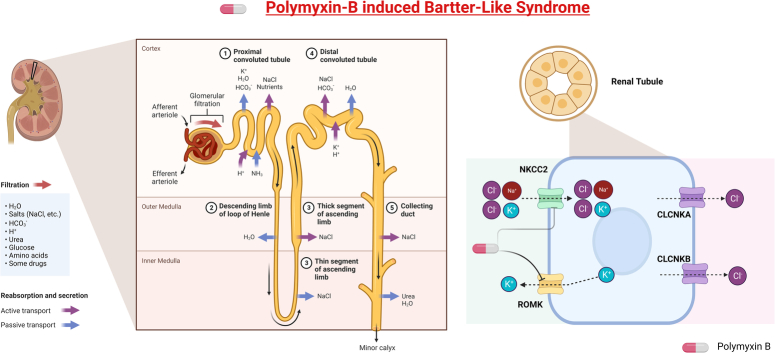
Bartter syndrome is a rare autosomal recessive disorder affecting renal tubular function leading to disturbances in electrolyte and volume homeostasis. It can also manifest as Bartter-like syndrome (BLS), a rare side effect of certain medications. Polymyxin-B, an antibiotic used to treat multidrug-resistant infections is infrequently associated with BLS. Hence, early diagnosis of this adverse effect is crucial to prevent severe electrolyte imbalances.
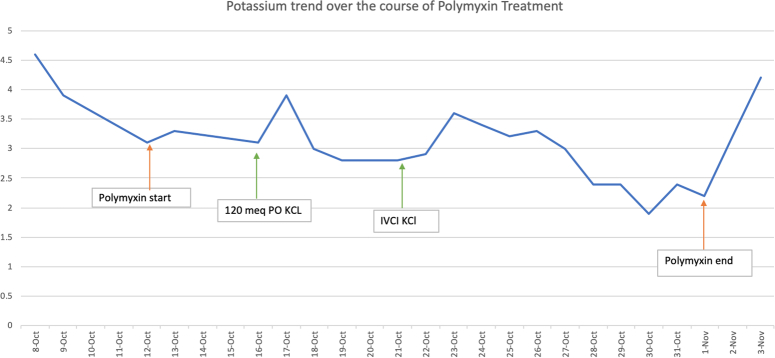
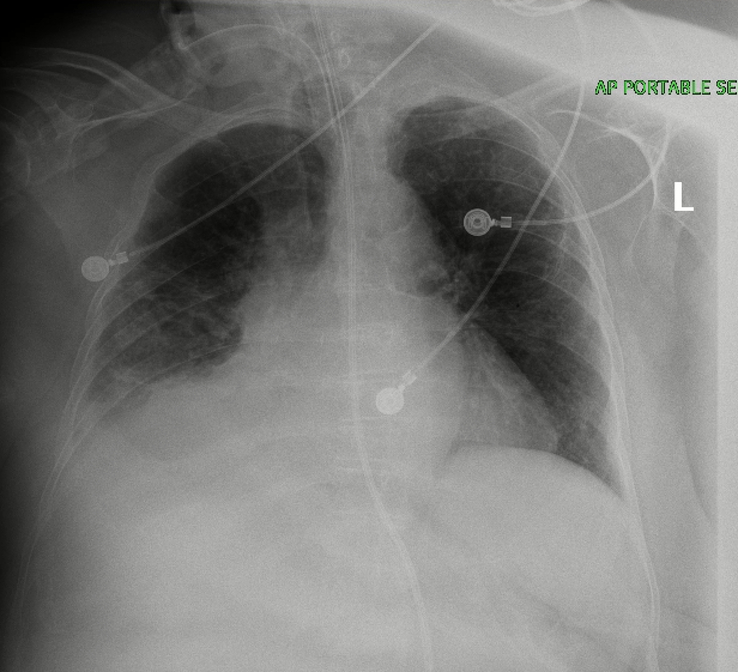
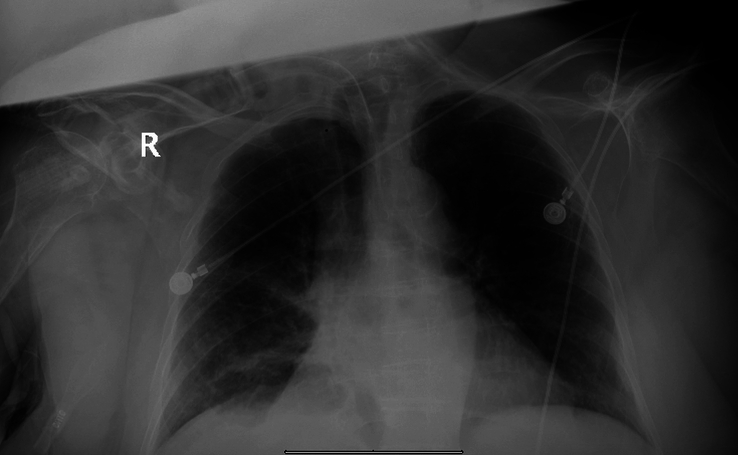
A 73-year-old female with coronary artery disease, chronic obstructive pulmonary disease, and hyperlipidemia, presented with fever, respiratory distress, and hypoxia on mechanical ventilation. Initial labs showed leukocytosis, anemia, and normal potassium. Despite receiving broad-spectrum antibiotics there was no improvement in her clinical condition. A sputum culture revealed pandrug-resistant Acinetobacter baumannii, sensitive only to Polymyxin-B. After six days of receiving polymyxin-B, the patient developed fever, hypotension, hypokalemia, hypomagnesemia, and polyuria. Urine studies indicated increased potassium excretion. A diagnosis of BLS was made. Polymyxin-B was discontinued, and the patient's electrolytes normalized. She was discharged with daily potassium and magnesium supplements.
BLS can result from polymyxin-B-induced tubular dysfunction characterized by hypokalemia and hypomagnesemia. Early recognition allowed for the timely discontinuation of polymyxin-B, which rapidly reversed her electrolyte disturbances.
This case underscores the importance of recognizing polymyxin-B-induced BLS. Clinicians should be vigilant for electrolyte disturbances in patients receiving treatment with polymyxin-B, ensuring timely interventions to mitigate adverse outcomes.
巴特综合征是一种罕见的常染色体隐性疾病,会影响肾小管功能,导致电解质和容量稳态紊乱。它也可能表现为巴特样综合征(BLS),这是某些药物罕见的副作用。多粘菌素B是一种用于治疗多重耐药感染的抗生素,很少与BLS相关。因此,早期诊断这种不良反应对于预防严重的电解质失衡至关重要。
一名73岁女性,患有冠状动脉疾病、慢性阻塞性肺疾病和高脂血症,在机械通气时出现发热、呼吸窘迫和低氧血症。初始实验室检查显示白细胞增多、贫血,血钾正常。尽管使用了广谱抗生素,她的临床状况仍无改善。痰培养显示泛耐药鲍曼不动杆菌,仅对多粘菌素B敏感。在接受多粘菌素B治疗六天后,患者出现发热、低血压、低钾血症、低镁血症和多尿。尿液检查表明钾排泄增加。诊断为BLS。停用多粘菌素B后,患者的电解质恢复正常。她出院时需每日补充钾和镁。
BLS可能由多粘菌素B诱导的肾小管功能障碍引起,其特征为低钾血症和低镁血症。早期识别使得能够及时停用多粘菌素B,从而迅速逆转了她的电解质紊乱。
本病例强调了认识多粘菌素B诱导的BLS的重要性。临床医生应对接受多粘菌素B治疗的患者的电解质紊乱保持警惕,确保及时干预以减轻不良后果。